Camp Kitchen Box vs. Plastic Storage Bins: Is the Upgrade Worth It?

Almost everyone starts the same way: a couple of plastic totes from the hardware store, one for food and one for cookware, stacked in the trunk. It works — until it doesn't. The real question isn't whether a bin can hold your camp kitchen. It's whether trading two cheap totes for a dedicated camp kitchen box actually buys you anything you'll feel at the campsite.
The tote-tower setup most campers start with
The plastic-bin kitchen is the default for a reason: it costs almost nothing and you probably already own the bins. You toss in a stove, a pot set, plates, a jug of water, and a bag of utensils, snap the lid, and drive off. For a once-a-summer trip to a developed campground with picnic tables, that's genuinely hard to beat on value.
But "a bin full of gear" and "a kitchen" are not the same thing. A storage tote is a big, cavernous space waiting to be filled — there's no internal structure, so the heavy stove ends up crushing the plates and the spork migrates to the bottom every single time. You're not organizing a kitchen so much as burying one. The moment you need a knife, you're elbow-deep, unloading half the bin onto the dirt to find it.

Where plastic bins actually earn their keep
Let's give the humble tote real credit, because a good one is more capable than people assume. A rugged latching container like a Rubbermaid ActionPacker is built for transport and rough handling, with a double-walled, grooved lid that sheds water instead of letting it pool. They come in 8, 24, 35, and 48-gallon sizes, the 24-gallon holds up to roughly 50 pounds, and the line is rated to take temperature swings from 0°F to 115°F without getting brittle. That is a serious workhorse, and it stacks flat in a garage all winter.
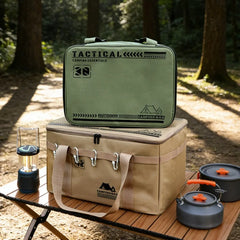
If your "camp kitchen" is really just storage and your cooking happens on a picnic table you didn't have to bring, a couple of heavy-duty bins covers a lot of ground. They're cheap, replaceable, and you can dedicate one purely to food and one to grosser outdoor gear so the two never touch. Our camp storage range includes waterproof organizer bags built on exactly that logic — keep cookware in its own protected carrier and the chaos drops fast.


Where the bin system falls apart
The cracks show up the more you camp, and they fall into four buckets.
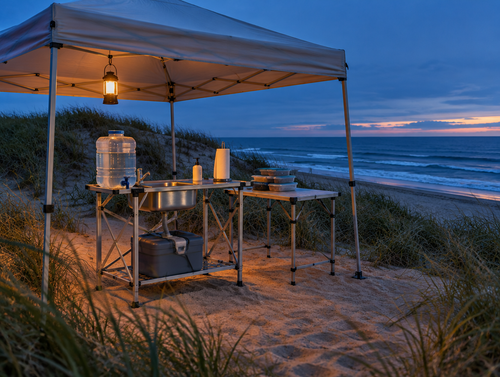
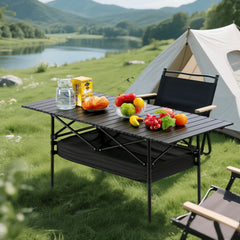
- No work surface. A tote gives you a place to store a kitchen, not a place to cook one. You still need a separate table, and you're balancing the stove on the tailgate or on the ground. A dedicated box opens into its own prep surface.
- Weather is hit or miss. Even a good ActionPacker is marketed as water-resistant, not waterproof — there's no gasket, so a hard overnight rain or a creek-bank tip-over can get inside. The cheaper translucent bins are worse: thin polypropylene gets brittle and cracks in real cold, and a split corner ends the bin's life.
- Everything is loose. No tank, no faucet, no sink. Washing dishes means a separate basin and hauling water by hand. Knives, fuel, and lighters rattle around with the food.
- Multiple trips, every time. Loose gear means relaying armloads from the car to the table. A self-contained kitchen is one trip, set down, open, cook.
None of these is a dealbreaker on its own. Stacked together, over a season of weekends, they're the difference between dreading the kitchen setup and not thinking about it. If you want the deeper history of how the dedicated-box category grew out of the old wooden chuck box, our camp kitchen box guide walks through it.
Bins vs. a camp kitchen box, side by side
| What you care about | Plastic storage bins | Camp kitchen box |
|---|---|---|
| Upfront cost | Lowest — often gear you already own | Higher — you're buying integration |
| Work surface | None; bring a separate table | Built-in prep surface / lid |
| Internal organization | One open cavity | Dedicated slots for stove, gear, utensils |
| Water & dishwashing | Separate jug and basin | Often built-in tank, faucet, and sink |
| Weather protection | Water-resistant at best | Weatherproof case on premium units |
| Setup time | Unload and arrange every piece | One trip, open, cook |
| Doubles as | Storage only | Storage, table, and kitchen in one |
What the upgrade actually buys you
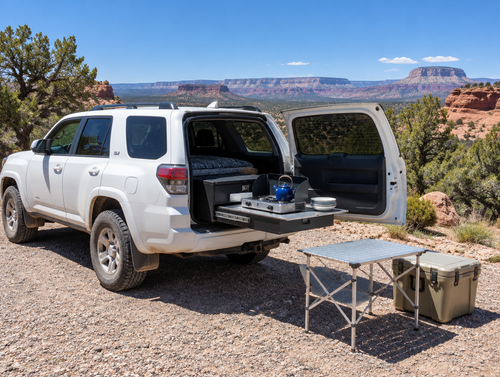
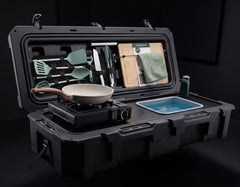
A camp kitchen box isn't magic — you can't cook anything in it that you couldn't cook out of a bin. What you're paying for is that everything is already packed, organized, and ready, and that the box itself becomes the table, the sink, and the storage all at once. The VOZ Camp Kitchen is the clearest version of that idea: a weatherproof hard case that opens into a prep surface, with a built-in stove, a real sink, a USB-rechargeable faucet, an onboard water tank, and 30-plus camping items already inside. There's no tote tower to dig through and no second table to remember.


That's the trade in one sentence: bins are cheaper to buy, a box is cheaper to use. Every trip you skip the sourcing, the packing, and the multi-trip relay. Whether that's worth the sticker depends entirely on how often you camp — which is the same math we run in our look at what to look for in a camp kitchen before you buy.

Who should upgrade — and who shouldn't
Stick with bins if: you camp a handful of nights a year, almost always at sites with tables, and you don't mind a little digging. The money is better spent elsewhere, and a pair of rugged latching totes will serve you for years.
Upgrade to a box if: you camp most months, you cook real meals rather than just boiling water, you camp where there's no picnic table, or you simply hate the setup-and-teardown tax. The more often you cook outdoors, the faster a box pays back its premium in saved time and saved frustration. We break down where each option lands across brands in our honest review of the best camp kitchens.
FAQ
Are plastic bins waterproof enough for camping?
Most aren't truly waterproof. Even a heavy-duty ActionPacker is sold as water-resistant — the lid sheds rain but has no gasket, so a hard storm or a tip-over near water can get inside. Thin translucent totes are worse and can crack in cold weather. If weather protection matters, a sealed case or a waterproof storage bag is the safer call.
Is a camp kitchen box just an expensive plastic bin?
No. A bin stores gear; a box is engineered to cook out of. The upgrade adds a work surface, internal organization so heavy items don't crush fragile ones, and on premium units a built-in stove, sink, faucet, and water tank. You're paying for integration and setup time, not just a sturdier container.
Can I just use two bins instead of buying a box?
Absolutely, and for occasional campers it's the smart move. Dedicate one tote to food and one to cookware, add a folding table and a water jug, and you have a functional kitchen for very little money. You'll just do more packing, more trips from the car, and more digging than a box owner does.
What size bin do I need for a camp kitchen?
For a two-person setup, a single 24-gallon-class tote handles cookware and utensils, with a second smaller bin for food. Larger 35 or 48-gallon containers fit a family's gear but get heavy and awkward fast — a full one can top 50 pounds, which is a two-person lift.
Ready to upgrade your camp kitchen?
The VOZ Camp Kitchen includes everything you need in one weatherproof case. Sets up in 15 seconds.
Shop VOZ Camp Kitchen →