The Ultimate Camp Kitchen Checklist (47 Items) — Free Printable PDF

Why a Camp Kitchen Checklist Saves Your Trip
Anyone who has spent a night in the woods knows the feeling: you arrive at the campsite, start unpacking, and suddenly realize you forgot the can opener. Or the dish soap. Or, worst of all, the fuel canister for your stove. A weekend that should have been about firelight and cast-iron pancakes turns into a 40-mile drive to the nearest gas station.

Camp cooking is one of the most rewarding parts of any outdoor trip, but it is also where most preparation mistakes happen. Unlike a backpack of clothes or a tent, a camp kitchen has dozens of small, easy-to-overlook items. Spices, a cutting board, the second sponge, a long-handled lighter, fresh batteries for the lantern. Each one is small. Together, they decide whether you eat a hot meal or cold granola for dinner.
This checklist covers 47 items grouped into eight clear categories: cooking gear, sink and water, eating, food storage, lighting, cleanup, safety and miscellaneous, and optional upgrades. It is built for car campers, family trips, basecamps, and overlanders. Print it, save it, or bookmark it on your phone. Run through it the night before every trip.
The 47-Item Camp Kitchen Checklist
Cooking Gear (10 items)
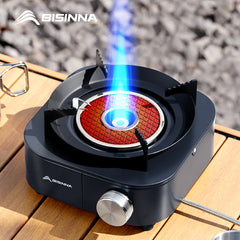
- Camp stove — a two-burner butane or propane stove handles 90% of camp meals.
- Fuel canister + spare — always pack one extra; a single butane can lasts roughly 1.5–2 hours on high.
- Frying pan — a 10–12 inch nonstick or cast-iron pan covers eggs, fish, pancakes, and stir-fries.
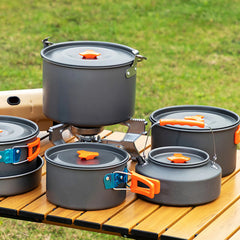
- Cooking pot with lid — for boiling water, pasta, soup, and rinsing rice.
- Spatula — heat-resistant silicone or metal works for both flipping and scraping.
- Tongs — essential for grilling, fire cooking, and pulling food out of hot pans.
- Chef's knife — one sharp 6–8 inch knife replaces three dull ones; store it in a sheath.
- Cutting board — a thin flexible board takes almost no space and protects your table.
- Can opener — the most-forgotten item in camp cooking. Pack a small manual one.
- Cooking oil + small bottle — decant into a 4 oz leakproof bottle so it survives the cooler.
Sink & Water (6 items)
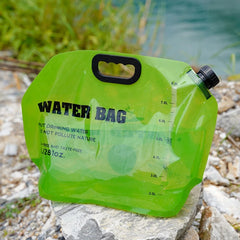
- Water tank or jug (2+ gallons) — the minimum for two people over a weekend, including dish washing.
- Faucet or spigot — a USB-pump faucet or simple gravity spigot turns a jug into a real sink.
- Wash basin — a collapsible basin keeps grey water contained instead of soaking the ground.
- Dish soap (biodegradable) — Dr. Bronner's or Campsuds are the campsite standards.
- Sponge + scrubber — bring two: one for dishes, one for pots. Replace after each trip.
- Microfiber dish towel — dries faster than cotton and packs flat.
Eating (7 items)
- Plates — enamel, melamine, or stainless. One per person plus one spare.
- Bowls — deeper than plates, usable for cereal, chili, soup, and salad.
- Insulated mugs — double-walled keeps coffee hot and cold drinks cold.
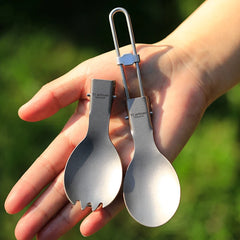
- Utensils set (fork, knife, spoon) — pack one full set per person plus a serving spoon.
- Cups — small enamel or hard plastic for water, juice, and wine.
- Reusable napkins or bandanas — better than paper, easy to rinse and reuse.
- Food storage containers — for leftovers, pre-chopped vegetables, and breakfast prep.
Food Storage (5 items)
- Cooler with ice — block ice lasts 2–3x longer than cubes; pre-chill the cooler the night before.
- Dry-food bin — a hard plastic tote keeps pasta, oats, and bread safe from rodents.
- Ziplock bags (gallon + quart) — for marinating, leftovers, sandwiches, and trash sorting.
- Spice containers — small twist-top tubes for salt, pepper, garlic powder, and chili flakes.
- Herbs + olive oil + vinegar — the difference between camp food and restaurant-quality camp food.
Lighting (3 items)
- LED lantern — a 300-lumen lantern lights the entire kitchen area; rechargeable models save batteries.
- Headlamp — keeps both hands free for cooking after dark; pack one per person.
- Spare batteries or USB power bank — nothing worse than a dead lantern at 9 pm.
Cleanup (5 items)
- Trash bags (heavy-duty) — pack twice as many as you think you need; double-bag wet trash.
- Pot scrubber — chain-mail or stainless scrubber tackles burned-on food without ruining nonstick.
- Biodegradable soap — required in most national parks; safe for grey-water disposal 200 ft from streams.
- Bear-safe food storage — bear canister, locker, or hung bag depending on the area.
- Paper towels — one roll per weekend handles spills, hands, and pre-rinse wipes.
Safety & Misc (6 items)
- Fire extinguisher — a small ABC-rated extinguisher belongs in any camp with a stove or fire.
- First-aid kit — make sure burn cream, blister pads, and tweezers are inside.
- Lighter + waterproof matches — pack both; lighters fail in cold, matches fail when wet.
- Multi-tool — pliers, screwdriver, scissors, and bottle opener in one. A camp kitchen lifesaver.
- Work gloves — for handling firewood, hot pots, and cleaning the grill grate.
- Weather cover or tarp — a 10x10 tarp over the kitchen lets you cook through rain.
Optional Upgrades (5 items)
- French press or pour-over kit — fresh coffee at sunrise is a non-negotiable for many campers.
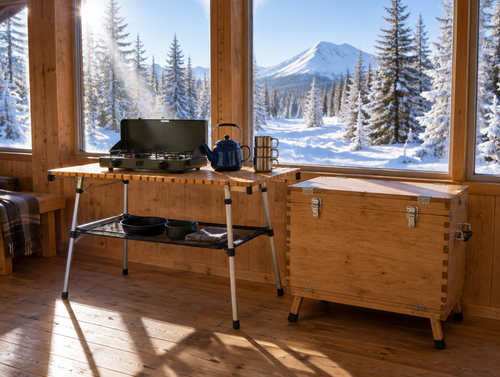
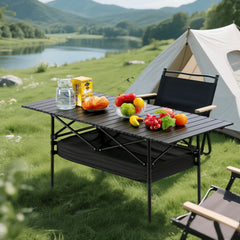
- Foldable table — extra prep surface; choose one with adjustable legs for uneven ground.
- Cast-iron skillet — perfect for steaks, cornbread, and fire cooking; season before each trip.
- Smoker box — turns any grill or campfire into a smoker with a handful of wood chips.
- Propane lantern — bright, warm light that doubles as ambient heat on cool evenings.
How to Use This Checklist
The trick to a smooth camp kitchen is treating the checklist as a process, not a list to glance at once. Go through it in three passes.
One week before the trip. Open the list and audit your gear. Fuel canisters get used up, batteries die in storage, and a sponge that worked last summer is now a science experiment. Replace consumables now so you have time to order anything missing. This is also the moment to test the stove on the back patio for two minutes; it is much better to discover a clogged regulator at home than at 6,000 feet.
The day before the trip. Pack everything in two clear groups: hot kitchen (stove, pots, utensils) and cold kitchen (cooler, food, drinks). If you use a kitchen tote or hard case, lay items out on the floor and physically check them off the list as they go in. Pre-chop onions, peppers, and garlic at home so the campsite knife sees less work. Freeze water bottles to use as long-lasting cooler ice that becomes drinking water by day three.
The morning of departure. Do a final five-minute sweep using only the checklist. Most missed items, fuel, lighter, dish soap, can opener, get caught here. If you are car camping with kids, hand them the printed list and let them call out items while you load. It works.
Mistakes Campers Make (and How to Avoid Them)
After enough weekends in the woods, the same handful of mistakes shows up again and again.
1. Bringing the home kitchen. A full knife block, three pans, four mixing bowls. Camp cooking rewards minimalism. One sharp knife, one pan, one pot. Anything more is dead weight in your trunk.
2. Underestimating water. A solo camper uses around 1 gallon per day for drinking, cooking, and washing combined. A family of four needs 4–5 gallons per day. Most campers bring half that and end up rationing on day two.
3. Forgetting fire-related basics. A stove without fuel. A grill without a lighter. A campfire without dry kindling. Always pack two ignition sources and one extra fuel can. They take up almost no room and they save dinner.
4. Skipping the cleanup setup. Without a wash basin and biodegradable soap, you either skip dish washing (next morning is grim) or wash dishes in a stream (illegal in most parks and bad for the ecosystem). Set up a real cleanup station from day one.
5. Storing food carelessly. A loaf of bread on the picnic table at night is an open invitation for raccoons, mice, and in some areas bears. Use sealed bins, hang bags, or a bear canister depending on where you are camping.
6. Trusting one light source. A single lantern with dying batteries is a recipe for cold-pasta-by-phone-flashlight dinner. Always pack a lantern plus a headlamp per person plus spare power.
The All-in-One Alternative
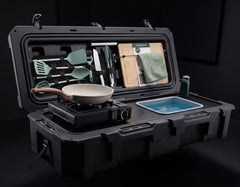
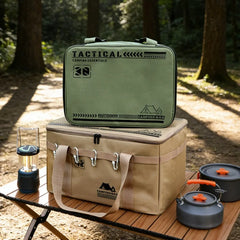
Sourcing 47 items, fitting them into bins, and remembering them every trip is a project in itself. If you would rather not buy 47 items separately, the VOZ Camp Kitchen Premium ships pre-loaded with 30+ of the essentials in this checklist, including a butane stove, 2-gallon water tank with USB-powered faucet, sink basin, plates, utensils, cutting board, and storage bins, all packed inside a single weatherproof case that opens into a full kitchen in about 15 seconds. It is made in the USA, ships free, and weighs 57 lbs, lighter than the eight separate bins it replaces.
Whether you build your own kit from this checklist or grab an all-in-one case, the goal is the same: spend less time looking for the spatula and more time eating outside.
Frequently Asked Questions
How much water should I pack for camp cooking?
Plan on roughly 1 gallon per person per day for drinking, cooking, and basic dish washing combined. For a family of four on a 3-day trip, that is around 12 gallons. If your campsite has a potable water source, you can carry less, but always bring at least 2 gallons in reserve in case the spigot is broken or the source is contaminated.
What is the most-forgotten item on this checklist?
The can opener, followed closely by dish soap, the lighter, and a second fuel canister. These items are small enough to live in a junk drawer at home, which is exactly why they get left behind. Tape a mini list of the four to the inside of your kitchen tote lid.
Do I really need a fire extinguisher for car camping?
Yes. A small ABC-rated extinguisher costs around $20 and weighs under 3 lbs. Stove leaks, grease fires, and stray sparks happen even to careful campers, and many state and national park campgrounds either require or strongly recommend one for any site with cooking equipment.
Can I use regular dish soap at a campsite?
Avoid it. Standard dish soap contains phosphates and surfactants that harm aquatic ecosystems. Use a biodegradable soap like Dr. Bronner's or Campsuds, dispose of grey water in a designated drain or by scattering at least 200 feet from any stream, lake, or trail, and follow Leave No Trace principles.
How do I keep food from spoiling on a 3-day trip?
Pre-chill your cooler 12 hours before packing. Use block ice instead of cubes; it lasts 2–3x longer. Pack frozen water bottles as secondary ice that becomes drinking water as it melts. Keep the cooler in shade, drain melt-water daily, and store raw meat in sealed containers at the bottom. With this setup, most foods stay safe for 3–4 days.
Ready to upgrade your camp kitchen?
The VOZ Camp Kitchen includes everything you need in one weatherproof case. Sets up in 15 seconds.
Shop VOZ Camp Kitchen →