Camp Kitchen Stove BTU: How Much Power Do You Actually Need?

The BTU number printed on a camp stove is the spec everyone fixates on and almost nobody understands. Bigger sounds better, so it's easy to assume a 30,000-BTU monster will run circles around the modest single burner built into a camp kitchen box. In practice, the right amount of heat for car camping is a lot less than the marketing implies, and the number on the box is rarely the number you cook with. Here's how to read BTU honestly and figure out what your setup actually needs.
BTU, Explained Without the Marketing Spin
A BTU (British Thermal Unit) is simply the amount of heat it takes to raise one pound of water by one degree Fahrenheit. On a stove, the BTU rating tells you how much heat the burner can throw at maximum output, per hour. More BTU means more raw heat available, which generally means a faster boil and a quicker sear.
But there's a catch the spec sheet never mentions: a higher BTU burner also drinks fuel faster. All that heat has to come from somewhere, so a stove cranking 20,000 BTU empties a canister noticeably quicker than one sipping 8,000. Raw output and fuel efficiency pull in opposite directions, and for most camp cooking you do not need to live at the top of that range. Heat you can't use is just fuel you're wasting.
How Many BTUs Do You Actually Need?
The honest answer depends almost entirely on how many people you're feeding and what you're cooking. The widely repeated rule of thumb across stove makers and camping guides is that around 10,000 BTU per burner is plenty for most campers. That's enough to fry eggs and pancakes, brown burgers, and saute vegetables without standing around waiting. Here's how it scales:
| Group / cooking style | Practical BTU target (per burner) |
|---|---|
| Solo or couple, simple meals | 7,000–10,000 BTU |
| Small family, everyday camp cooking | 10,000 BTU |
| Larger groups, faster turnaround | 15,000–20,000 BTU |
| Big crowds, searing, wok / stir-fry | 20,000 BTU and up |
For reference, the ever-popular Coleman Classic two-burner puts out 20,000 BTU total, or 10,000 per burner — and it has fed campsites for decades. A typical portable butane single-burner cassette stove lands in the 8,000 to 12,000 BTU range; the well-known Iwatani cassette models, for instance, sit around 12,000 BTU. In other words, the “normal” camping burner is already in the sweet spot for the kind of cooking most people actually do at a campsite.
Your Camp Kitchen's Built-In Stove vs. a Standalone Burner
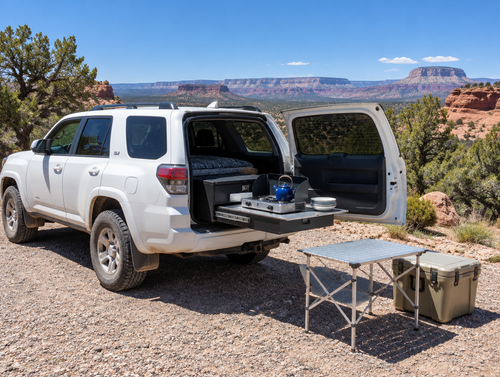
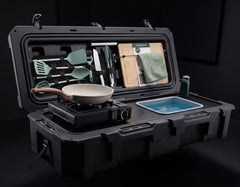
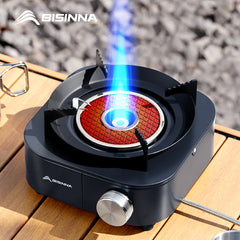
This is where a camp kitchen box changes the conversation. The VOZ Camp Kitchen runs a portable single-burner butane stove that drops into the case's stove platform, fed by standard butane canisters you can buy at any camping store or Walmart. It's a single burner in the everyday-cooking BTU class — not a high-output beast, and it doesn't need to be. The value of an integrated stove isn't peak BTU; it's that the burner, prep surface, sink, and storage all deploy together in seconds instead of being hauled out of five different bags.


A standalone two-burner stove can absolutely push more total heat, and there are good reasons to own one (more on that below). But for the rhythm of real camp cooking — coffee and eggs in the morning, a one-pan dinner at night — a single well-protected burner in the 8,000–12,000 BTU range does the job while leaving your case organized and your propane bottle untouched. If you want to see exactly what comes packed alongside that stove, our full kit breakdown walks through every piece.

Why the BTU on the Box Is Not the BTU You Get
Here's the part that matters more than the rating itself: you almost never cook in the lab conditions where those BTU numbers were measured. Manufacturers test on calm days at sea level with the burner wide open. Take that same stove outside and the real-world heat reaching your pan drops fast.
- Wind is the biggest thief. Even a light 5 mph breeze can roughly double the time it takes to boil water, because moving air strips heat off the pot and destabilizes the flame. Stoves rated 10,000+ BTU often deliver less than half their claimed heat in a stiff 15 mph wind.
- Cold compounds it. In cold, gusty conditions, heat-transfer efficiency can fall 30–50% as wind scatters the flame and low temperatures sap canister pressure — butane in particular gets sluggish when it's cold.
- Altitude thins the air. Less oxygen at elevation means less complete combustion, so the same burner simply produces less usable heat the higher you climb.
Counterintuitively, in windy tests the most fuel-efficient stoves are often the lower-BTU tabletop models — a 10,000-BTU burner that's well shielded doesn't have to fight as hard, so it wastes less fuel than a big burner blasting heat into the breeze. The lesson: wind protection and a tight-fitting lid do more for your boil time than chasing a bigger BTU number. A wider-based pot that captures more of the flame, plus a lid to trap the heat, will beat raw output almost every time.

When to Add a Standalone Stove to Your Kit
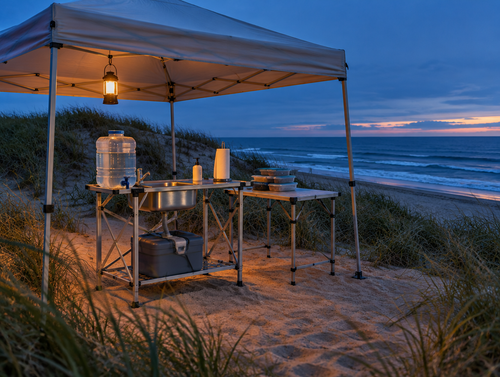
None of this means high-BTU stoves are pointless. There's a clear case for keeping a dedicated burner alongside your camp kitchen box. Reach for more power when you're feeding a crowd and want two pots going at once, when you're searing steaks or running a wok and need a hard, fast flame, or when you want to run off a refillable propane bottle instead of swapping butane canisters on a long trip.
If that's you, a propane two-burner in the 17,000-BTU class covers most family and group cooking, while a hybrid or high-output unit pushing 30,000-plus BTU is built for big-batch and survival-style cooking. The smart move for a lot of campers is a layered setup: the integrated single burner for everyday speed and convenience, plus a separate two-burner that comes out only when the menu earns it.


Whatever you choose, match the burner to your cooking and your fuel plan — not to the biggest number on the shelf. A camp kitchen lives or dies on how smoothly everything works together, and BTU is just one piece of that system.
FAQ
Is 10,000 BTU enough for a camping stove?
For most campers, yes. Around 10,000 BTU per burner handles eggs, pancakes, burgers, and sauteed vegetables for solo cooks and small families without a frustrating wait. You only really need 15,000–20,000+ when you're cooking for larger groups or doing high-heat work like searing and stir-frying.
Does a higher BTU stove always cook faster?
Not in the real world. More BTU means more heat available, but wind, cold, altitude, and your cookware all cut into how much of it reaches your food. A well-shielded 10,000-BTU burner with a lid often boils water faster — and uses less fuel — than a bigger burner exposed to a breeze.
What BTU is a camp kitchen box's built-in stove?
Integrated camp kitchen stoves are typically single butane burners in the everyday-cooking range, roughly 8,000–12,000 BTU. That's intentional — it's matched to one-pan campsite cooking, and the real advantage is that the stove deploys instantly as part of the whole kitchen rather than as a separate piece of gear.
Will a higher BTU stove burn through fuel faster?
Yes. Heat output and fuel consumption rise together, so a 20,000-BTU burner empties a canister faster than a 10,000-BTU one. On longer trips, that's a real consideration — either pack more fuel for a high-output stove or stick with a right-sized burner that sips it.
Butane or propane for a camp stove?
Butane canisters are compact, clean, and ideal for the integrated single burner in a camp kitchen box — great in warm weather. Propane handles cold better and comes in larger refillable bottles, which makes a propane two-burner the better backup for long trips or chilly shoulder-season camping.
Ready to upgrade your camp kitchen?
The VOZ Camp Kitchen includes everything you need in one weatherproof case. Sets up in 15 seconds.
Shop VOZ Camp Kitchen →