How Long Does a Camp Kitchen Last? Lifespan and What Wears Out First

A camp kitchen is one of the few pieces of gear you set up, splash, scrub, slam shut, and then leave baking in a hot vehicle — over and over, trip after trip. So the honest question before you buy isn't just “does it work” — it's “how long will it keep working, and what breaks first?” Here's the real lifespan picture, part by part.
So How Long Should a Camp Kitchen Last?
There's no single number, because a camp kitchen isn't one thing — it's a stack of components that age at very different rates. A well-built all-in-one box with a food-grade polyethylene shell, stainless-steel hinges, and a sealed water system can give you many seasons of regular weekend and base-camp use. The case body itself almost always outlasts everything bolted to it. Budget units fail faster, and they almost always fail at the same places: the moving and electronic parts.
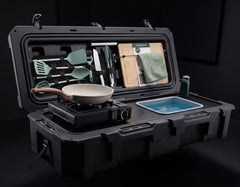
The smart way to think about longevity isn't “will this last 10 years?” It's “which part dies first, and can I baby it or replace just that piece?” Get that right and a quality box becomes a buy-once item where you swap a $20 part instead of tossing a $300 kit. A complete box like the VOZ Camp Kitchen is built around that idea — a rugged case with a built-in stove area, sink, USB-rechargeable faucet, and water tank, where the consumable parts are the exception, not the rule. If you want the full breakdown of every component in the box, our guide to everything that's included in a camp kitchen kit walks through the whole stack.


What Wears Out First (Ranked)
Failures cluster in a predictable order, driven by how often a part moves and whether it holds water or electrons. Here's the ranking, fastest-wearing first.
| Part | Why it wears | Typical first-wear point |
|---|---|---|
| Hinges & latches | Opened and closed every single meal | Cheap plastic latches crack; pins loosen |
| USB faucet pump | Rechargeable battery is a consumable | Weak flow as the cell ages |
| Water tank, lines & seals | Constant moisture; rubber gaskets age | Mold, odor, slow drips at fittings |
| Plastic shell | UV and heat over years | Fading, then brittleness if unprotected |

1. Hinges and latches go first
The lid and latch are the busiest parts of any camp kitchen — you open and shut them at every meal, often with wet or sandy hands. On lower-end boxes, thin plastic latches are the number-one failure point: they crack, the catch wears smooth, or the hinge pins work loose from vibration on washboard roads. This is exactly why better boxes use continuous (piano-style) hinges, stainless or corrosion-resistant fasteners, and positive latches that handle road vibration. The fix is cheap and proactive: a light wipe of marine-grade or silicone lubricant on hinge pins and latch points every 10–15 trips keeps grit from grinding them down, and corrosion away from the metal.
2. The USB-rechargeable faucet pump
The single most “consumable” part of a modern camp kitchen is the rechargeable faucet pump — and that's by design, not a flaw. The pump runs on a lithium-ion cell, and consumer lithium-ion batteries typically deliver about 300 to 500 full charge cycles before capacity settles to roughly 80% of new. In plain terms, the pump doesn't die one day; it slowly pushes a little less water per charge over a few years of use. On a full charge, small USB water pumps in this class generally move on the order of 20–25 gallons, or several large jugs' worth, before they need topping up.
The good news: a faucet pump is the easiest part to replace. Stand-alone USB and USB-C water pumps and faucets are sold on their own, so a worn pump is a quick swap rather than a reason to retire the whole box. If you ever need one, our camp water gear covers exactly these parts.


3. The water tank, lines, and seals
Anything that holds water lives a hard life. The tank, faucet lines, and rubber gaskets face constant moisture, and the most common “failure” here isn't a crack — it's mold, biofilm, and odor from being put away damp. Seals and O-rings also stiffen with age and can start to weep at fittings. None of this is fatal, and almost all of it is preventable with cleaning and full drying. We cover the full routine in how to clean a camp kitchen sink and water system.
4. The plastic shell (the slow one)
The case body is the longest-lived major part, but it isn't immortal. Polyethylene degrades under ultraviolet light: without UV stabilizers, polyolefin plastics can lose a large share of their tensile strength and flexibility inside a year of hard sun exposure, eventually fading and turning brittle. UV-stabilized plastics — the kind quality boxes are molded from — resist this far better and hold up for years of seasonal use. The practical takeaway is simple: the enemy isn't the camping, it's leaving the box parked in direct sun and heat for months on end.
What Lasts the Longest
Not everything is a wear item. The parts that tend to outlive the rest of the kit — often by a wide margin — are the simple, passive, metal ones:
This is the core argument for an integrated box over a pile of loose gear: the expensive, durable parts are built in, and the cheap, replaceable parts stay cheap and replaceable. If you're weighing how a compact all-in-one holds up versus a sprawling DIY setup, our portable camp kitchen guide on size and weight digs into that trade-off.
How to Stretch a Camp Kitchen's Lifespan
Lifespan is mostly in your hands. None of this is fussy — it's five habits that target the exact parts that fail first.

For the full step-by-step, see how to clean your camp kitchen after a trip and how to store a camp kitchen between trips.
FAQ
How many years should a quality camp kitchen last?
With a UV-stabilized case, stainless hinges, and basic post-trip care, the box body and metal parts can serve many seasons of regular use. The wear items — latches, pump battery, and seals — age faster, but each can be maintained or replaced without retiring the whole kit.
How long does the rechargeable faucet pump last?
The pump itself can run a long time; its battery is the limiting factor. Consumer lithium-ion cells generally hold up for roughly 300–500 charge cycles before dropping to about 80% capacity, which usually translates to a few years of camping before flow weakens. At that point you replace the pump, not the kitchen.
Does leaving it in a hot car hurt it?
Yes — heat is one of the worst things for both the lithium-ion battery and the plastic shell. High temperatures accelerate battery aging and speed up UV-driven plastic breakdown. Long-term storage in a hot vehicle or direct sun shortens lifespan more than the actual camping does.
Can I replace just the worn part instead of the whole box?
Usually, yes, and that's the point of a modular all-in-one. USB and USB-C water pumps are sold separately, latches and hinges are serviceable, and stainless cookware rarely needs replacing at all. Buying a quality box up front is what makes those single-part swaps possible.
Ready to upgrade your camp kitchen?
The VOZ Camp Kitchen includes everything you need in one weatherproof case. Sets up in 15 seconds.
Shop VOZ Camp Kitchen →