Stainless Steel vs. Plastic Camp Kitchen: Which Lasts Longer?

“Plastic feels cheap, steel lasts forever” is the gut reaction most people have when they compare two camp kitchens side by side. It's also wrong — or at least far too simple. Which material actually survives more seasons of being splashed, slammed, loaded, and baked in a hot vehicle depends entirely on which part you're talking about. Here's the honest breakdown.
The Real Question Isn't “Metal vs. Plastic”
A camp kitchen is not one material. It's a case, a set of hinges and latches, a stove area, a water system, and cookware — and the smartest designs use different materials for each job. The case body has to shrug off impacts, rain, and UV. The hinges have to survive thousands of open-close cycles. The cookware has to take direct flame. No single material is best at all three, so asking “is stainless or plastic more durable?” is like asking whether leather or rubber makes a better shoe — the answer is you want both, in the right places.
What most shoppers really mean is: which case material lasts longer outdoors — a stainless-steel shell or a food-grade polyethylene one? That's the comparison worth having, and the answer surprises people.

How Each Material Actually Fails
Durability isn't about which material is “stronger” on a spec sheet — it's about how each one breaks down in the specific abuse a camp kitchen takes. Steel and polyethylene fail in completely different ways.
| Material | How it fails outdoors | Real-world trigger |
|---|---|---|
| Stainless steel (304) | Surface rust, pitting, dents, scratched finish | Salt air, acidic food residue, scratches that expose bare metal |
| Stainless steel (430) | Rust and staining in damp or acidic conditions | Lower-grade alloy with no nickel — common in budget gear |
| Polyethylene (HDPE/LLDPE) | UV chalking, cold-weather brittleness, warping | Years of direct sun on a non-stabilized plastic; impact in freezing temps |
Here's the catch most people miss: not all stainless is equal. Grade 304 stainless — the good stuff — contains about 18% chromium and 8% nickel, which is what gives it strong corrosion resistance. Budget products often use 430 stainless, which has roughly 17% chromium and no nickel, making it noticeably more prone to rust and staining in damp or acidic conditions. If a cheap “stainless” camp kitchen never lists its grade, assume it's the lower one.
Polyethylene's weak spot is UV. Bare, un-stabilized plastic genuinely does degrade in sunlight. But that's a solved problem: UV-stabilized polyethylene (the kind used in marine and outdoor products) can last 20–30 years in direct sun. The material that fails in two summers and the material that outlives your truck are both technically “plastic” — the additive package is what separates them.
Durability Head-to-Head
Put the two case materials next to each other on the factors that actually matter for a portable kitchen, and the picture gets clear fast.
| Factor | Stainless steel | Food-grade polyethylene |
|---|---|---|
| Corrosion / rust | Resists rust (304); can pit or stain, especially lower grades | Cannot rust — immune to corrosion entirely |
| Impact resistance | Very high tensile strength, but dents and creases permanently | Flexes and rebounds; won't crack or shatter (LLDPE especially) |
| Weight | Dense — steel is roughly 8x heavier than polyethylene by volume | Light; easy to lift in and out of a vehicle solo |
| UV / weather | Unaffected by UV; can get very hot to the touch in sun | Needs UV stabilizers, then lasts decades; stays cooler |
| Heat (direct flame) | Excellent — ideal for cookware and burner surfaces | Poor — never use as a cooking surface |
| Maintenance | Wipe dry, watch for rust spots and salt | Rinse and go; essentially maintenance-free |
The numbers behind the impact line are striking. Grade 304 stainless has an ultimate tensile strength around 73,200 psi versus roughly 4,600 psi for HDPE — so steel is far stronger in pure structural terms. But “stronger” and “more durable for a camp kitchen” aren't the same thing. Steel's strength means it holds a shape; it also means that when it does deform from a hard drop, the dent or crease is permanent. Polyethylene absorbs the same hit by flexing and springing back. For gear that lives in a bouncing truck bed and gets dropped on tailgates, that flexibility is often the more useful kind of toughness.
Why Food-Grade Polyethylene Wins for the Case
For the shell of a portable kitchen — the part that takes the rain, the drops, and the years of storage — a food-grade polyethylene case has real advantages that steel can't match: it can't rust, it shrugs off impacts instead of denting, it weighs a fraction as much, and it needs almost no maintenance. Polyethylene is also FDA-approved for food contact, so the surfaces your food and gear touch are safe.
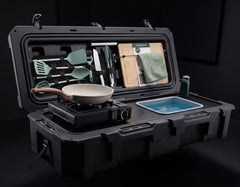
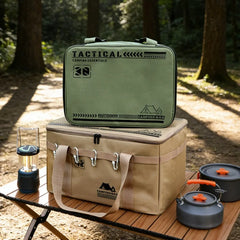
This is exactly the approach the VOZ Camp Kitchen takes. Its case is food-grade LLDPE — a flexible, high-impact grade of polyethylene that resists punctures and cracking better than rigid HDPE — paired with stainless-steel hinges where the metal's strength matters most. The result is a weatherproof, dustproof, UV-resistant box rated to hold over 300 lb on its lid, light enough to load solo, and built to be left in a garage or truck between trips without corroding. You get the corrosion immunity and weight savings of plastic on the body, and the cycle-strength of steel on the moving parts.


Weight is a bigger deal than it sounds. A steel-bodied kitchen of the same size can be brutal to lift in and out of an SUV at the end of a long day — which is the whole reason we wrote about why size and weight matter more than you think in a portable setup. A case you dread carrying is a case you leave home.
Where Stainless Steel Still Wins
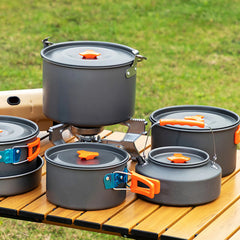
None of this means “avoid steel.” For the parts that meet fire and food, stainless is the right call — and a good camp kitchen leans on it heavily. Stainless cookware takes direct flame without flinching, doesn't leach or warp, cleans up easily, and lasts effectively forever. The same goes for hinges, latches, and burner hardware, where steel's tensile strength keeps things tight through thousands of cycles.
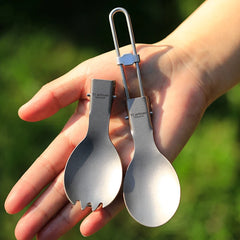
If you're building out your kit, this is where to spend on metal: pots, pans, utensils, and a solid mess kit. A 304-stainless camping cookware set will outlive almost everything else you own.


The takeaway: a well-designed camp kitchen isn't a steel box or a plastic box. It's a polyethylene shell carrying stainless components — each material doing the job it's actually best at. For a full look at every part that goes into a complete kit and what each one is made of, see our guide to everything that's included in a camp kitchen kit.
FAQ
Does a plastic camp kitchen really last as long as a steel one?
For the case, often longer. A UV-stabilized food-grade polyethylene shell can't rust, won't dent, and resists impact — the three things that actually retire a case. Steel bodies last too, but they're heavier, can corrode if scratched or made from a lower grade, and dent permanently. The smart move is plastic for the body, steel for the cookware and hinges.
Will a polyethylene case crack in cold weather?
Rigid plastics can get brittle in freezing temperatures, which is one reason flexible grades like LLDPE are used for outdoor cases — they stay pliable and absorb impacts better than stiff HDPE. Avoid dropping any plastic gear hard when it's well below freezing, but a quality flexible-grade case is built to handle normal cold-weather camping.
Is 304 stainless worth paying more for over 430?
For anything exposed to moisture and food acids — cookware especially — yes. The nickel in 304 gives it meaningfully better rust and stain resistance than nickel-free 430. If a product doesn't state its stainless grade, it's usually the cheaper one.
Is food-grade plastic safe to store food and cook gear in?
Yes. Polyethylene is FDA-approved for food contact, which is why it's used for everything from milk jugs to cutting boards. “Food-grade” on a camp kitchen case means the surfaces touching your food and gear are safe — just don't confuse the case with a cooking surface; only metal cookware goes over flame.
So which lasts longer overall?
A camp kitchen built the right way — a food-grade polyethylene shell with stainless hinges and stainless cookware — outlasts both an all-steel box (heavier, rust-prone at scratches) and an all-cheap-plastic one (UV failure, brittle parts). Material choice matters less than putting each material where it belongs.
- Camp Kitchen Kit: Everything That's Included (and Why It Matters)
- Portable Camp Kitchen: Why Size and Weight Matter More Than You Think
- Best Camp Kitchen in 2026: What to Look for Before You Buy
- How Long Does a Camp Kitchen Last? Lifespan and What Wears Out First
- Camp Kitchen Box vs. Plastic Storage Bins: Is the Upgrade Worth It?
Ready to upgrade your camp kitchen?
The VOZ Camp Kitchen includes everything you need in one weatherproof case. Sets up in 15 seconds.
Shop VOZ Camp Kitchen →