Single-Burner vs. Two-Burner Stove: Which One Belongs in Your Camp Kitchen?

Every camp kitchen is built around its stove, and the first real decision is burner count: one burner or two. Get it right and dinner flows; get it wrong and you're either hauling dead weight or juggling pots over a single flame while the pasta goes cold.
The Real Question: How Do You Actually Cook at Camp?
Burner count isn't a spec-sheet debate — it's a question about your menu. Think back to your last three camp dinners. If they were one-pot meals — chili, ramen, dehydrated dinners, scrambled eggs — a single burner did everything you needed and the second one would have sat cold. If they involved a protein in a skillet plus a side in a pot, or pancakes while the coffee water heated, you were either running two burners or cooking in shifts.
The same logic applies to group size. Solo campers and couples rarely outrun one burner. Families of four or more almost always do, because feeding more people usually means staging: one pot boiling while another simmers. Most gear editors land in the same place — for the average car-camping household, a two-burner stove is the sweet spot because it lets you run a skillet and a pot side by side. But "average" is doing a lot of work in that sentence, and the right answer for a solo overlander is different from the right answer for a family basecamp.
Single-Burner Stoves: Small Footprint, One Pot at a Time
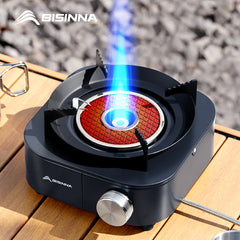
The classic single-burner for car camping is the cassette stove: a flat tabletop unit that runs on an 8-ounce butane canister that clicks in sideways. Typical output runs from about 7,500 to 12,000 BTUs depending on the model — enough to boil water fast and sear in a 10-inch pan, which is the practical size limit for most single-burner cooktops.

What you get in exchange for the single flame:
- Footprint. A cassette stove takes up roughly half the packed space of a two-burner suitcase stove, and it slides into a slot in a camp kitchen box instead of demanding its own bin.
- Weight. Single-burner cassette stoves are dramatically lighter than steel two-burner units — a difference you feel every time you load the truck.
- Simplicity. One knob, one canister, matchless ignition on most models. Nothing to level, nothing to hook up.
- Wind behavior. Compact burners with built-in windscreens hold a flame surprisingly well, though any stove cooks faster out of the wind.
A windproof model like our Single-Burner Portable Cassette Stove covers the whole one-pot menu: boils, simmers, and skillet work, one dish at a time.


The tradeoff is sequencing. Cooking bacon and eggs on one burner means cooking bacon, then eggs, while the bacon cools. For simple menus that's a non-issue. For anything two-stage, it turns a 20-minute dinner into a 40-minute one.
Two-Burner Stoves: A Real Range for the Campsite
The two-burner suitcase stove is the closest thing to bringing your home cooktop outside. For a concrete reference point, Coleman's current Cascade 222 — one of the most common stoves at any campground — puts out 22,000 total BTUs (11,000 per burner), measures 22 inches wide, and weighs 13 pounds. Those numbers are typical of the category: two-burner propane stoves generally land in the 17,000–24,000 BTU range and around 10–13 pounds.

What the second burner buys you:
- Parallel cooking. Sauce on one flame, pasta water on the other. Pancakes and bacon at the same time. This is the whole argument, and for family cooking it's decisive.
- Independent heat zones. One burner on high, one at a simmer — something no single-burner stove can fake.
- Bigger cookware. Most two-burner cooktops fit a 12-inch pan next to a 10-inch pot.
- Built-in wind protection. The lid and fold-out side panels form a three-sided windscreen.
If your trips look like this, something in the class of our 17,000 BTU 2-Burner Propane Camp Stove with Windshield is the workhorse option — and there are more sizes in our camp stoves collection, from folding double-burners to compact cassette units.


The costs are the mirror image of the single burner's virtues: more packed bulk, more weight, and a bigger claim on your table. A 22-inch stove plus a propane cylinder effectively owns half of a standard camp table before a single plate lands on it.
Single vs. Two Burners: Head-to-Head
| Single-burner (cassette) | Two-burner (suitcase) | |
|---|---|---|
| Typical output | 7,500–12,000 BTU | 17,000–24,000 BTU total |
| Typical weight | Light — a few pounds | Roughly 10–13 lb |
| Packed footprint | Fits inside a kitchen box slot | Needs its own space, ~22" wide |
| Fuel | 8-oz butane canisters | 16-oz propane cylinders (or bulk tank with adapter hose) |
| Best for | Solo, couples, one-pot menus | Families, groups, multi-dish meals |
| Weak spot | Sequential cooking only | Bulk, weight, table space |
The Fuel Math: Propane vs. Butane
Burner count also decides your fuel logistics, and the arithmetic is simple. A 16-ounce propane cylinder holds roughly 21,500 BTUs of energy, so run time is just that number divided by how hard you run the stove. A two-burner cranked wide open at 22,000 BTUs drains a cylinder in about an hour; throttled back to real-world cooking levels, the same cylinder stretches across a weekend of meals.
Butane cassette stoves sip by comparison because the burner is smaller: an 8-ounce butane can typically runs about 1.5 hours at full flame on a mid-power single burner, and roughly double that at a simmer. In practice, one can per weekend per stove is a safe planning number for a single burner, versus two to three propane cylinders for a heavily used two-burner feeding a family.
Two planning notes either way: butane performs poorly below about 40 °F, so shoulder-season campers should lean propane, and neither fuel belongs inside a closed tent or vehicle — carbon monoxide doesn't negotiate. We break down output numbers in more depth in our guide to how many BTUs a camp kitchen stove actually needs.
How the Stove Fits Into a Camp Kitchen Box
Here's the part most stove reviews skip: the stove is one station in a larger kitchen. Burner count matters less when the rest of the setup — prep surface, sink, water, storage — is already handled, because you're not improvising counter space around the stove's footprint.
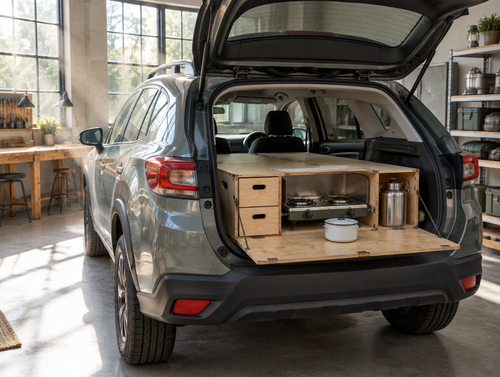
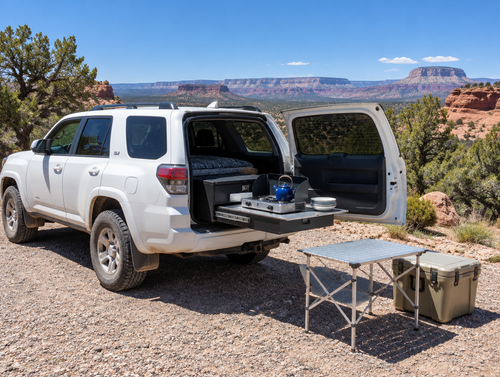
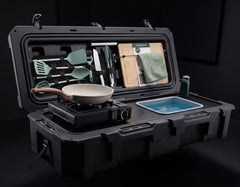
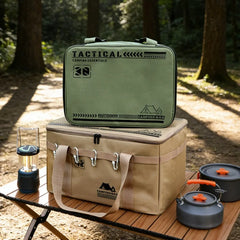
That's the design logic behind the VOZ Camp Kitchen: the box carries the stove, a sink with a USB-rechargeable faucet, a water tank, and 30-plus cooking items in one weatherproof case, so the burner question becomes about your menu rather than about what else you have room to pack. A single burner inside an organized camp kitchen kit often outcooks a two-burner balanced on a wobbly table, simply because prep, cooking, and cleanup each have a place.


If you cook big for a big crew, the hybrid answer works well too: run the kitchen box as your prep-wash-storage hub and set a two-burner suitcase stove beside it on the table. You get parallel burners and running water without giving up organization.
FAQ
Is a single burner enough for two people?
Usually, yes. Two people eating one-pot meals — pasta, stir-fry, chili, breakfast scrambles — won't feel limited. The pinch shows up with multi-dish menus, where everything has to cook in sequence.
Can I just bring two single-burner stoves instead of one two-burner?
You can, and it's a legitimately flexible setup: two independent cassette stoves cost less packed space than one suitcase stove and can be spread across two cooks. The downsides are two canisters to manage and no shared windscreen or lid.
Do two-burner stoves use twice as much fuel?
Only when both burners run. Fuel use scales with total BTU output, not burner count — a 16-ounce propane cylinder holds about 21,500 BTUs regardless of how many flames draw from it. Two burners at moderate heat can actually finish dinner faster and burn less total fuel than one burner running longer.
Which is better in wind?
A two-burner suitcase stove has the edge out of the box because its lid and side panels form a windscreen. Windproof cassette stoves close the gap, and either type benefits from positioning the kitchen out of direct wind.
What if I mostly boil water?
Go single. Boiling is one task on one flame, and a compact high-output burner brings water up quickly. Save the weight and the table space.
Ready to upgrade your camp kitchen?
The VOZ Camp Kitchen includes everything you need in one weatherproof case. Sets up in 15 seconds.
Shop VOZ Camp Kitchen →