What Size Camp Kitchen Box Do You Actually Need?

Ask any camping forum what size camp kitchen box to buy and you will get two regrets in the same thread: one camper hauled a giant chuck box they could barely lift, and another packed something so small they kept leaving gear at home. Sizing is the decision people get wrong most often — not brand, not price. Here is how to figure out the size you actually need before you spend a dollar.
The real question isn't "how big" — it's "how big for what"
A camp kitchen box exists to do one thing: hold your whole cooking setup in a single grab-and-go case. So the right size is the smallest box that still fits everything you genuinely cook with, fits your vehicle, and isn't so heavy it stays in the garage. Three inputs decide that: your group size, your typical trip length, and your cargo space. Nail those three and the size answers itself.
The trap is shopping by the box's headline dimensions alone. A case that looks roomy on a spec sheet can still be the wrong shape for your trunk, or so deep that the gear at the bottom becomes a treasure hunt. Think in terms of what you cook and where it rides — not just cubic inches.
The three numbers that actually define a camp kitchen's size
"Size" is really three separate specs, and they don't move together. A box can be physically large but light, or compact but dense. Read all three before you judge whether something is "big":
- Packed footprint — the closed length × width × height. This is what has to fit your trunk or truck bed.
- Internal capacity — usually given in gallons or liters. This is how much gear and food it swallows.
- Loaded weight — what it weighs full, not empty. This is the number that decides whether one person can carry it from the tailgate to the table.
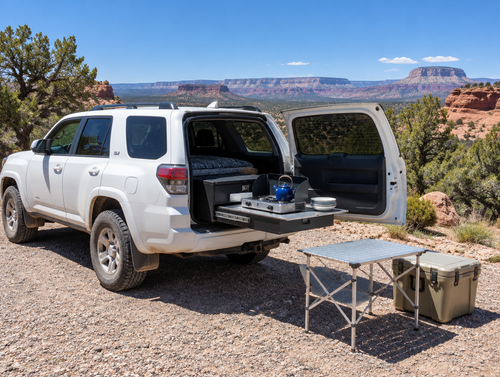
For reference, most traditional plywood and aluminum chuck boxes land somewhere around 24 to 36 inches wide, 15 to 20 inches tall, and 14 to 18 inches deep. That footprint exists because it fits a two-burner stove and the rear cargo area of a typical wagon or mid-size SUV. The all-in-one cases are a different shape — flatter and longer — but the same logic applies: the footprint has to earn its place in your vehicle.

Size by group: solo, couple, family, or crew
Group size is the single biggest driver of how much kitchen you need, because it sets how many people you cook for and how much cookware and tableware you carry. Use this as a starting point:
| Group | What you're really sizing for | Box you need |
|---|---|---|
| Solo / couple | 1 burner, one pot and pan, two place settings | Compact box or a kitchen-in-a-bag |
| Small family (3–4) | 2 burners or a fast single, mid-size cookware, 4 settings, a real prep surface | Mid-size all-in-one case |
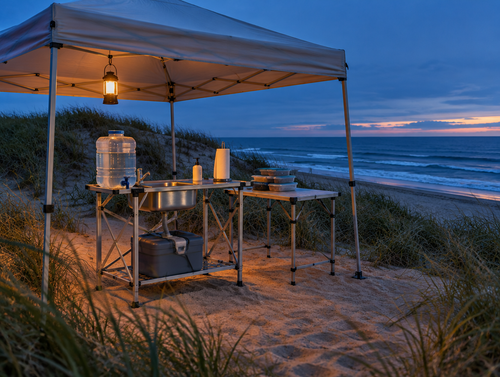
| Large family / group (5+) | More cookware, more water, more counter space, faster cleanup | Largest box, or a box plus an add-on table and storage |
A common piece of advice from experienced campers: once you're regularly cooking for more than about four people, a dedicated kitchen station stops being a luxury and starts saving your back. Below that, a single well-organized case usually covers it. If you're torn between two sizes, size for your normal trip, not the once-a-year reunion — you can always bring an extra bin for the big weekends.
Size by trip length: weekend vs. week-long
Trip length changes how much food, water, and backup gear you carry — and that's really a question of capacity, not footprint. A two-night weekend needs almost nothing in reserve. A week at a base camp means more consumables, more cleanup, and a stronger case for built-in water.
A useful planning rule borrowed from cooler sizing: budget roughly one quart of cold-storage capacity per person per day for fresh food. That math tells you how big a cooler rides alongside the box, which in turn tells you how much room is left in the vehicle for the kitchen itself. A built-in water supply matters more the longer you stay out — refilling a tank beats hauling jug after jug. If running water is a priority, our guide to a camp kitchen setup worth buying walks through which features actually earn their weight.


Don't forget the vehicle — the footprint that gets ignored
The most common sizing mistake isn't buying too much kitchen — it's buying a box that doesn't fit the way you load your car. Measure your cargo space before anything else: the flat floor behind the rear seats, the height to the window line, and the width between the wheel wells. A box that's an inch too tall to see over, or two inches too wide to sit flat, becomes a daily annoyance.
Lighter, flatter cases win here because they slide under other gear and don't fight your sightlines. This is the whole reason size and weight matter more than people expect — a kitchen you can actually load in 30 seconds is a kitchen you'll bring. If you drive a smaller vehicle, prioritize a low, flat footprint over raw capacity and lean on a separate cooler and a folding table for the overflow.

Where the VOZ Camp Kitchen lands
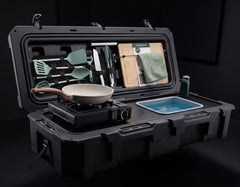
For most car campers and families, the sweet spot is a single mid-size case that carries the whole kitchen without needing a second trip. The VOZ Camp Kitchen is built around that target. It packs down to about 47.6 by 19.3 by 11.4 inches — a long, flat case rather than a tall tower — with roughly 25 gallons of internal capacity and a loaded weight near 57 pounds with all 30-plus items aboard. Inside it carries a single-burner butane stove, a non-stick pan, a collapsible sink fed by a USB-rechargeable faucet, and a removable 2-gallon water tank.
That combination is sized for the 3-to-4-person trip that most weekend campers actually take: enough burner and water to cook and clean up for a family, a flat footprint that lies down behind the rear seats, and one case to carry instead of five loose bins. Solo campers may want less; a large crew cooking three hot meals a day will want to add a table and extra storage. But as a default size, a flat mid-capacity case hits the most trips for the most people.


FAQ
Is a bigger camp kitchen box always better?
No. Past a certain point, extra capacity just means a heavier box and more wasted cargo space. The best size is the smallest case that still holds everything you genuinely use on a normal trip. Oversizing is the most common regret campers report.
How heavy is too heavy?
The practical limit is whatever one person can comfortably carry from the vehicle to the cook spot without help. A fully loaded all-in-one case can run close to 60 pounds, so look at the loaded weight — not the empty weight — and consider whether you'll always have a second set of hands.
What size fits a small SUV or sedan?
Measure the flat cargo floor first. A low, flat case that slides in under your sightline beats a tall box with more capacity nearly every time in a smaller vehicle. Pair it with a separate cooler and a folding table instead of buying one giant box.
Can one box cover both weekend and week-long trips?
Usually, yes — the kitchen hardware barely changes between a 2-night and a 7-night trip. What changes is food and water volume, which ride in a cooler and water containers alongside the box. Size the box for your gear, and scale the consumables separately.
- What Is a Camp Kitchen Box? The Modern Chuck Box Explained
- Portable Camp Kitchen: Why Size and Weight Matter More Than You Think
- Best Camp Kitchen in 2026: What to Look for Before You Buy
- Are Camp Kitchen Boxes Worth It? An Honest Cost-Benefit Look
- Camp Kitchen for a Sedan or Small Car Trunk: How to Make It Fit
Ready to upgrade your camp kitchen?
The VOZ Camp Kitchen includes everything you need in one weatherproof case. Sets up in 15 seconds.
Shop VOZ Camp Kitchen →