Camp Kitchen Box vs. Hitch-Mounted Kitchen (Yakima EXO, HitchFire): Which Setup Fits Your Vehicle and Budget?

A hitch-mounted kitchen hangs your cook station off the back of the truck, swings clear of the tailgate, and takes up no cargo space. A camp kitchen box does the same job from inside the vehicle. Here is how they compare on price, tongue weight, hitch conflicts, theft exposure, and cooking, with numbers from the current spec sheets.
What a hitch-mounted kitchen actually is
Two products define the category right now. The Yakima EXO OpenRange is a rotomolded 85-liter gear box, about 31 by 18 by 18 inches and 30 pounds, that clips onto Yakima's EXO SwingBase hitch platform with tool-free locking knobs. It is a lockable cabinet with a drop-down door that doubles as a prep surface, an internal shelf, and a utensil drawer. It does not include a stove, a sink, or any water system.
The HitchFire Hitch Kitchen goes the other direction: it is a complete kitchen in an aluminum and stainless locker. It carries dual 10,000 BTU propane burners, a battery-powered pump and faucet rated around one liter per minute, a removable basin with a greywater container, a fold-out side table with cutting board, and about 77 liters of storage. It weighs roughly 83 pounds dry, mounts to a standard 2-inch receiver on its own swing arm, and pivots 90 or 180 degrees to clear the tailgate. You bring your own propane cylinder and water container.
Both live outside the vehicle, occupy the hitch receiver full time, and depend on that receiver being rated for the load.
What a camp kitchen box is
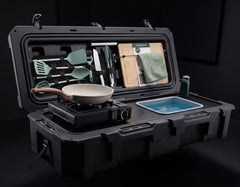
A camp kitchen box is a self-contained case that rides inside the cargo area and opens on the tailgate, a picnic table, or the ground. The VOZ Camp Kitchen is the example we know best: a weatherproof food-grade LLDPE case measuring 47.6 by 19.3 by 11.4 inches closed, about 57 pounds fully loaded, with a single-burner butane stove, a collapsible sink, a USB-rechargeable faucet, a removable 2-gallon water tank, and more than 30 cooking and prep items stored in fixed positions. Setup is three latches and a lid, under 15 seconds, with nothing bolted to the truck.


If you are still sorting out a modern box from a classic chuck box, our camp kitchen vs. chuck box guide covers that. This article assumes you want an organized kitchen and are deciding where it should live.

Price: what you actually pay for a working kitchen
The sticker price on a hitch kitchen rarely tells the whole story, because the platform, the stove, and the water system are often separate line items. Here is the bill for a kitchen you can actually cook on, using list prices and the sale prices shown at the time of writing.
| Setup | What you buy | List price | Sale price seen | Still missing |
|---|---|---|---|---|
| Yakima EXO OpenRange | OpenRange box + EXO SwingBase | $999 + $899.99 = about $1,899 | $599 + $699 = about $1,298 | Stove, basin, water, tables |
| HitchFire Hitch Kitchen | Kitchen unit with swing arm, burners, pump, hoses | $1,899 | $1,799 | Propane cylinder, water container |
| VOZ Camp Kitchen box | Case with stove, sink, faucet, tank, 30+ items | $1,649 | $1,169 | Butane canisters, food |
The Yakima route is the cheapest hitch-mounted cabinet, but it is a cabinet; add a stove, a basin, and a jug and you are a few hundred dollars deeper and carrying all of it separately. HitchFire's all-in price lands within a few hundred dollars of a box that already includes everything, before you account for the hitch itself. If your vehicle lacks a 2-inch Class III receiver, the hitch install is a cost a box never asks for.
Will your hitch take it? Tongue weight and hitch class
This is the question most buyers skip, and the one that disqualifies the most vehicles. A hitch-mounted kitchen is cantilevered weight behind the bumper, held only by the receiver tube and the frame it bolts to.
- Class I: 1-1/4-inch receiver, roughly 200 pounds of tongue weight. Rack makers advise against more than about 65 pounds on a cargo carrier.
- Class II: usually 1-1/4-inch, roughly 300 to 350 pounds of tongue weight.
- Class III: 2-inch receiver, typically 500 to 600 pounds of tongue weight.
Both products require a 2-inch receiver, and Yakima states that the SwingBase fits Class III and IV hitches only. That rules out most crossovers and sedans with 1-1/4-inch hitches before you look at weight. Then the math starts. The SwingBase weighs 68.5 pounds, and that weight comes straight off your available tongue capacity. Stack the 30-pound OpenRange on it and load it with gear, and you are near 150 pounds on the receiver before adding a stove or water. The HitchFire starts at 83 pounds dry; a propane cylinder and a few gallons of water push it past 100.
The critical detail is that tongue weight capacity is set by the vehicle's chassis, not by the hitch you bolted on. A heavy-duty aftermarket receiver on a unibody SUV does not raise the number in the owner's manual. The National Highway Traffic Safety Administration's towing guide says the maximum tongue weight your vehicle can carry is listed in the owner's manual, and that is the number to work from. Rack makers add one more rule: use the lowest rating among vehicle, hitch, and carrier, then subtract the carrier's own weight. Cargo farther behind the bumper adds leverage on top of that.
A box sidesteps all of it. A 57-pound case inside the cargo area is ordinary payload.
The hitch is a shared resource
Your receiver does one thing at a time. With a hitch kitchen installed, that thing is the kitchen.
- Bikes. On the Yakima system, the OpenRange takes the SwingBase, so bikes go on a second-level TopShelf with a DoubleUp bike rack, which GearJunkie priced at about $930 for the two-level platform plus $499 for the rack. The HitchFire occupies the receiver on its own swing arm, so a receiver bike rack needs another home.
- Trailers. A hitch kitchen and a trailer cannot share a receiver. If you pull a teardrop, a boat, or a utility trailer, the kitchen comes off first.
- Swing clearance. Swing arms need open space beside the vehicle to pivot. On a tight campground pad or against a guardrail, you may not be able to swing far enough to drop the tailgate.
- Clearance on the trail. On rutted forest roads, 100-plus pounds hanging behind the bumper is the first thing to drag and the last thing you want bouncing on washboard.
A box leaves the receiver free for the bike rack, the trailer, or nothing at all, and the same kitchen moves between the truck, the partner's SUV, and a rental with no hardware changing hands. Our camp kitchen vs. slide-out vehicle kitchen article covers a similar lock-in, where the cargo floor is claimed instead of the hitch.
Theft, weather, and staying legal on the road
A hitch kitchen lives outside, in the open, at every gas station, motel lot, and trailhead. Both makers take that seriously: the OpenRange ships with SKS locking latches, the SwingBase includes a HitchLock for the receiver, and the HitchFire has a keyed lockable cabinet. Locks stop opportunists, but they do nothing about the kitchen advertising itself to everyone who walks past. A box rides inside a locked vehicle and comes into the garage between trips.
Then there is the law. In every state, your rear plate and your brake, turn, and tail lights must remain visible from behind, and a hitch cabinet sits exactly where those are. Some owners relocate the plate to the carrier and add a light bar wired to the trailer harness.
Cooking: what each setup is like once you stop
To be fair, the HitchFire's two 10,000 BTU burners and pump faucet make a capable cook station. The OpenRange is a nice locker you cook next to on whatever stove you brought. The box's single butane burner and 2-gallon tank are sized for a family's breakfast and dinner, not a base camp feeding ten, and the trade is a case that opens anywhere, not just at the back bumper.

With a hitch kitchen, the stove is wherever the truck is parked: in the sun, in the wind, on a slope. With a box, you carry the kitchen to the shaded picnic table or the lee side of the tent. And if you want two burners, a separate 17,000 BTU two-burner propane stove with a windshield packs flat beside the case for a fraction of what any hitch platform costs.


For the built-in drawer approach some overlanders take instead, see our comparison of a portable box vs. Nomad Kitchen Co vehicle drawers.
Which setup fits your vehicle and budget
- Truck or body-on-frame SUV with a Class III hitch, no trailer, no bikes, cargo area already full: a hitch kitchen makes sense. The HitchFire is the complete option; the OpenRange is the cabinet you build out yourself.
- Crossover, minivan, sedan, or any 1-1/4-inch receiver: a hitch kitchen is off the table. A box is the answer.
- You tow anything, ever, or run a hitch bike rack: box, or budget for the Yakima two-level platform and its tongue-weight math.
- You want the kitchen away from the truck, at the table or under the awning: box.
- You park on the street or overnight in motel lots: box, for theft exposure alone.
- Budget under $1,300 for a kitchen that cooks on day one: box. Neither hitch option gets there with a stove and water included.
FAQ
Can I put a hitch-mounted kitchen on a Class II hitch?
Not these two. Both require a 2-inch receiver, and Yakima specifies Class III and IV only. Check the tongue weight limit in your owner's manual before buying anything that hangs off the receiver.
Can a camp kitchen box be used on a tailgate like a hitch kitchen?
Yes. The VOZ case is 47.6 inches long and sits across a full-size or mid-size tailgate, a picnic table, or a folding camp table, and it also works on the ground. You choose the spot every time instead of the hitch choosing it for you.
Is a hitch kitchen more secure than a box because it locks?
It locks to the receiver and locks its own door, which beats an unlocked cooler. But it is still outside the vehicle around the clock. A box inside a locked vehicle, and inside your garage between trips, is exposed to fewer people for fewer hours.
- Camp Kitchen vs. Chuck Box: Complete 2026 Comparison Guide
- Camp Kitchen vs. Slide-Out Vehicle Kitchen: Which One Makes Sense for You?
- Camp Kitchen vs. Nomad Kitchen Co: Portable Box vs. Vehicle Drawers
- Camp Kitchen for an SUV: Setups That Fit Behind the Rear Seats
- How to Secure a Camp Kitchen for Transport
Ready to upgrade your camp kitchen?
The VOZ Camp Kitchen includes everything you need in one weatherproof case. Sets up in 15 seconds.
Shop VOZ Camp Kitchen →