Camp Kitchen for an SUV: Setups That Fit Behind the Rear Seats

An SUV is the most popular car-camping vehicle in America, and also the trickiest to outfit — the space behind your rear seats can be a generous flat floor or a cramped, wheel-well-pinched cubby depending on the model. Get the measurements right and a full camp kitchen slides in and out in seconds; guess wrong and you are repacking the trunk at every campsite.
Why "behind the rear seats" is the hardest fit in car camping
With a truck you have an open bed. With a van you have a flat floor and standing room. An SUV gives you neither — you get a defined cargo box bounded by the seatbacks, the wheel wells, the load floor, and the window line. That box changes dramatically from one model to the next, and the published cargo numbers don't always tell you what you need to know.
Cargo volume behind the second row ranges from roughly 36.6 cubic feet in a compact like the Kia Sportage to 55.5 in a Volkswagen Atlas and well over 100 in a full-size GMC Yukon XL. A three-row SUV is more complicated still: a Toyota Grand Highlander holds about 20.6 cubic feet behind the third row but opens up to 57.9 once you fold that rearmost bench. And here's the catch — the Society of Automotive Engineers publishes a recommended method for measuring cargo volume, but automakers aren't required to follow it, so two SUVs with identical "cubic feet" can hold very different real-world gear. Volume tells you almost nothing about whether a 47-inch-long box will physically slide in.
Measure your SUV before you buy anything
Forget cubic feet. A camp kitchen is a rigid object, so what matters is whether its three outside dimensions fit your cargo opening. Pull a tape measure and write down three numbers with the rear seats in the position you'll actually camp in:
Measure twice. The single most common mistake SUV campers make is buying for the published cargo volume and discovering the load floor is four inches too short for the box they ordered.

One-box vs. modular: which SUV kitchen actually fits
There are two honest ways to build an SUV camp kitchen, and the right one depends entirely on the numbers you just wrote down.
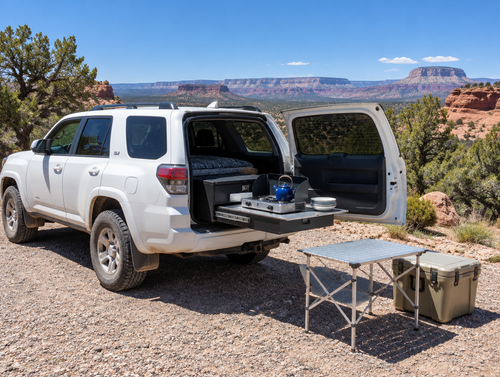
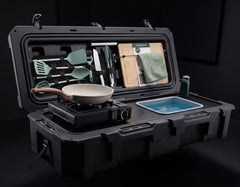
The one-box approach is a single all-in-one case that holds the stove, sink, water, and utensils together. It is the fastest to deploy and the easiest to load — one lift in, one lift out. The VOZ Camp Kitchen is built this way: a weatherproof case measuring 47.6" × 19.3" × 11.4" closed, weighing about 57 lbs, with a built-in butane stove, a collapsible sink, a USB-rechargeable faucet, a 2-gallon water tank, and 30-plus pieces inside. It sets up in under 15 seconds because everything travels assembled. At 47.6 inches long it lays flat across the cargo floor of a midsize or larger SUV — think Grand Highlander, Atlas, Honda Pilot, 4Runner — with room left for a cooler beside it.


If your tape measure says the load floor is shorter than about 48 inches — common in compact SUVs and many wagons — the one-box case won't lie flat, and you move to the modular approach: separate, smaller components that nest into the gaps your cargo area actually has. It's a little slower to set up, but it conforms to a tight space the way a single rigid box never will. For comparison, purpose-built behind-seat units from brands like Nomad Kitchen Co are sized around 25" deep × 20" wide × 14" high precisely so they can stand upright behind the second row of a small crossover.
Building a modular SUV kitchen for tight cargo areas
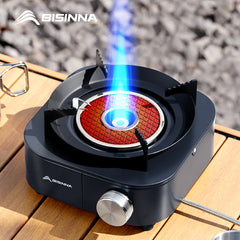
A modular setup is just the same functions — heat, water, prep, storage — split into pieces you can stack and rearrange. Start with the cook source. A folding two-burner or a single cassette stove flattens to a few inches and slides into the gap beside a wheel well, and gives you the same output as the burner in an all-in-one box.


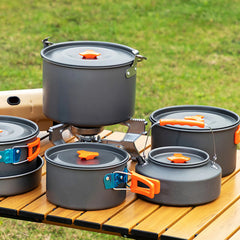
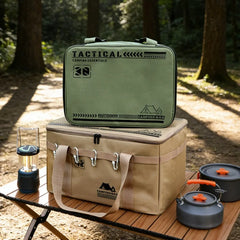
Next, contain everything. The reason a one-box kitchen loads fast is that nothing rattles loose; you recreate that in a modular build with a couple of structured, waterproof bins. Pack the heavy, hard items (stove, cookware) in one and the soft goods (towels, utensils, food) in another, so the load floor stays flat and nothing shifts on a forest-service road.


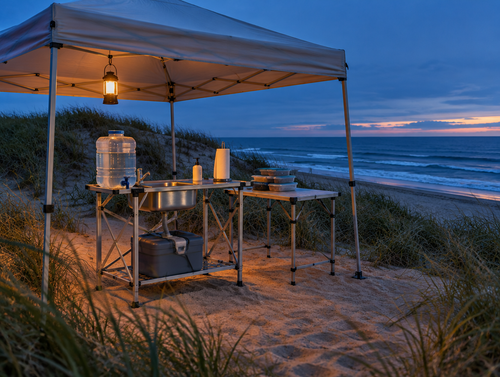
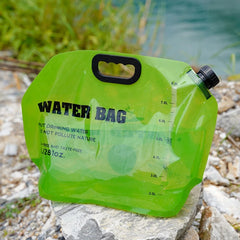
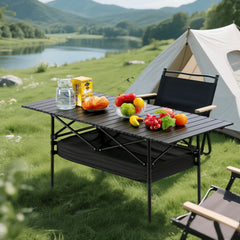
Finally, water. This is where SUV campers cut the most corners and regret it. A collapsible jug or a foldable electric pump gives you a real rinse station without a plumbed tank, and packs down flat when empty. Pair it with a folding camp table and your tailgate becomes a full prep-and-clean surface in about a minute.


How to pack it so it loads and unloads fast
However you build it, the goal behind the rear seats is the same: heavy and low, light and high, and nothing you reach for daily buried at the bottom. A few rules that survive real trips:
- Heaviest item against the seatback. Weight rides best near the vehicle's center, not hanging off the rear axle at the liftgate. A 57-lb kitchen box belongs pushed forward, not parked against the tailgate.
- Cook gear last in, first out. Whatever you use to make coffee and dinner should be the thing you touch when the liftgate opens — not behind the sleeping bags.
- Leave a "launch gap." Keep four to six inches of clearance at the liftgate so a folding table or chair can come out without unloading the whole stack.
- Keep water upright and accessible. A leaking jug under everything else is the one mistake that ruins a cargo carpet for good.
If you want a deeper breakdown of how camp kitchens differ across truck beds, vans, trailers, and RVs — and where an SUV sits in that spectrum — our vehicle camp kitchen guide walks through each rig type.
FAQ
Will a full camp kitchen box fit behind the rear seats of a compact SUV?
Usually not lying flat. A box around 47 inches long needs a midsize or larger cargo floor. In a compact SUV like a Sportage (about 36.6 cubic feet behind the second row), you'll either fold a seat to gain length or go modular with smaller nesting components.
Do I have to remove my rear seats?
No. The point of a behind-the-seats setup is that the seats stay in. Measure with the seats up if you carry passengers, or with one side folded if you camp solo or as a couple and want the extra length.
How much cargo space do I actually need for a camp kitchen?
Length matters more than volume. You can run a complete modular kitchen in a compact SUV with under 40 cubic feet, while a full one-box system wants roughly 48 inches of flat floor regardless of the total cubic-foot rating.
Can I cook out of the back of the SUV in the rain?
You can prep and stage gear under an open liftgate, which acts as a small awning, but never run a fuel-burning stove inside or directly under the vehicle. Pull the stove out onto a table a safe distance away — the liftgate keeps your supplies dry, not your flame.
Ready to upgrade your camp kitchen?
The VOZ Camp Kitchen includes everything you need in one weatherproof case. Sets up in 15 seconds.
Shop VOZ Camp Kitchen →