Using a Camp Kitchen Sink as a Handwashing Station for Farmers Market and Food Booth Vendors

If you sell food at a farmers market, a craft fair, or a weekend festival, the health inspector will look at your handwashing setup before they look at anything else. A camp kitchen sink with a powered faucet can be the base of that station, as long as you know which rules it already meets, which it doesn't, and what your county actually asks for.
One thing up front: no portable sink is "health-code certified" for every booth in the country. Temporary food rules are written and enforced locally, and they differ from county to county. Read this as a planning guide, then check with your county health department before your first market day.
What Health Departments Usually Ask For at a Temporary Booth
Most temporary handwashing rules come from the same basic idea in the FDA Food Code: anyone touching unpackaged food needs running water, soap, and a way to dry their hands. How each county writes that down is where vendors get tripped up. Here is how a few real jurisdictions describe it:
| Jurisdiction | Water | Spigot | Wastewater |
|---|---|---|---|
| Oklahoma City-County Health Dept. | 5-gallon insulated container, warm (100°F) | Continuous-flow spigot | 5-gallon catch container |
| North Dakota HHS | Minimum of 2–5 gallons of hot water | Must flow freely; no push-button spouts | Catch bucket, emptied into a sanitary sewer |
| Portsmouth, NH Health Dept. | Insulated container, at least 85°F | Must stay open without being held | Sanitary sewer only; never the ground or a storm drain |
| San Francisco | Warm potable water, 100–108°F | Hands-free; swap push-button for lever | See county guide |
| Garfield County, WA | Warm water, 100–120°F | See county guide | See county guide |
Almost every guide also lists the same supplies: liquid soap in a pump bottle, single-use paper towels, and a trash can next to the station. Minnesota's state rule specifically allows a stand that is taken down after each use to run a handwashing device that delivers water "under pressure or by gravity," as long as the faucet gives hands-free flow.
A few details worth noting. San Francisco says you don't need a handwashing station at all if you only sell prepackaged food and offer no samples. North Dakota requires that the station be used for nothing but handwashing, and that food and utensils be protected from splash. Portsmouth reminds vendors that handling money means washing hands again before touching food.
Where a Camp Kitchen Sink Fits Those Rules
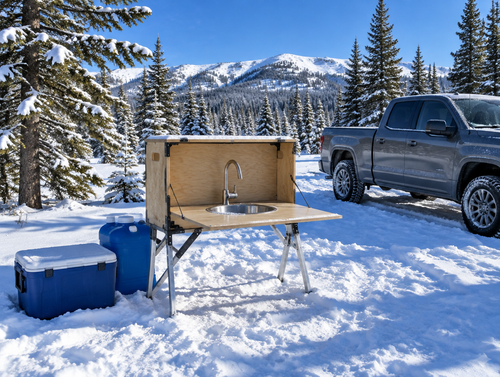
The classic temporary station is an insulated drink cooler with a spigot, set on a table over a bucket. It works, but it is a pile of loose parts that you rebuild every Saturday. A camp kitchen with a built-in sink puts the basin, faucet, and water supply in one case that opens on the table, which is why vendors who already own one start asking whether it can pull double duty.
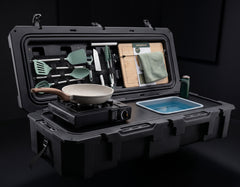
Take the VOZ Camp Kitchen as an example. It has a collapsible built-in sink, a USB-rechargeable electric faucet, and a removable 2-gallon water tank, with room in the case for a spare 2-gallon water bag. The whole box is about 57 lb loaded and measures roughly 47.6 x 19.3 x 11.4 inches, so it sets up on a standard folding table.


Here is how that lines up against the typical checklist:
- Running water, hands-free: An electric faucet pumps water out of the tank, so nobody is holding a spigot open. The rules above ban push-button spouts because a button spigot stops when you let go. Ask your inspector whether a powered faucet that keeps running after one touch meets their "continuous flow" language, and demonstrate it if they want to see it.
- Volume: A 2-gallon tank meets the low end of North Dakota's "2–5 gallons," but it does not meet a rule that names a 5-gallon container, like Oklahoma City-County's. If your county writes "5 gallons," plan on a larger supply (more on that below) or ask whether a spare filled bag on site counts.
- Warm water: The tank holds whatever you pour into it. It doesn't heat water, so warm-water rules are on you.
- Catch container: You still need a sealed way to capture the dirty water, which is covered below.
Our sibling guide on why a camp kitchen with a sink and faucet changes how you cook outdoors goes deeper on the sink itself.
Getting Warm Water Into the Tank
This is the rule vendors most often miss. Several jurisdictions set a minimum temperature, and the numbers vary: at least 85°F in Portsmouth, 100°F in Oklahoma City-County, a 100–108°F band in San Francisco, and up to 120°F in Garfield County. Cold tap water won't pass any of those.
The simple fix is to warm water before it goes into the tank:
- At home: Fill the tank from the hot tap or mix in water from a kettle, then check it with a probe thermometer. Aim for the middle of your county's range so it can lose a few degrees during setup.
- At the market: Use the camp stove to heat a pot of water and mix it into cooler water in a separate container. Never pour boiling water straight into a plastic tank or onto a pump, and check the mix with a thermometer before it goes in.
- Through the day: Re-check the temperature mid-shift. A tank sitting in October shade cools off much faster than an insulated cooler.

For more ways to get warm water at the basin, including propane on-demand heaters and kettle methods, see our breakdown of hot water options for a camp kitchen sink.
Wastewater Goes to a Sanitary Sewer, Not the Grass
At a campsite you might scatter strained dishwater well away from water sources. At a vendor booth, that is usually not allowed. North Dakota requires handwashing wastewater to be discarded into a sanitary sewer. Portsmouth spells it out: wastewater goes to the sanitary sewer, never on the ground, the pavement, or down a storm drain. Storm drains carry water untreated to nearby streams and lakes, while the sanitary sewer goes to a treatment plant.
In practice that means:
- Route the sink drain into a lidded, leak-proof container under the table, sized at least as big as your fresh water supply.
- Ask the market manager ahead of time where vendors are allowed to dump graywater. Restroom utility sinks or a designated dump point are common answers.
- Empty the container before it is full. Water weighs about 8.3 lb per gallon, so a full 5-gallon jug is more than 40 lb to carry across a parking lot.
Our guide to camp kitchen graywater disposal covers the campsite side of this; the booth side is simpler because the answer is almost always "the sewer."
Handwashing Only: Keep the Booth Sink Separate From Dishes
North Dakota's rule says the station is for "no purpose other than handwashing," and many counties enforce the same idea. That matters if you were planning to rinse tongs or cutting boards in the same basin. At the booth, the camp kitchen sink should be the hand sink and only the hand sink.
If you also need to wash utensils on site, most health departments want a separate wash, rinse, and sanitize setup. Portsmouth, for example, asks sampling vendors to run a three-bay wash station under the tent and to clean food-contact surfaces at least every four hours. A lightweight second option is a stand-alone folding sink with its own pump, set up at the other end of the table:


If you are comparing basins for this job, our head-to-head on foot-pump sink stations vs. a camp kitchen sink walks through what each one does well.
Running Out of Water Mid-Market
We can't give you a fixed "washes per gallon" number, because it depends on your faucet's flow and how long people keep it running. What you can do is measure it yourself. Fill the tank, run ten realistic handwashes at home (a full 20-second scrub, as the CDC recommends, plus rinse), and see how far the level drops. Multiply out to your busiest day.
Then plan your water supply around that number:
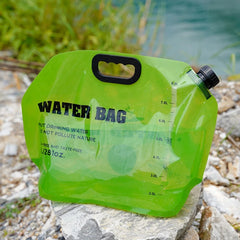
- Bring a spare filled water bag so you can swap instead of driving off-site to refill. A collapsible water bag or a hard container with a tap keeps the warm water ready.
- Charge the faucet battery the night before every market. A dead pump means no running water and an unhappy inspector.
- Keep soap and paper towels stocked to match your water, not the other way around.


FAQ
Is a camp kitchen sink approved as a vendor handwashing station?
Not automatically. Approval comes from your local health department, and rules vary on container size, water temperature, and spigot type. Bring the specs (tank size, faucet type) to your permit application and ask directly.
Does a 2-gallon tank meet the 5-gallon rule?
Not if your county specifies a 5-gallon container. Some jurisdictions accept 2 gallons as a minimum, as North Dakota's 2–5 gallon wording shows. If yours says 5, ask whether extra filled water on site satisfies it, or plan a larger supply.
Can I dump the gray water on the grass behind my booth?
Usually not. The vendor rules we reviewed require handwash wastewater to go to a sanitary sewer, and Portsmouth specifically bans the ground, pavement, and storm drains. Ask the market where the approved dump point is.
Can I wash dishes in the same sink between customers?
Plan on no. Many health departments require the handwashing station to be used only for handwashing. Set up a separate utensil-washing station if you need one.
For the bigger picture on choosing a box with a sink, stove, and storage that works at camp and at the market, start with our camp kitchen buying guide for 2026.
Ready to upgrade your camp kitchen?
The VOZ Camp Kitchen includes everything you need in one weatherproof case. Sets up in 15 seconds.
Shop VOZ Camp Kitchen →