How Big Should a Camp Kitchen Water Tank Be? The Gallons-Per-Day Math

Camp kitchen water tanks run anywhere from a gallon to five-plus, and the right size has less to do with "bigger is better" than with how much water actually flows through your sink in a day. Here's the real gallons-per-day math, and why a 2-gallon tank hits the sweet spot for most car campers.
How Much Water a Camping Day Actually Uses
Start with the official baseline. The National Park Service tells backcountry campers to carry at least one gallon of water per person per day, and federal emergency guidance at Ready.gov uses the same figure — one gallon per person per day for drinking and sanitation. Of that gallon, roughly three quarters goes to drinking; NPS camping guidance separately recommends drinking about 2 liters a day, and more in hot weather.
But that gallon is a survival minimum, not a camp-cooking budget. Once you're rinsing vegetables, boiling pasta, washing hands before you handle raw chicken, and doing a full round of dishes after dinner, real-world usage climbs. RV boondocking guides that track actual tank draw-down put a comfortable figure at about two gallons per person per day — one for drinking, one for cooking, washing, and hygiene combined.

So a family of four on a two-night weekend runs through roughly 16 gallons of water in total. Nobody wants to lift a tank that size onto a countertop — which is exactly why camp kitchen tanks aren't built to hold your whole supply.
What Your Tank Needs to Cover (and What It Doesn't)
A camp kitchen water tank feeds the faucet and sink. That's its whole job. It is not your drinking supply, your dog's bowl, or your fire bucket. In practice, the tank covers:
- Hand washing — before cooking, after handling raw meat, before eating
- Food prep — rinsing produce, wetting a cutting board, topping off a pot
- Dishwashing — the wash-and-rinse cycle after each meal
- Wipe-downs — countertop and stove cleanup before you close the box
Drinking water should live in its own dedicated jug or bottles, kept sealed and out of the sun. When you split duties this way, the sink side of the ledger works out to roughly half of total usage — about one gallon per person per day of the two-gallon total. That's the number your tank size should be built around. If you're new to how a pump-fed camp sink works in the first place, our guide to the camp kitchen with sink and faucet walks through the whole water loop.
The Math: Tank Size by Group and Trip Length
Here's what the one-gallon-per-person-per-day sink budget looks like in practice, and how often you'd top off a 2-gallon tank:
| Trip | Total water to bring | Sink-side usage | Refills of a 2-gal tank |
|---|---|---|---|
| Solo, 2 nights | ~4 gal | ~2 gal | ~1 per trip |
| Couple, 2 nights | ~8 gal | ~4 gal | ~1 per day |
| Family of 4, 2 nights | ~16 gal | ~8 gal | ~2 per day |
| Couple, 7-day base camp | ~28 gal | ~14 gal | ~1 per day |
Two patterns jump out. First, for one or two people, a 2-gallon tank covers a full day of sink work on a single fill. Second, even for a family of four, "too small" just means one extra 30-second top-off per day — not a ruined trip. The tank is a working reservoir, not a storage hold.
Why a Bigger Tank Isn't Automatically Better
It's tempting to want a 5-gallon tank so you never refill. The problem is physics: water weighs about 8.34 pounds per gallon, a figure straight from the U.S. Geological Survey. Five gallons is nearly 42 pounds of water alone — before the tank, before the kitchen. A tank that size either lives on the ground (awkward faucet plumbing) or turns your camp kitchen into a two-person lift every time you move it.

There's a second cost: a big built-in tank makes the whole kitchen bulkier even when it's empty, eating trunk space you paid for. We've written before about why size and weight matter more than you think in a portable camp kitchen — an oversized tank is one of the fastest ways to lose that battle. The smarter architecture is a small, removable tank that one person can carry to the spigot, backed by cheap, separate storage for the rest of your supply.
How the VOZ 2-Gallon Tank Fits the Math
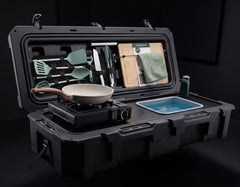
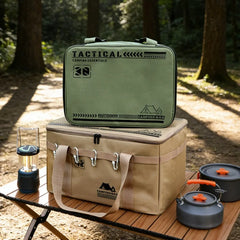
This is the sizing logic behind the VOZ Camp Kitchen. Its 2-gallon tank is removable and refillable — you carry about 16 pounds of water, not 40 — and it feeds a USB-rechargeable electric faucet over a collapsible sink, all packed inside a weatherproof case with the stove, cookware, and 30-plus other pieces. One fill handles a full day of hand washing, prep, and dishes for two people; a family tops it off at the campground spigot while the coffee brews. The tank rides inside the case in transit, so there's nothing extra to pack. You can see how the water system fits alongside everything else in our breakdown of everything included in the camp kitchen kit.


Backup Water Storage That Pairs With a Small Tank
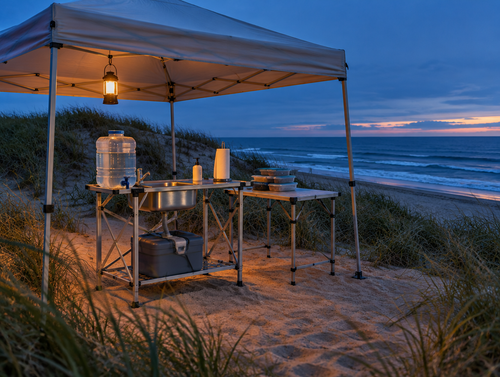
The 2-gallon tank plus a larger reserve container is the setup that scales. Keep the reserve in the shade near your kitchen and decant into the tank as needed. Good options from our camp water gear lineup:
- 3.4-gallon water container with faucet — a gravity-fed reserve that doubles as a second wash station
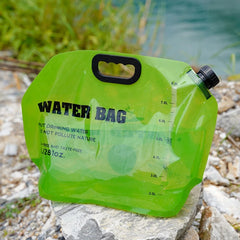
- 2-gallon foldable water bag — packs flat on the drive out, matches your tank one-for-one
- 1.5 / 2.6-gallon collapsible water bucket — handy for hauling from a spigot that's a few sites away


For a family weekend, the tank plus one 3.4-gallon reserve covers the sink side entirely; add a dedicated drinking jug and you've matched the full two-gallons-per-person-per-day budget without a single monster container.
FAQ
Is a 2-gallon tank enough for a weekend of camping?
For one or two people, yes — comfortably. At roughly one gallon per person per day of sink use, a couple refills once a day, and a solo camper may stretch one fill across the whole weekend. A family of four should plan on about two top-offs per day, or carry a reserve container.
How many gallons of water should I bring per person per day?
The National Park Service and Ready.gov both set the floor at one gallon per person per day. For car camping with real cooking and dishwashing, plan on about two gallons per person per day — half for drinking, half through the kitchen.
Can I put drinking water in the camp kitchen tank?
Fill the tank with potable water either way — you'll splash sink water on dishes and hands, so it has to be clean. Most campers still keep a separate sealed jug for drinking, simply because the tank's job is flow-through washing, and a dedicated jug stays cold and untouched. Whatever you choose, empty and dry the tank between trips.
What happens to the water after it goes down the sink?
It becomes graywater, which collects below the sink for disposal. Established campgrounds have utility sinks or graywater drains; in dispersed sites you'll scatter strained graywater well away from water sources. Budget for it too — every gallon that enters the tank has to leave camp responsibly.
- Camp Kitchen Kit: Everything That's Included (and Why It Matters)
- Camp Kitchen With Sink: Why Running Water Changes Everything Outdoors
- Portable Camp Kitchen: Why Size and Weight Matter More Than You Think
- How to Wash Dishes With a Camp Kitchen Sink: The 3-Bin Method Made Easy
- Where to Dump Camp Kitchen Sink Graywater (Leave No Trace, Done Right)
Ready to upgrade your camp kitchen?
The VOZ Camp Kitchen includes everything you need in one weatherproof case. Sets up in 15 seconds.
Shop VOZ Camp Kitchen →