How to Pack a Camp Kitchen So Nothing Breaks or Spills

Half the damage a camp kitchen ever takes doesn't happen at camp — it happens on the drive in. Pack the box for the road instead of the driveway, and your plates, stove, oil bottle, and cooler will arrive exactly the way they left.
Why gear breaks on the way to camp
Three forces work on your kitchen between the garage and the campsite. The first is vibration: a washboard forest road shakes everything in the vehicle hundreds of times a minute, and builders who design chuck boxes for off-road use note that this vibration loosens the small screws in hinges and latches surprisingly fast. The second is shifting: every hard brake and tight corner throws unsecured weight sideways. The third is impact — the pothole you didn't see, or the box coming down hard on a tailgate.
The practical takeaway: a box that looks tidy sitting still in your driveway can still be a rattle-trap at 40 mph on gravel. The test isn't "does everything fit?" — it's "can anything move?" If an item can slide even an inch, it will slide that inch ten thousand times before you park.

Give every item one home — then kill every rattle
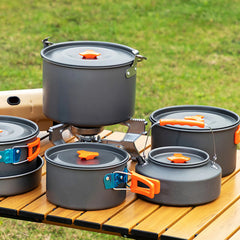
Start by nesting hard goods. Pots go inside bigger pots, the pan sits on top, and a folded dish towel or a sheet of paper towel goes between every metal-on-metal layer. That padding does two jobs: it stops the chipping and scratching, and it silences the clatter that tells you something is grinding itself apart back there.
- Nest cookware with padding between layers. Towels, pot grippers, and oven mitts are packing material you were bringing anyway.
- Load plates on edge, not in a flat stack. A vertical plate flexes with impact; a flat stack concentrates the whole load on the bottom plate.
- Fill every void. Dead space is where movement starts. Stuff gaps with soft goods — dish rags, the tablecloth, bagged sponges.
- Nothing rides loose. Pack against a list like our 47-item camp kitchen checklist so the last five minutes of loading doesn't turn into tossing stray utensils on top of the pile. A loose ladle is a projectile.
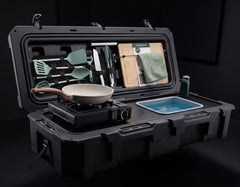
This is also where an all-in-one box earns its keep. The VOZ Camp Kitchen gives each of its 30+ included items a dedicated slot inside a hard weatherproof case, so the stove, cookware, and faucet can't migrate no matter how rough the road gets — and the latches hold the lid shut over washboard instead of letting it walk open.


Liquids: stop spills before they start
Cooking oil is the classic offender. A full glass bottle from the pantry warms up in a hot cargo area, the oil thins and expands, and it finds its way past the cap and onto everything below it. Dish soap and condiments fail the same way. The fix is a routine, not a product:
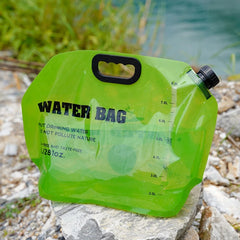
- Decant. Carry only what the trip needs in small, leak-proof squeeze bottles instead of full-size store packaging.
- Leave headroom. Fill bottles to about 80 percent so heat and altitude changes have air to expand into instead of forcing liquid past the threads.
- Wrap the threads. A square of plastic wrap over the bottle mouth before you screw the cap down gives a second seal for nearly zero weight.
- Double-bag and stand upright. Every liquid goes in a zip-top bag, and all the bags ride together in one tall-walled bin or tote. One container to check, one place a leak can end up.
Spices deserve the same treatment in miniature — loose grocery-store shakers with flip lids will dust everything in the box. A dedicated kit like our 12-piece camping spice bottle set keeps seasonings in sealed, uniform bottles that pack as one block.


Fuel travels upright — and never inside the packed box
Propane and butane canisters get their own rules. Industry safety guidance is consistent: cylinders travel upright and secured so they can't tip, roll, or strike other gear, in a ventilated space rather than a sealed hot cabin, and out of direct sun. Don't leave them baking in a closed vehicle at the trailhead, either — heat raises the pressure inside the canister.
Two more points worth taking seriously. First, keep canisters out of the packed kitchen box itself: metal edges plus vibration is exactly how a valve gets dinged. Give fuel its own crate or bin where nothing can contact the valve. Second, never refill single-use cylinders. The National Park Service warns that DOT-39 single-use cylinders are designed for one fill only, and transporting a refilled one can carry penalties of up to a $500,000 fine and five years' imprisonment — details are on the NPS propane safety page. When a canister is empty, recycle it through the campground or your local hazardous-waste program.
Pack the cooler so nothing leaks and food stays safe
A cooler spill is a spill inside your food. USDA guidance for camping is to keep raw meat and poultry sealed and separated — put the original packages inside zip-top freezer bags, squeeze the air out, and load them at the bottom of the cooler so juices can't drip onto produce or ready-to-eat food. Anything that would suffer from sitting in meltwater goes in a watertight container.
Temperature is the other half of transit safety. The FDA's outdoor food-handling guidance sets the danger zone at 40 °F to 140 °F: perishables shouldn't sit in that range for more than 2 hours, or 1 hour when it's above 90 °F outside. Keep the cooler at 40 °F or below, load it last so it spends the least time in a warm vehicle, and put it inside the air-conditioned cabin rather than the trunk on a summer drive.

At parks with active wildlife rules you'll transfer the cooler into a food locker like the one above on arrival — one more reason a cooler with sturdy handles and a leak-free interior pays off. If you run a soft cooler for day trips and a hard cooler for the weekend haul, pack the soft one where it can't be crushed.


Loading the vehicle: heavy, low, and strapped
Order of operations matters as much as padding. Drain the water tank and run the faucet dry before you load — a third of a tank sloshing back and forth is a battering ram working on the tank walls and fittings for the whole drive. Then:
- Box flat on the floor, latch side up. Never on its side; hinges, the faucet, and anything mounted inside were designed to carry load in one orientation.
- Heaviest items lowest and closest to the axle. High weight rocks; low weight rides.
- Strap it to the vehicle, not to other gear. One cam strap over the top to a cargo ring or seat anchor, and a second strap or a bulkhead stopping forward movement under braking.
- Do the shake test. Grab the box and push hard. If the vehicle rocks before the box moves, you're done. If the box moves first, add a strap or fill a void.
Packed this way, arrival is the easy part — an all-in-one box goes from tailgate to cooking in well under a minute, and we've broken that whole sequence down in how to set up a camp kitchen in 30 seconds.
FAQ
Should I drain the camp kitchen water tank before driving?
Yes, every time. Water weighs about 8.34 pounds per gallon, and a partly full tank sloshes with every brake and corner, stressing the tank walls, fittings, and the pump. Drain the tank, run the faucet until it's dry, and refill from a jug at camp.
Can plates and mugs stay inside the box during transport?
If each piece has a dedicated slot or is padded so it can't contact hard surfaces, yes — that's the point of a fitted camp kitchen box. If your dishes ride in an open bin, stack mugs with cloth between them and load plates on edge.
Is it safe to carry a propane canister inside the car?
The safest setup is upright, secured, in a ventilated area, out of direct sun, and removed from the vehicle promptly when you arrive. Never leave canisters in a hot, closed vehicle, and never transport a refilled single-use (DOT-39) cylinder — it's dangerous and illegal.
What's the best way to keep dish soap from leaking?
Decant it into a small squeeze bottle filled to about 80 percent, put plastic wrap under the cap, bag the bottle, and stand it upright in a bin with the rest of your liquids. Any one of those steps catches most failures; together they catch nearly all of them.
- How to Set Up a Camp Kitchen in 30 Seconds
- The Ultimate Camp Kitchen Checklist (47 Items) — Free Printable PDF
- Portable Camp Kitchen: Why Size and Weight Matter More Than You Think
- The Camp Kitchen Pack-Up Routine: Break Camp in 20 Minutes Without Forgetting Anything
- How to Organize a Camp Kitchen Box So You Can Find Everything Fast
Ready to upgrade your camp kitchen?
The VOZ Camp Kitchen includes everything you need in one weatherproof case. Sets up in 15 seconds.
Shop VOZ Camp Kitchen →