
Adding a Sink to a Chuck Box: DIY Pump, Tank, and Drain Retrofit vs. Buying a Kitchen With One Built In

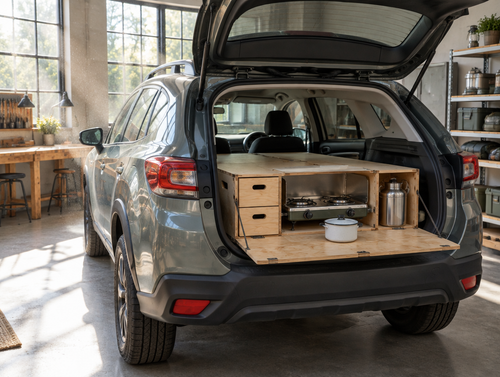
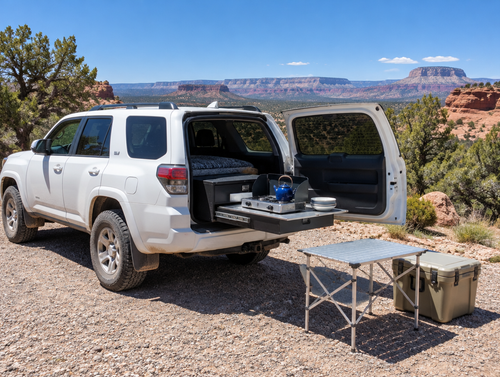
You already own a chuck box, and the one thing it doesn't have is running water. Adding a sink is a very doable weekend project. Before you start drilling, though, it helps to know the full parts list, how much a full tank weighs, where the dirty water goes, and what the finished job really costs next to a kitchen that comes with a sink built in.
This guide is for people who already have a box. If you're still choosing between building one and buying one, start with our DIY plywood chuck box vs. buying a camp kitchen breakdown. Here we only cover the plumbing: pump, tank, faucet, bowl, and drain.
The Retrofit Parts List
Every chuck box sink needs the same five things. A water source, a way to move the water, a faucet, a bowl, and a place for the used water to go. Here's what builders typically use for each, with prices from current US retailer listings:
| Part | Typical choice | Listed price |
|---|---|---|
| Pump | 12V self-priming diaphragm pump, 1.2 GPM at 35 psi (Seaflo 21 Series class) | about $33 to $78 |
| Power | 12V 6Ah LiFePO4 battery (charger extra) | about $80 |
| Faucet | RV single-handle kitchen faucet | about $25 to $100 |
| Sink bowl | 15-inch stainless drop-in bar or RV sink | about $80 to $110 |
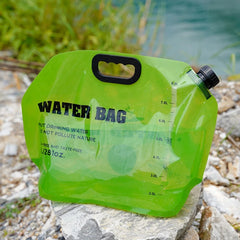
| Fresh water | 7-gallon rigid jug (Reliance Aqua-Tainer) | about $20 |
| Supply line | 3/8" ID food-grade vinyl tubing, 10 ft, NSF/ANSI 51 | about $4 |
| Small parts | Inline fuse, sealed switch, hose clamps, drain fitting, gray-water jug | varies |
Add up the priced rows and you land at roughly $240 to $390 before small parts, a battery charger, and anything you break along the way. That's for parts only. It doesn't include the box, the stove, or your Saturday.
A few details from people who have already done this on teardrop and van forums are worth knowing before you order:
- Pumps with a pressure switch run on demand. The pump kicks on when you open the faucet and shuts off when you close it. At least one experienced builder calls hand and foot pumps a hassle by comparison.
- Fuse the circuit. Run the pump off the battery through an inline fuse sized to what the pump's manual specifies. One Seaflo 1.2 GPM listing rates the draw at 1.7 A, with a 2.7 A maximum. A small 6Ah LiFePO4 pack rated at 1C continuous can deliver about 6 A, so it has headroom.
- Buy a sealed switch. One builder reported a cheap switch corroding after a single week outdoors. Marine-rated parts cost more but survive wet dishes.
- Expect splash. Even a small pump can push hard enough to spray out of a shallow bowl. Some builders end up pinching the supply line or adding a flow restrictor.

Skip the Wiring: Battery-Powered and Foot Pumps
If wiring a 12V circuit into a wooden box sounds like more project than you want, there are two simpler ways to move water.
A rechargeable jug-top pump. These clip onto the top of a water jug and charge over USB. You lose the fixed faucet, but there's nothing to wire, fuse, or mount. For a chuck box, it's the fastest way to get hands-free water over a basin.


A galley foot pump. These come from boat galleys. The Whale Gusher Mk3 galley foot pump is rated at about 4 GPM and lists for roughly $128 to $142 at US marine retailers. It needs no power at all. The trade-off is that the pump has to mount low, at foot level, which doesn't fit a box that sits on a tailgate or a table. We compared this approach in more detail in foot-pump sink station vs. camp kitchen sink.
Full-Tank Weight: The Number That Changes the Design
Water is heavy. The USGS lists it at about 62.4 lb per cubic foot, which works out to roughly 8.3 lb per US gallon. That number decides whether your tank can live inside the box at all.
| Tank size | Water weight (approx.) |
|---|---|
| 2 gallons | 17 lb |
| 5 gallons | 42 lb |
| 7 gallons | 58 lb, plus a 2 to 3 lb empty jug |
A 7-gallon Aqua-Tainer measures about 11.25" x 11" x 15.25", and full it weighs about as much as a fully loaded all-in-one camp kitchen. You can't build it into a box that one person still needs to lift into a truck. That leaves you three realistic layouts:
- Tank outside the box. The jug sits on the ground or tailgate and a supply line runs up to the pump. The box stays liftable, but every setup now involves an extra jug and a hose connection.
- Small tank inside. A 2-gallon bladder or jug lives in the box. That keeps the full water load around 17 lb, but you'll top off more often.
- Tank inside, filled on site. Carry the box empty and fill it at camp. This works, but now you need a separate water jug for the drive anyway.
How much water you actually need per day is its own question. Our camp kitchen water tank size guide runs the gallons-per-day math by group size.
Drain Routing: Where the Dirty Water Goes
This is the part most retrofit plans skip, and it's the part you'll deal with every single meal. A sink bowl is only useful if the water leaving it has somewhere sensible to go.
- Route the drain down and out. Run the drain fitting through the bottom of the box or out the back into a hose that ends in a jug or bucket. Van builders point out that without a black-water tank, a simple drain needs no P-trap. A trap in a portable box is just a place for food scraps to sit and smell.
- Use a sealed gray-water jug, not an open bucket. One forum builder's warning is worth repeating: sooner or later, you'll drive off and forget to dump it. A capped jug at least won't spill all over the cargo area.
- Know the campground rules. The National Park Service sets disposal rules park by park. Shenandoah's Lewis Mountain campground asks campers to strain dishwater and pour it only into restroom utility sinks, never at water spigots. Glacier sends dishwater to utility sinks or RV dump stations and bans washing dishes at campground faucets.
- Away from developed sites, Leave No Trace guidance is to strain out food scraps and scatter dishwater at least 200 feet from camp and water sources.
Plan the drain path before you cut the bowl opening. Moving a drain hole after the fact in a plywood box means patching and resealing.

The Honest Cost: Retrofit vs. a Kitchen With a Sink Built In
Here's how the two paths compare when you price the whole thing, not just the pump.
| Retrofit your chuck box | Kitchen with built-in sink | |
|---|---|---|
| Upfront cost | About $240 to $390 in priced parts, plus small parts and a charger | VOZ Camp Kitchen lists at $1,169 |
| What you get | Running water added to the box you already have | Stove, sink, faucet, tank, cookware, and 30+ items in one case |
| Build time | A weekend or more, depending on wiring and cutouts | None |
| Water tank | Your choice of size, often outside the box | Removable 2-gallon tank inside |
| Weatherproofing | Your job: sealing cutouts, protecting the wiring | Done at the factory |
If you already own a solid box and a stove you like, the retrofit is clearly cheaper. A few hundred dollars and a weekend gets you running water, and you can size the tank however you want. That's a good deal for anyone who enjoys the build.
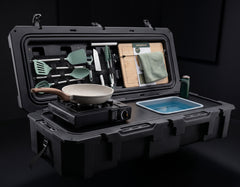
The case for buying gets stronger if your box is due for replacement anyway, or if the stove, cookware, and wash setup are all still on your shopping list. The VOZ Camp Kitchen puts a collapsible sink, a USB-rechargeable faucet, and a removable 2-gallon tank in the same weatherproof case as the stove. It weighs 57 lb fully loaded, so the full water tank is already part of a one-case carry. There's nothing to wire or seal, and nothing to re-plumb when a fitting works loose on a washboard road. For the full list of what's in the box, see everything included in a camp kitchen kit.


There's also a middle option: keep the chuck box for storage and cooking, and add a standalone folding sink with its own electric pump next to it. You skip the cutting and wiring and still get a faucet and drain.


Not sure running water is worth the trouble at all? We weighed that question in built-in camp kitchen sink vs. collapsible sink.
FAQ
Can I put a 12V pump in a wooden chuck box safely?
Yes, if you fuse the circuit at the battery to the rating in the pump's manual, use a sealed switch, and keep the battery and wiring away from the stove and from splash. Secure the battery so it can't slide around in transit.
How big a tank should go inside the box?
For most builds, about 2 gallons. Full, that's around 17 lb of water. A 5-gallon tank adds about 42 lb, which makes most chuck boxes too heavy to lift alone. Bigger supplies are better off in a separate jug feeding the pump.
Do I need a P-trap under a camp sink?
No. Builders note that a trap only matters when there's a sewer or black-water tank to block gases. In a portable box, a straight drain to a capped gray-water jug is simpler and easier to clean.
Where can I dump the gray water?
It depends on where you're camping. Many national park campgrounds send dishwater to restroom utility sinks or dump stations and prohibit washing at spigots. In dispersed camping, strain it and scatter it at least 200 feet from water. Check the posted rules wherever you stay.
- Camp Kitchen Kit: Everything That's Included (and Why It Matters)
- DIY Plywood Chuck Box vs. Buying a Camp Kitchen: Real Cost and Time
- How Big Should a Camp Kitchen Water Tank Be? The Gallons-Per-Day Math
- Where to Dump Camp Kitchen Sink Graywater (Leave No Trace, Done Right)
- Camp Kitchen Faucet or Water Pump Not Working? Troubleshooting Guide
Ready to upgrade your camp kitchen?
The VOZ Camp Kitchen includes everything you need in one weatherproof case. Sets up in 15 seconds.
Shop VOZ Camp Kitchen →