How a USB-Rechargeable Faucet Works on a Camp Kitchen

Press a button at a campsite and clean water runs out of a faucet just like at home — no hand pumping, no holding a jug overhead, no gravity bag hung from a tree. That is the small magic of a USB-rechargeable faucet, and it is one of the features that separates a real camp kitchen from a folding table with a water jug on it. Here is exactly what is happening inside that faucet, what the battery and pump actually do, and what to expect from one in the field.
What a USB-Rechargeable Faucet Actually Is
A USB-rechargeable faucet is not a faucet in the plumbing sense — there is no household water pressure behind it. It is really three parts working together: a small electric pump, a rechargeable battery, and a flexible spout. The pump sits down in your water tank or jug; the battery and a one-touch switch live in the faucet head or a small base; and a food-grade silicone hose carries the water up to the spout. Push the button, the pump runs, water flows. Let go (or wait for the auto shutoff), and it stops.
That is the whole reason these systems exist on portable setups. Your camp kitchen carries its own water — usually a removable tank in the 2-gallon range — and the pump is what turns that stored water into running water on demand. Without the electric pump you are back to a manual foot or hand pump, or a gravity feed that needs the tank mounted higher than the tap.

How the Pump Moves Water
The heart of the system is a tiny 5- to 12-volt electric pump. When you press the switch, current from the battery spins a small motor. Depending on the design, that motor either turns an impeller (a little finned rotor that flings water outward) or flexes a diaphragm (a membrane that pulses in and out). Either way, the motion creates a low-pressure zone on the inlet side that pulls water in, and a high-pressure zone on the outlet side that pushes it up the hose and out the spout. No movement, no flow — which is why the faucet only runs while the motor is powered.
The pump type matters more than it sounds. Diaphragm pumps are positive-displacement: they give a steady, consistent stream and, importantly, they can run dry without damaging themselves — useful at a campsite where you might pump the tank empty without noticing. Impeller-style pumps run dry far less gracefully; spin one with no water for even a minute and you risk burning it out. That single trait is a big reason quality portable systems lean on the run-dry-tolerant style.
Most camp faucets are submersible — the pump body actually sits in the water rather than beside it. That keeps the motor quiet, self-priming (no need to manually fill the line before it works), and simple: drop it in the tank, screw the lid down, and it is ready.
The Battery and USB Charging
This is the part the name is built around. Inside is a small lithium battery — commonly around 1,200 mAh on compact units — that you top up through a USB port, the same way you charge a phone. Many newer pumps use USB-C; older ones use micro-USB or USB-A. Either way, you can charge from a wall adapter, a car USB port, or a power bank, which is the whole point for people who are off-grid for days.
Real-world numbers vary by model, but the ballpark for compact portable pumps looks like this:
| Spec | Typical range (compact portable pumps) |
|---|---|
| Flow rate | ~1–2 quarts per minute (about 1–2 liters) |
| Battery | Small lithium cell, often ~1,200 mAh |
| Charge time | ~2–4 hours from a 5V/2A USB source |
| Water per charge | Often 20–30+ gallons of dispensing |
| Charge port | USB-C (newer) or micro-USB / USB-A |
For perspective on the high and low ends: a slim drinking-water pump like the Dometic GO is rated to move about 1 liter a minute and roughly 150 liters per charge, while a heavy 12-volt sink system like Trail Kitchens' Water Boy pushes around 3.5 gallons per minute off a 9 Ah battery. Camp kitchen faucets sit toward the gentle, efficient end of that spread — you want enough flow to rinse a pan and wash hands, not a pressure washer. That efficiency is why a single charge can stretch across multiple weekend trips before you think about it again.
One practical habit: don't let the battery sit dead for months. Lithium cells dislike being fully discharged for long stretches, so topping the faucet off every few months — even when it is parked in the garage — keeps it ready and protects the cell.
Why It Beats a Manual or Gravity Faucet
The honest comparison is against the two older ways of getting water at a camp sink:
- Manual pump (foot or hand): reliable and battery-free, but it ties up a hand or foot and gives you an uneven, surging stream. Hard to rinse a plate and scrub it at the same time.
- Gravity feed: dead simple, but only works when the tank is mounted above the spout, and the flow fades as the tank empties. Awkward inside a closed camp kitchen case.
- USB-rechargeable electric: one-touch, hands-free, steady pressure from full tank to nearly empty, and it packs flat because the pump is small. The trade-off is that you have a battery to keep charged.
For most car campers and overlanders, the convenience wins easily — especially when the whole reason you bought a kit with a basin was to make cleanup feel normal. We dug into why running water changes the outdoor-cooking experience in our piece on a camp kitchen with a sink, and the electric faucet is the part that makes that sink genuinely usable instead of a glorified bowl.

How It Fits Into the VOZ Camp Kitchen
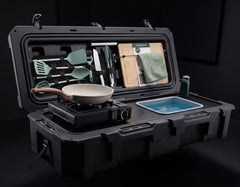
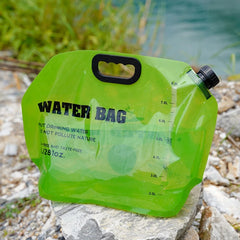
On the VOZ Camp Kitchen, the faucet is built around a USB-rechargeable pump that draws from a removable 2-gallon water bag, feeding a collapsible sink that folds flat inside the case. Lift the tank out to refill it at a campground spigot, drop it back in, press the button, and you have running water at the basin — all from a box that closes up and rides in your trunk. Because the pump is rechargeable rather than disposable-battery powered, you get multiple trips per charge, and the only maintenance note worth remembering is to top the battery up every three to six months even in storage.


The same faucet-and-pump idea also shows up as a standalone accessory you can add to a jug or cooler if you are building a setup piece by piece — a USB-rechargeable dispenser pump threads onto a standard water bottle and gives you the same one-touch flow without the full kitchen. It is the same mechanism in a smaller package.


If you want the whole picture of what comes in a complete box — sink, faucet, stove, tank, and the rest — our camp kitchen kit breakdown walks through every included part and why it is there.
FAQ
Is the water from a USB-rechargeable faucet pressurized like at home?
No. There is no line pressure — the pump creates a gentle, steady flow only while the motor runs. It is plenty for rinsing food, washing dishes, and cleaning hands, but it is not a high-pressure spray.
How long does one charge last?
It depends on the model, but compact pumps commonly dispense well over 20 gallons per charge, which for most campers means several weekend trips before a recharge. Flow can taper slightly as the battery drains.
Can I charge it from my car or a power bank?
Yes. That is the advantage of USB charging — any wall adapter, 12-volt car USB port, or portable power bank works. A 5V/2A source typically refills a small pump in a couple of hours.
What happens if I run the tank dry?
With a run-dry-tolerant pump (common on quality camp systems), nothing bad — it just stops moving water until you refill. It is still good practice not to leave it running empty for long stretches.
Does cold weather affect it?
Lithium batteries lose some capacity in the cold, so expect slightly shorter runtime on freezing mornings. Never leave water in the pump or lines below freezing, since trapped ice can crack components.
Ready to upgrade your camp kitchen?
The VOZ Camp Kitchen includes everything you need in one weatherproof case. Sets up in 15 seconds.
Shop VOZ Camp Kitchen →