How to Secure a Camp Kitchen for Transport: No Sliding, No Rattling on Washboard Roads

You can hear an unsecured camp kitchen before you see the damage: a 57-pound box sliding into the wheel well on the first hard corner, then two hours of silverware buzzing over every corrugation on the forest road. Both problems are fixable in about five minutes with two cam straps, a bit of foam, and the right anchor points — here's exactly how to do it.
Why a loose camp kitchen is more than an annoyance
A camp kitchen box is one of the heaviest single items most car campers carry. Loaded, a full-size box like the VOZ Camp Kitchen weighs about 57 pounds — and physics doesn't care that it's full of pots instead of bricks. Federal cargo securement rules for commercial trucks are built around a hard-braking benchmark of 0.8 g of forward deceleration, per the FMCSA cargo securement standard. Apply that to a 57-pound box and you're asking your straps — or the back of your front seats — to absorb roughly 46 pounds of forward force in a single panic stop. Unrestrained, the box becomes a projectile inside the cabin or, in an open bed, leaves the vehicle entirely.
That second scenario is a documented killer. The AAA Foundation for Traffic Safety found that road debris played a role in more than 200,000 crashes over a four-year study period, causing roughly 39,000 injuries and more than 500 deaths — and about two-thirds of debris crashes trace back to improperly secured loads or poor vehicle maintenance. Nearly 37 percent of the deaths came from drivers swerving to avoid an object. A chuck box bouncing out of a pickup bed on the interstate is precisely this kind of event. Strapping it down isn't fussy overpacking; it's the difference between cargo and debris.


Start with the anchor points, not the straps
A strap is only as strong as what it's hooked to — securement pros call this the weakest-link rule, and it's written into the federal standard: the rating of the whole system is the rating of its lowest-rated component. So before you buy straps, walk around your vehicle and find the hard points:
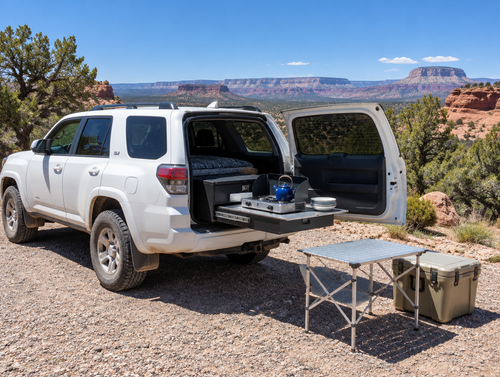
- Truck beds: Factory tie-down cleats or D-rings sit in the four corners of most modern beds; many trucks add adjustable rail cleats. Use them — not the plastic bed liner lip. If you cook off the tailgate, our guide to camp kitchen setups for a truck bed covers where the box should live between the wheel wells.
- SUVs and wagons: Look for the four metal cargo-area anchors recessed into the floor or side walls behind the rear seats. They're rated for exactly this job.
- Vans and trailers: E-track rails or bolted D-ring plates give you anchor points anywhere along the wall. A bulkhead behind the cab is even better — cargo pushed tight against a solid barrier can't build momentum in a stop.
- No anchors at all? Wedge the box tight against a seat back or bulkhead and fill the gaps — a box that has nowhere to go can't slide. But add anchors when you can; adhesive solutions and bungees are not substitutes.
Position matters as much as hardware. Put the box low, tight against the bulkhead or seat backs, with its long side across the direction of travel. For a full walkthrough of where a kitchen box rides best in each vehicle type, see our vehicle-by-vehicle camp kitchen guide.

Cam straps vs. ratchet straps: which one your box actually needs
The two common tie-downs work differently, and the difference matters for a plastic-cased kitchen box:
| Cam buckle strap | Ratchet strap | |
|---|---|---|
| Tension | Hand-pulled; spring-loaded cam bites the webbing | Geared spool multiplies force far beyond hand strength |
| Typical 1-inch rating | ~1,500 lb break strength, ~500 lb working load limit | Substantially higher — sized for heavy freight, ratings vary by width |
| Overtightening risk | Low — you can't crank past hand tension | High — can crack a plastic case or crush a lid seal |
| Best for | Gear boxes, coolers, water jugs | Vehicles, machinery, lumber |
For a camp kitchen, cam straps win. A working load limit is the load a strap is rated to carry in normal use — typically one-third of its breaking strength — and the federal benchmark says your combined tie-down rating should equal at least half the cargo's weight. For a 57-pound box that's about 29 pounds of required working load limit; a single quality 1-inch cam strap clears that bar seventeen times over. You genuinely don't need ratchet power, and the geared mechanism makes it easy to crank hundreds of pounds of tension into a polyethylene case — enough to bow a lid, stress the latches, or deform the seal that keeps rain out. Two 9- to 12-foot cam straps are the right tool: cheap, fast, and impossible to overtighten by hand.
The two-strap tie-down that stops sliding
Here's the whole routine — it takes about five minutes the first time and under two once the straps live in the vehicle:
- 1. Butt the box against something solid. Bulkhead, seat backs, or the front wall of the bed. Contact on one side means the straps only have to fight movement in the other directions.
- 2. Run the first strap over the top, anchor to anchor, across the box's midsection. Pull it snug by hand. An over-the-top strap pressing the box into the floor counts its full rating, and friction does the rest of the work.
- 3. Run the second strap to block the remaining direction of travel — usually rearward, across the face of the box, so acceleration and hills can't walk it backward. Two straps also mean one failure doesn't free the load.
- 4. Check the latches. Snap every case latch fully closed so the lid can't chatter open. Positive-locking latches are exactly what keeps a chuck box shut on rough roads.
- 5. Re-tension after the first ten minutes of driving. Loads settle, webbing seats into buckles, and a strap that was tight in the driveway is loose on the highway. Commercial drivers are required to re-check their securement early in a trip for this reason — steal the habit.
Skip bungee cords entirely. They stretch under exactly the loads you're trying to stop, most carry no published working load rating, and a stretched bungee stores energy that releases at your face when a hook slips.
Killing the rattle on washboard roads
Straps stop the box from moving; they don't stop the 30 things inside it from moving. Washboard is the worst case: those corrugations form on dry gravel roads at any traffic speed above roughly 5 mph, with ripples spaced about 4 to 12 inches apart — which at driving speed means your gear absorbs many small impacts every second, continuously, for miles.

The fix is eliminating every metal-on-metal and hard-on-hard contact point:
- Foam and silicone between the noisy layers. A silicone baking mat or a layer of closed-cell foam between nested pots kills the loudest rattle in the box. Foam liner in utensil trays does the same for silverware.
- Wrap what clanks. Roll metal utensils in a dish towel or slide them into a padded pouch. Bag loose pot lids so they can't chatter against pot rims.
- Nest and fill. A tightly packed compartment can't rattle; a half-empty one is a maraca. Stuff gaps with the soft goods you're bringing anyway — towels, paper towel rolls, oven mitts.
- Drain the water system. Water weighs about 8.3 pounds per gallon per the U.S. Geological Survey, so a full 2-gallon tank is roughly 17 pounds of sloshing mass hammering its mounts on every corrugation. Travel with the tank empty or removed and fill at camp.
- Soft-side the perimeter. Packing soft storage bags around the box does double duty: they cushion the case, and the friction keeps everything planted.


Interior packing is its own science — what goes where, what breaks first, and how to spot trouble before it happens. We covered it in depth in how to pack a camp kitchen so nothing breaks or spills.
FAQ
Can I just set the box on a rubber mat and skip the straps?
A rubber bed mat or non-slip liner is a great friction layer and worth using, but friction alone disappears the moment the box starts bouncing on washboard — a box in the air has zero grip. Use the mat and two cam straps, not one or the other.
Do I need to secure the box inside an SUV, or only in an open bed?
Inside matters more, not less. In an open bed a loose box becomes road debris; inside the cabin it becomes a 57-pound object moving toward the seat backs in a hard stop. Use the cargo-area anchors, and keep the box low and tight against the second row.
What size straps should I buy?
Two 1-inch cam buckle straps, 9 to 12 feet long, cover almost every vehicle. Quality 1-inch cam straps typically carry around a 1,500-pound break strength and a 500-pound working load limit — vastly more than a camp kitchen box requires, with the margin you want for shock loads on rough roads.
Should the box travel full or empty?
Full of gear, yes — a tightly packed box rattles less than an empty one, and the cookware is what the box is for. But drain the water tank, empty the graywater, and make sure fuel canisters are capped and wedged so they can't roll.
Does the lid need its own strap?
No — if the case latches are fully engaged, the lid is part of the box. What you should do is check the latches every time you strap down, because an over-the-top strap can hold a partially latched lid almost closed until washboard vibration works it free.
Ready to upgrade your camp kitchen?
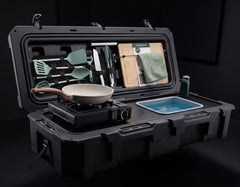
The VOZ Camp Kitchen includes everything you need in one weatherproof case. Sets up in 15 seconds.
Shop VOZ Camp Kitchen →