Camp Kitchen for UTV and Side-by-Side Camping: What Fits and How to Strap It Down

A side-by-side will carry you farther past the trailhead than almost anything on four wheels — and then give you less room to cook out of than a sedan trunk. UTV camping is a cargo puzzle: small beds, hard payload limits, and trail vibration that punishes anything packed loose. Here's what a full camp kitchen box actually fits in, what it weighs against your bed rating, and how to strap it down so it's still latched when you reach camp.
Why UTV Cargo Is a Different Problem
A pickup gives you a 60-plus-inch bed, a suspension tuned for pavement, and a cab between your gear and the dust. A UTV gives you none of that. Three things change the packing math the moment your kitchen rides in a side-by-side:
- The bed is a fraction of truck size. Sport machines carry a parcel shelf, not a bed. Even full-size utility machines top out around 38 inches of bed depth.
- Vibration is constant and violent. Washboard, whoops, and rock gardens at trail speed shake cargo far harder than any highway. Loose bins slide, chafe, and eventually eject.
- Everything rides exposed. Open beds take dust, mud spray, and rain the whole ride. Cardboard boxes and soft totes don't survive a weekend of it.
That combination is exactly why the one-case approach works here: a sealed, hard-sided kitchen box with everything captive inside is the difference between unpacking dinner and picking utensils out of the mud.

What Fits Where: UTV Bed Dimensions vs. a Camp Kitchen Box
Bed sizes vary enormously between sport and utility machines, so start with the published numbers. Here are representative specs from current full-size models:
| Machine | Type | Bed (L x W x H) | Bed rating |
|---|---|---|---|
| Polaris RZR XP 1000 | Sport | 28 x 22 x 7 in | 300 lb |
| Polaris Ranger Crew XP 1000 | Utility | 36.75 x 54.25 x 12.5 in | 1,000 lb |
| Can-Am Defender HD10 | Utility | 38 x 54.5 x 12 in | 1,000 lb |
| Honda Pioneer 1000 | Utility/rec | Full-size dump bed | 1,000 lb (600 lb CA models) |
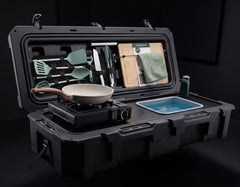
Now the box. The VOZ Camp Kitchen closes to 47.6 x 19.3 x 11.4 inches and weighs about 57 lb loaded with its 30-plus included items. Lay it crosswise in a Ranger or Defender bed and the 47.6-inch case spans the 54-plus-inch bed width with several inches to spare, sits at or below the top of the 12-inch bed walls, and uses under 6 percent of a 1,000-lb bed rating. That low, wide, hard-shelled footprint is close to ideal UTV cargo: it doesn't raise your center of gravity the way a stacked cooler tower does, and the weatherproof case shrugs off the dust bath. For the full rundown of how the same box rides in pickups, vans, and trailers, see our vehicle camp kitchen guide.


Sport machines are the hard no. A RZR-class bed at 28 x 22 inches simply cannot take a 47.6-inch case in any orientation, and aftermarket overbed racks trade wind exposure and height for that space. If you ride a sport UTV, skip ahead to the base-camp section — that's the setup that actually works.
The Weight Math: What Your Bed Rating Really Leaves You
A 1,000-lb bed rating sounds like infinite headroom for a 57-lb kitchen. It isn't, once you add the rest of a real camp load: a loaded 50-quart cooler, a spare fuel can, recovery gear, firewood, a canopy, duffels. Sport-machine math is tighter still — at a 300-lb rating, a cooler and two full jerry cans can eat half the budget before food comes aboard.
Water is the line item campers underestimate. Water weighs about 8.34 lb per gallon, per the U.S. Geological Survey, so a filled 5-gallon container is roughly 42 lb of shifting weight. Two habits keep it manageable:
- Haul the kitchen's tank empty. The VOZ's removable 2-gallon tank adds nearly 17 lb full — fill it at camp, not at the trailhead, and it can't slosh on the ride in.
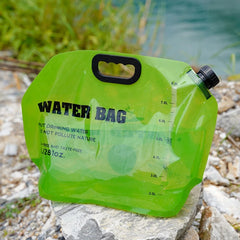
- Carry bulk water low and forward. Collapsible jugs and soft water containers pack flat on the drive out and sit low against the bed bulkhead on the ride in, keeping the sloshing mass ahead of the axle instead of hanging off the tailgate.


Whatever the load, put the heaviest items against the front bed wall and keep the stack below the cage line. High, rearward weight is what makes a machine feel loose in whoops.
How to Strap It Down So It Survives Washboard
There's a useful benchmark here from the commercial trucking world: federal cargo securement rules require the combined working load limit of your tie-downs to be at least half the weight of the cargo (49 CFR 393.106). For a 57-lb kitchen box that's a trivial 29 lb of aggregate strap rating — a single 1-inch cam strap clears it many times over. On a UTV, though, the enemy isn't strap strength. It's vibration walking the load and the hardware loose. Rig it like this:

- Use two straps, not one. Run them parallel over the case, one near each end, anchored to the bed's tie-down points on both sides — or cross them in an X over the lid for extra side-to-side control. Two straps means one chafing through on a rock shelf doesn't send your kitchen overboard.
- Latches up, handles out. Orient the case so the three lid latches face up and nothing can lever them open. You also want to be able to pop the lid at a lunch stop without unstrapping the whole rig.
- Put rubber under it. A cheap rubber bed mat or even a section of anti-fatigue mat under the case kills the micro-sliding that abrades both the case bottom and the bed floor on washboard.
- Snug, not crushing. Cam-buckle straps are plenty for this weight and can't over-crank the way ratchets can. If you use ratchets, stop at snug — the case is built to take it, but over-tension just preloads the straps to go slack when the plastic flexes cold.
- Recheck at ten minutes. Every load settles in the first mile of rough trail. Stop once, re-tension, and it'll hold all day.
Skip bungee cords as the primary attachment. They're fine as a backup over a strapped load, but their stretch is exactly what trail vibration exploits.
Riding 50-Inch Trails? Let the Kitchen Hold Base Camp
A lot of the best technical trail systems are legally closed to full-size machines: many National Forest OHV trails are designated for vehicles 50 inches or less in width, which is why 50-inch sport machines exist at all. If that's your riding, the kitchen was never going to come along — and it doesn't need to.
The pattern that works is the same one moto campers use, scaled up: haul camp to a staging area, then day-ride light. Your truck or trailer carries the kitchen box to base camp, it sets up once — under 15 seconds, three latches — and it feeds the whole crew every morning and evening while the machines run the loops unloaded. We covered the two-wheel version of this logic in our moto-camping camp kitchen guide, and the same thinking applies to a Jeep Wrangler trail setup: the kitchen serves the camp, not the ride.
If your utility machine tows, a small trail-rated utility trailer is the third option — Honda rates the Pioneer 1000 to tow 2,500 lb, which swallows an entire camp including the kitchen, canopy, and water without touching bed space.

FAQ
Will a full camp kitchen box fit in a sport UTV like a RZR?
No. A RZR XP 1000 bed measures 28 x 22 x 7 inches and the VOZ Camp Kitchen closes to 47.6 inches long — it doesn't fit in any orientation. Sport-machine campers should stage the kitchen at base camp or haul it in the truck that trailers the UTV.
Should the water tank be full while riding?
No. At 8.34 lb per gallon, the 2-gallon tank adds nearly 17 lb of sloshing weight that works against your straps on rough trail. Ride with the tank empty and fill it from your bulk water at camp.
How many straps does a 57-lb box need?
Two. By the federal cargo securement benchmark you only need about 29 lb of combined strap working load limit, which one cam strap exceeds — but the second strap is redundancy against chafe and vibration, and it stops the case from pivoting on washboard.
Will trail vibration rattle everything inside apart?
This is where a molded case earns its keep: the VOZ's 30-plus items ride in fixed positions inside the case rather than loose in a bin, and the lid closes on three latches. Gear that can't move can't rattle loose. Still check the latches when you re-tension your straps.
Can it ride exposed in dust and rain?
Yes — the case is a weatherproof, dustproof food-grade LLDPE shell, which is exactly what an open UTV bed demands. Give the lid seam a quick wipe before opening so trail dust doesn't fall into your prep surface.
Ready to upgrade your camp kitchen?
The VOZ Camp Kitchen includes everything you need in one weatherproof case. Sets up in 15 seconds.
Shop VOZ Camp Kitchen →