How Much Does a Camp Kitchen Weigh? Real Numbers for a One-Person Carry

Ask a spec sheet how much a camp kitchen weighs and you'll get the empty number — usually somewhere between 19 and 32 pounds for popular models. Ask your lower back and you'll get a different answer: what matters is the loaded weight, and whether one person can move it from the tailgate to the picnic table in a single trip.
The Short Answer: What Camp Kitchens Actually Weigh
Camp kitchens span roughly 6 to 60 pounds depending on the style. Outdoor Life's 2026 camp kitchen roundup treats weight as a primary comparison spec, and the spread in that guide runs from a 6-pound fold-flat stand to hard-sided boxes past 30 pounds before you load a single spatula. Here's how the categories break down:
| Type | Typical weight | What that number includes |
|---|---|---|
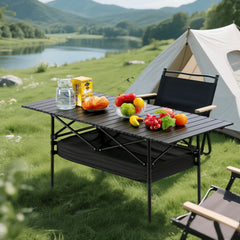
| Folding stand kitchen | 19–24 lb | Frame, shelves, and counter only — no stove, no cookware, no water |
| Hard-sided kitchen box | 25–32 lb empty | The box itself; your gear adds 20–30 lb on top |
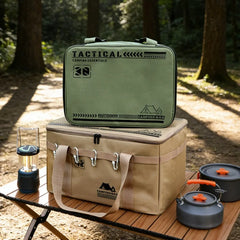
| All-in-one loaded kitchen | ~57 lb packed | Case plus stove, sink, faucet, water tank, and 30+ cooking items — everything |
| DIY plywood chuck box | ~32–48 lb empty, 50+ lb loaded | Depends on plywood thickness; big builds go well past that |
A few real numbers to anchor those ranges: the Coleman Pack-Away Deluxe folds into a 24.2-pound carry package, and the GCI Outdoor Slim-Fold Cook Station comes in at 18.9 pounds. On the box side, the Chuk Kitchen Box weighs 32 pounds empty and Trail Kitchens' Compact model runs 25 pounds. A homebuilt chuck box cut from half-inch plywood commonly lands around 32 pounds before you put anything in it and clears 50 once loaded.
Empty Weight vs. Loaded Weight: Compare the Right Number
Those stand-style kitchens look light on paper for one reason: nothing rides inside them. The frame is 19 to 24 pounds, but your stove, pots, plates, utensils, and wash bins all travel in separate containers. You're not carrying 24 pounds — you're carrying 24 pounds, then going back for two bins and a stove. The total load across all those trips usually beats a loaded kitchen box; it's just spread out.
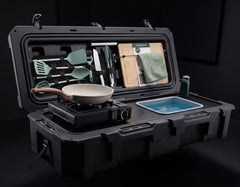
An all-in-one case flips that math. The VOZ setup weighs about 57 pounds fully packed, but that figure includes the built-in stove, collapsible sink, USB-rechargeable faucet, 2-gallon water tank, and the 30-plus cooking items stored inside — the full manifest is in our what's-included breakdown. One heavier carry replaces three or four lighter ones, and nothing gets forgotten on the garage shelf.
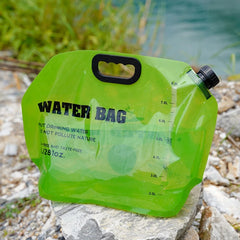
Water deserves its own line item. Water weighs about 8.34 pounds per gallon, per the U.S. Geological Survey, so a full 2-gallon tank adds nearly 17 pounds by itself. The single easiest weight cut on any camp kitchen: travel with the tank empty and fill it at the campground spigot.
The 51-Pound Rule: What One Person Can Safely Carry
There's a useful benchmark for "can I carry this alone?" The NIOSH lifting equation — the standard ergonomists use to evaluate manual lifting — starts from a maximum recommended load of 51 pounds under ideal conditions, per OSHA's guidance on safe lifting. Ideal means the load sits close to your body, at about waist height, with a solid grip and no twisting. Every step away from ideal — reaching over a tailgate, turning while holding the load, awkward handles — pushes the safe number down.
Translated to camp kitchens: a 57-pound loaded box is a real one-person carry, but a deliberate one. Empty the water tank and you're down around 40 pounds, comfortably inside the benchmark. The VOZ Camp Kitchen helps its own cause with its shape — it packs into a long, flat 47.6 by 19.3 by 11.4 inch case rather than a tall cube, so it carries at your side like an oversized suitcase instead of out in front of your chest, keeping the load close to your body where the lifting math works in your favor.


Form matters as much as poundage. A side carry with your arm straight beats a front carry with bent elbows; switching sides halfway saves your grip; and two short carries with a rest beat one long stagger. If you're moving a fully loaded box more than 50 feet or so, take the break.
Getting It Into a Truck Bed, SUV, or Trunk

The carry across camp is the easy half. The lift into a vehicle is where people tweak something, because a tailgate or trunk lift adds height and reach to the equation. A few field-tested habits:
- Slide, don't press. Rest one edge of the case on the tailgate or bumper, then pivot and push it in. You lift half the weight for half the motion instead of pressing the whole box over the lip.
- Load it light, pack it in place. For a trunk with a tall liftover, put the empty-ish case in first and load the heavy items — cast iron, fuel canisters, canned goods — once it's sitting in the vehicle.
- Heavy side toward the car. If the load inside sits off-center, keep the dense end closest to the vehicle so the pivot does the work.
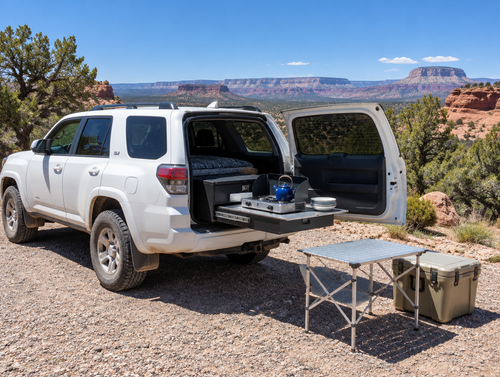
- Park like it's furniture. Back the vehicle as close to the cook site as the campground allows. Twenty fewer feet of carry matters more than any handle design.
- Call the second person when tired. End-of-trip lifts, done cold in the morning with a box that gained water weight overnight, are when solo pride gets expensive.
Five Ways to Make Any Camp Kitchen Easier to Carry
Whatever box or stand you own, these cuts and habits shrink the effort:
- Travel with the water tank empty. That's an instant 17-pound cut on a 2-gallon system, and campground water is usually a short walk away.
- Pack dense items low and centered. A box with cast iron at one end swings like a pendulum; the same weight centered over your grip carries clean.
- Split the perishables out. Food and drinks belong in a cooler bag, not the kitchen box — they're the weight that varies trip to trip, and a second person can carry them.
- Use a folding wagon for long hauls. Walk-in sites with 100+ yard carries are wagon territory. Wheels turn a two-person job into a one-person stroll.
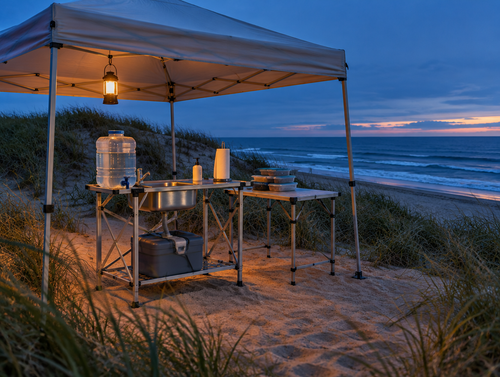
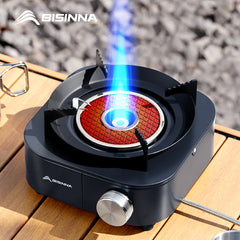
- Go lighter on purpose. If every ounce matters — small car, walk-in sites, solo trips — a split setup built around a roll-up aluminum table and a compact cassette stove spreads the same kitchen across two easy carries instead of one heavy one.


FAQ
How much does a fully loaded camp kitchen weigh?
Plan on 50 to 60 pounds for an all-in-one case with the stove, sink, cookware, and a full water tank inside. Stand-style kitchens weigh 19 to 24 pounds bare, but the gear that fills them adds another 20 to 30 pounds carried separately.
Can one person carry a camp kitchen box alone?
Yes, if you manage the water. NIOSH's benchmark for a safe lift under good conditions is 51 pounds, and most loaded kitchen boxes sit near or just over that line with a full tank. Empty the tank, keep the load at your side, and a healthy adult can handle the carry from vehicle to table without help.
Does a heavier camp kitchen mean a better one?
Heavier usually means more included — a stove, sink, tank, and full cookware set have real mass. Judge weight against what rides inside, not against an empty frame. A 57-pound box that replaces four separate bins is lighter in practice than a 19-pound stand plus everything it doesn't hold.
What adds the most weight to a camp kitchen?
Water, by a wide margin — about 8.34 pounds per gallon. After that: cast-iron cookware, glass containers, and canned food. All three are things you can pull out and carry separately when the full box feels like too much.
Ready to upgrade your camp kitchen?
The VOZ Camp Kitchen includes everything you need in one weatherproof case. Sets up in 15 seconds.
Shop VOZ Camp Kitchen →