Cooking With a Camp Kitchen in Rain and Wind: How to Weatherproof Your Setup

A forecast full of rain doesn't have to cancel dinner. With a tarp rigged the right way, a little wind sense, and a kitchen that closes up tight between meals, you can turn out hot food in weather that sends everyone else to the drive-through. Here's how to set up a camp kitchen that keeps working when the sky doesn't cooperate.
Wind Is the Bigger Problem — Here's Why
Most campers plan for rain and get ambushed by wind. Rain is mostly a comfort problem: you and your ingredients get wet. Wind is a performance problem: it strips heat off your pot and burner faster than the stove can replace it. Stove maker MSR has published test data showing that for open-burner stoves, even a 5 mph breeze can force up to three times more fuel use for the same cooking job. That's a barely-noticeable wind — at 5 mph, leaves are just starting to rustle.
The National Weather Service's Beaufort wind scale gives you a field gauge you can read off the trees. If leaves and small twigs are in constant motion, you're at roughly 8–12 mph — expect longer boil times and plan a windbreak. If small branches are moving, that's 13–18 mph, and an unprotected open flame will struggle. When larger branches and small trees start swaying (19–24 mph), it's time for serious wind protection or a different dinner plan.
So flip the usual priority: block the wind first, then handle the rain. A cook station that's dry but sitting in a wind tunnel still won't boil water.
Read the Site Before You Unpack
Weatherproofing starts with where you put the kitchen, not what you buy. Before you set anything down in bad weather, spend two minutes on the site:
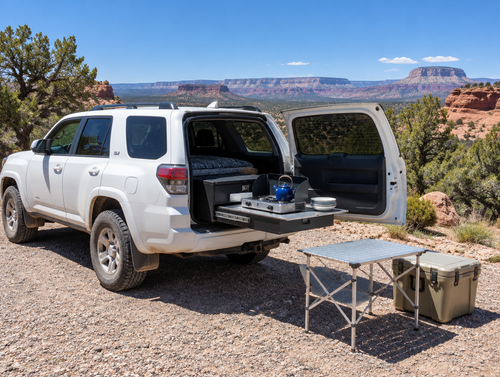
- Find the prevailing wind. Face into it, note the direction, and put something solid on that side — your vehicle, a boulder, a dense treeline. A parked SUV or truck makes an excellent windbreak for a tailgate kitchen.
- Pick a slight rise, not a dip. Low spots collect water. A gentle high point drains around you instead of under you.
- Orient the box with its back to the wind. The case itself becomes a partial windbreak, and the open lid shelters your prep area instead of catching gusts like a sail.
- Keep the cook zone clear of tent doors and traffic. In rain, people rush between shelters — you don't want them rushing past a lit burner.
If you want a deeper dive on choosing the spot itself, we've covered where to set up a camp kitchen at your campsite in detail.
Rig a Tarp Over the Cook Station

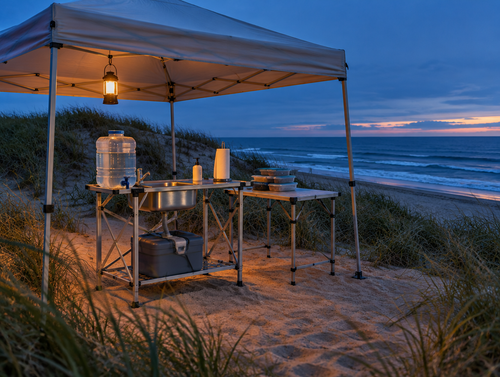
A tarp over the kitchen is the single biggest upgrade for rainy-trip cooking. The guidance below follows what tarp manufacturers recommend for camp kitchen canopies:
- Go 10x10 feet or larger. Smaller tarps leave your work area exposed the moment rain comes in at an angle.
- Pitch it with a slope. Stake one edge higher than the other so water runs off away from the cooking area — never let it pool overhead or drip onto the stove side.
- Run guylines out at about 45 degrees and drive stakes deep. Long anchor lines staked far from the tarp resist gusts far better than short, steep ones.
- Add drip lines. A simple knot or carabiner on each guyline redirects water running down the line so it drops before reaching your dry zone.
- Pitch lower in wind. A low, sloped canopy is more stable in gusts, and bringing the windward edge closer to the ground blocks sideways rain.
- Keep flame away from the fabric. Put the stove on a stable table or box near the tarp's open, downwind edge — never up against a tarp wall, and never with the burner directly under low fabric. Leave generous headroom and open sides for ventilation.
Let the Box Itself Do the Weatherproofing
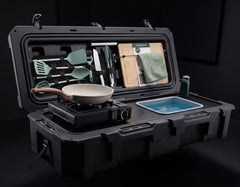
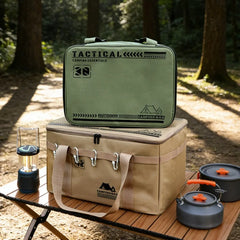
This is where a box-style kitchen quietly beats a table-and-bins setup in bad weather. Between meals, everything — stove, cookware, utensils, dry goods — lives inside a closed, weatherproof case instead of sitting out under the sky. When a squall rolls through, you shut the lid and walk away. Nothing blows off a table, and nothing needs toweling off before the next meal.
The VOZ Camp Kitchen was built around exactly this idea: a weatherproof case with a built-in stove, sink, USB-rechargeable faucet, and water tank, holding 30+ cooking items that stay dry no matter what's falling. Because the whole kitchen sets up in seconds, you can wait out a cell of heavy rain and still have dinner going minutes after it passes — no rebuilding a scattered setup.


The open lid earns its keep in wind, too. Angled toward the gusts, it acts as a standing windbreak for the burner and shelters your cutting board from spray. We've written a full guide to using the lid as a prep surface — in foul weather it doubles as your weather shield.
Wind Management at the Burner

Even under a tarp, moving air reaches the flame. A few burner-level habits make the difference between a 10-minute boil and a 30-minute one:
- Use a three-sided windscreen on the upwind side of the stove — not wrapped all the way around. The flame still needs airflow to burn cleanly.
- Never fully enclose a canister stove. A windscreen that traps heat around the fuel canister can overheat it, and an overheated canister can explode. Screen the burner, not the fuel.
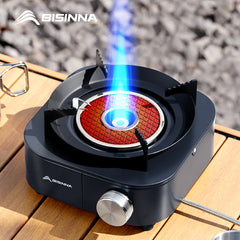
- Pick a stove with built-in wind protection. A two-burner propane stove with a lid and fold-out side panels — like our 17,000 BTU 2-burner camp stove with windshield — carries its own three-sided screen everywhere it goes.
- Cook with lids on and pots matched to the burner. A covered pot loses far less heat to gusts, and a wider pot shields more of the flame.


The One Hard Rule: Never Cook Inside the Tent
When rain gets miserable, the temptation is to pull the stove into the tent vestibule, a camper, or the back of the SUV. Don't. Burning any fuel produces carbon monoxide — an invisible, odorless gas — and in an enclosed space it accumulates fast. The U.S. Consumer Product Safety Commission warns against using portable fuel-burning camping equipment inside a tent, camper, or vehicle, and reports that since 2020 at least 12 people have died from carbon monoxide poisoning associated with camping equipment such as grills, lanterns, and stoves.
A tarp with open sides is the rain shelter that keeps airflow moving. If you feel a headache, dizziness, weakness, or nausea while cooking under cover, shut the stove off and get into open air immediately — those are early carbon monoxide symptoms.
FAQ
Can I cook under a pop-up canopy in the rain?
Yes, with the same rules as a tarp: keep at least two sides fully open for ventilation, keep the burner away from the canopy walls and well below the fabric, and angle or tilt the roof so water sheds away from the cooking side. A canopy with all four walls zipped on becomes an enclosed space — treat it like a tent and keep the stove out.
At what wind speed should I give up on cooking outside?
With a windbreak and a screened burner, most camp stoves cook fine into the low teens (mph). Once small trees are swaying — roughly 19–24 mph on the NWS Beaufort scale — open-flame cooking gets slow, wasteful, and risky, and tarps start taking real strain. That's the point to switch to no-cook food or wait out the front.
Will rain ruin the camp kitchen box itself?
A closed weatherproof case shrugs off rain falling on it — that's the point of the design. The gear inside stays dry as long as the lid is latched. What deserves attention is what happens afterward: trapped moisture inside a box that's packed away wet.
What should I do after a wet trip?
Open everything at home, towel off the case and hardware, and let it air-dry fully before storage — damp metal in a closed box is how rust starts. Our guide on keeping a camp kitchen from rusting walks through the full dry-out routine.
- How to Set Up a Camp Kitchen in Under 15 Seconds (Step-by-Step)
- How to Keep a Camp Kitchen From Rusting: Weatherproofing That Actually Works
- Using Your Camp Kitchen Lid as a Prep Surface: Counter Space Without Extra Gear
- Are Camp Kitchen Boxes Waterproof? What Actually Happens When It Rains
- Where to Set Up Your Camp Kitchen: Placement and Safety Rules That Actually Matter
Ready to upgrade your camp kitchen?
The VOZ Camp Kitchen includes everything you need in one weatherproof case. Sets up in 15 seconds.
Shop VOZ Camp Kitchen →