How to Keep a Camp Kitchen From Rusting: Weatherproofing That Actually Works

A camp kitchen earns its keep by living outdoors: dew at dawn, a surprise rainstorm at noon, salt air at the coast, and a damp trunk between trips. All of that is exactly what rust loves. The good news is that keeping metal from corroding is less about expensive coatings and more about a few habits you can build into how you pack and store your gear. Here is how to keep your box, stove, sink, and hardware looking and working like new for years.
Why Camp Kitchens Rust in the First Place
Rust is just iron reacting with oxygen and water. The trigger that matters most for gear is humidity. Once the air around bare steel sits above roughly 60% relative humidity, a microscopically thin film of water forms on the surface and corrosion starts to accelerate — below that, the reaction is slow enough to ignore. That is why a stove sealed wet inside its bag in a hot trunk rusts faster than the same stove left out in the open air.
Three situations do most of the damage to a camp kitchen:
- Trapped moisture. Packing anything damp into a closed case turns the case into a little humidity chamber.
- Salt. Chloride from beach air or road spray breaks down the protective layer on stainless steel and pits it. Coastal campers deal with far more corrosion than inland ones.
- Condensation. A cold box brought into warm, humid air sweats — the same way a cold drink beads up — leaving a water film on every metal part.

Know Which Parts Actually Rust
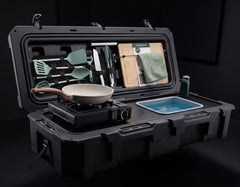
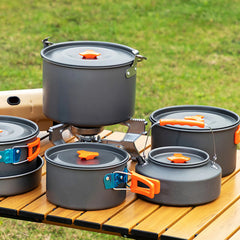
Not every metal in your setup corrodes the same way, so it helps to know what you are protecting. A complete kit mixes several materials, and a quick look at everything included in a camp kitchen kit shows why: stainless cookware, an aluminum or powder-coated steel frame, a stove with carbon-steel burner parts, and plastic water components that never rust at all.
- Stainless steel resists rust because chromium forms an invisible "passive" oxide layer that reseals itself. It is not rust-proof, though. Common 304 stainless handles inland use well but can pit in salt air; marine-grade 316 adds molybdenum for stronger chloride resistance.
- Aluminum does not rust in the iron sense — it forms a stable oxide skin. It can corrode with a dull white powder in salt air, but structurally it is very forgiving.
- Powder-coated or galvanized steel frames are protected only as long as the coating is intact. A deep scratch exposes bare steel, and that is where rust usually starts.
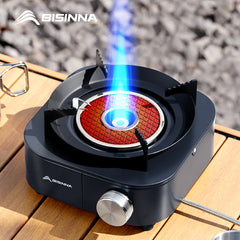
- Carbon-steel stove parts — burner rings, grates, springs, regulator hardware — are the most rust-prone pieces in the whole system and deserve the most attention.
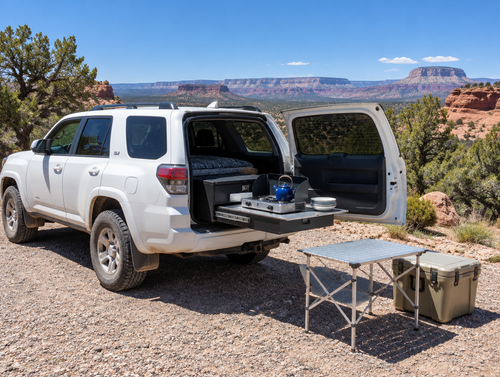
Our own VOZ Camp Kitchen is built around a weatherproof case for exactly this reason: keeping weather off the metal is the single biggest lever you have. If you want the reasoning behind why a compact, sealed box beats loose gear in a bin, our portable camp kitchen guide covers the size-and-protection tradeoffs.


The One Rule That Prevents Most Rust: Dry Before You Pack
If you do nothing else on this list, do this. Water left on or inside gear is the number-one cause of rust, and a dry stove is a good stove no matter what fuel it burns. Moisture trapped in a bag after a rainy trip becomes surface rust within days.
Build a five-minute dry-down into every pack-up:
- Wipe every metal surface with a towel before it goes back in the case — do not let parts air-dry inside a closed box.
- On the stove, dry the cooktop, burners, and drip tray. If you deep-clean, let the burners dry upside down and reassemble only when there is zero moisture left.
- Leave the lid or case open for a few minutes in the sun or breeze before you seal it for the drive home.

The stove is worth singling out because its carbon-steel parts rust fastest and rust here actually hurts performance — corrosion can slow fuel flow and shorten the burner's life. A full teardown-clean and dry a couple times a season keeps it reliable. Whatever stove you run, treat the burner assembly as the part most worth drying.


Don't Forget the Water System
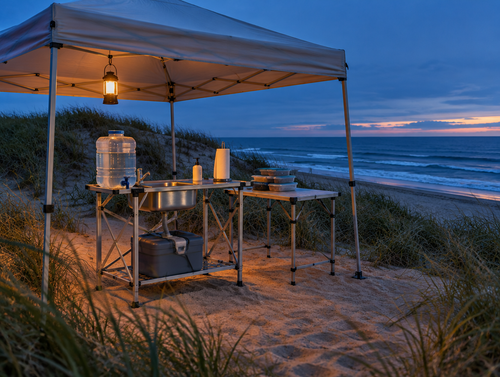
The sink, pump, faucet, and water tank are where moisture is unavoidable — that is their job — so they need their own routine. Standing water grows mold and mineral scale, and metal fittings around a wet basin can corrode if they never fully dry out. Running water outdoors is one of the best upgrades a camp kitchen offers, and our piece on why a sink and faucet change outdoor cooking explains the setup; the tradeoff is that you have to drain and dry it every time.
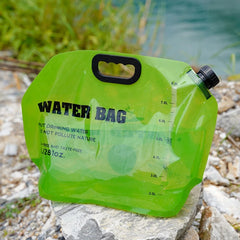
- Empty the tank and lines completely after each trip — never store water in the system between outings.
- Leave the tank cap and basin open so the inside can air out fully.
- Wipe metal faucet and clamp hardware dry; those small fittings are easy to overlook and quick to corrode.


Add a Barrier: Coatings, Oils, and Desiccants
Drying handles most of the battle. For the rest, a thin protective layer buys you real insurance, especially at the coast.
Off-Season Storage That Keeps Rust Away
Most corrosion actually happens in storage, not on the trip, because gear sits untouched for months in whatever conditions the garage offers. Store it right and it comes out ready.
| Do | Why it matters |
|---|---|
| Store fully dry and clean | Any leftover food residue or moisture feeds rust and mold over months |
| Keep it below ~60% humidity | Corrosion slows to a crawl under that threshold; a cheap hygrometer tells you where you stand |
| Elevate off concrete floors | Bare concrete wicks ground moisture; a shelf or pallet keeps damp air from pooling around the box |
| Leave the lid slightly vented if indoors | A little airflow prevents a sealed, humid micro-climate inside the case |
| Add fresh desiccant | Absorbs the moisture that does get in during long idle stretches |
A conditioned closet or an interior wall of the garage beats an unheated shed or an outdoor deck box, where temperature swings drive condensation cycle after cycle.
FAQ
Is stainless steel really rust-proof?
No — it is rust-resistant. Chromium gives stainless a self-healing oxide layer, but salt, scratches, and constant moisture can still cause pitting, especially on standard 304 grade. Marine 316 grade resists it better, but even 316 benefits from rinsing and drying.
My camp kitchen already has a few rust spots. Is it ruined?
Usually not. Surface rust on steel comes off with fine steel wool or a non-scratch pad, after which you dry the area and wipe on a thin protective oil. Catching it early keeps a cosmetic spot from turning into a pit that weakens the part.
Do I need to oil stainless cookware like cast iron?
No. Stainless does not need seasoning. Just clean it, dry it, and store it dry. Save the oil-and-wax barrier for carbon steel, cast grates, and any bare-metal hardware.
What is the single most important thing I can do?
Never pack anything wet. Dry every surface before it goes in the case, and store the whole kit somewhere below about 60% humidity. Those two habits prevent the vast majority of rust.
Does a weatherproof case mean I can leave it outside year-round?
A sealed case is built to shrug off a rainy weekend, not months of outdoor exposure. It keeps weather off the metal on a trip, but for long-term storage you still want it indoors, dry, and off the floor.
- Camp Kitchen Kit: Everything That's Included (and Why It Matters)
- Portable Camp Kitchen: Why Size and Weight Matter More Than You Think
- Camp Kitchen With Sink: Why Running Water Changes Everything Outdoors
- How to Clean Your Camp Kitchen After a Trip (So It Lasts for Years)
- How to Clean a Camp Kitchen Sink and Water System (and Prevent Mold)
Ready to upgrade your camp kitchen?
The VOZ Camp Kitchen includes everything you need in one weatherproof case. Sets up in 15 seconds.
Shop VOZ Camp Kitchen →