Where to Set Up Your Camp Kitchen: Placement and Safety Rules That Actually Matter

You can own the best portable camp kitchen on the market and still have a miserable trip if you set it up in the wrong spot — smoke in your face, a wobbling stove, and a bear sniffing around your tent at 2 AM. Placement is the one setup decision you make before anything else, and it costs nothing to get right.
The 60-Second Site Read
Before you unlatch a single buckle, walk the campsite and read it like a cook. You are looking for one spot that scores well on five things at once:
- Flat, firm ground — a stove that rocks is a pot of boiling water waiting to tip.
- Distance from the tent — food smells belong away from where you sleep, especially in bear country.
- Wind direction — you want the breeze carrying smoke, grease, and food odor away from sleeping areas, not into them.
- Water logistics — close enough that hauling water isn't a chore, far enough that food scraps and dishwater never reach a stream or lake.
- Traffic flow — out of the path between tents, cars, and the fire ring, so nobody walks through your cooking zone carrying firewood while you're holding a hot pan.
Most developed campgrounds make part of this decision for you: the picnic table and fire ring anchor the cooking area. Your job is deciding where the kitchen box itself lands within that zone — and everything below still applies to the stove, the food, and the dishwater.

Rule One: Flat Ground, Nothing Flammable Within Arm's Reach
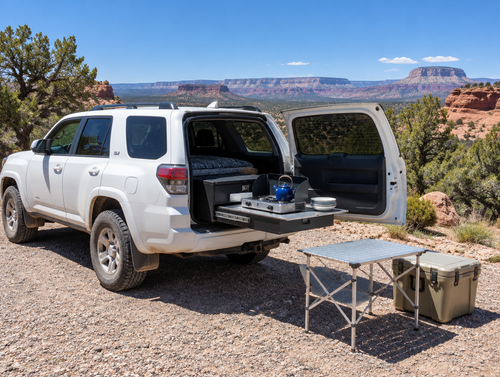
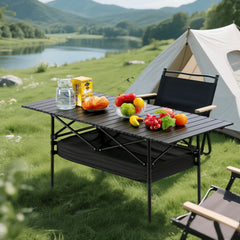
Start with the surface. A folding camp kitchen with a built-in stove needs level, firm ground — packed dirt, gravel pad, or short grass. Avoid soft sand and slopes; even a slight lean means oil pools on one side of the pan and pot handles swing on their own. If the legs have adjustable feet, level side-to-side first, then front-to-back.
Then look up and around. Camp stoves burning pressurized gas throw real heat, and U.S. Forest Service fire restrictions in some national forests require portable gas stoves to sit at least 5 feet from any flammable material. Treat that as your baseline everywhere: no overhanging branches, no dry brush at your feet, no nylon — tents, awnings, camp chairs — within that radius. And never cook inside a tent or enclosed shelter; besides the fire risk, that's how carbon monoxide builds up.
This is where an all-in-one unit earns its keep. A VOZ Camp Kitchen puts the stove, sink, and prep surface at standing height on its own legs, so you're not balancing a burner on a picnic table bench or kneeling over a stove on the ground — and the whole footprint is compact enough to fit the one genuinely flat patch most campsites have.


How Far From the Tent? Frontcountry vs. Bear Country
In a developed campground outside of bear country, the honest answer is: as far as the site allows, with the kitchen downwind of the tent. There's no regulation that dictates tent-to-stove distance in a frontcountry site, but the National Park Service does give a hard number for open flame: keep your tent, gear, and anything flammable at least 15 feet away — and upwind — of the fire pit. A camp stove is a controlled flame, but 10 to 15 feet of separation from the tent is a sensible habit for the same reasons: sparks, grease flare-ups, and food odor soaking into the fabric you sleep in.
In bear country, the numbers get serious. The National Park Service recommends setting up your cooking area, eating area, and food storage at least 100 yards — that's 300 feet, a full football field — from where you sleep. If you're dispersed camping or in the backcountry, NPS guidance is to pick a food prep spot that is 100 yards from your tent and 100 yards from any water source.
The Bear-Country Triangle: Sleep, Cook, Store
The classic backcountry layout is a triangle with roughly 100 yards on each side: tent at one corner, kitchen at the second, food storage at the third. Everything with a scent — food, coolers, trash, dish sponges, even the shirt you fried bacon in — lives at the kitchen and storage corners, never at the tent. NPS bear-safety guidance is blunt about this: don't store food in your tent or backpack, and change out of clothes with food spills on them before you turn in for the night.
Two placement details matter more than campers expect:
- Put the kitchen downwind of the tent. Wind carries cooking odor for a remarkable distance; you want that scent plume moving away from where you sleep, so a curious bear that follows it arrives at your (cleaned-up, food-free) kitchen — not your sleeping bag.
- Use the bear box if the site has one. Many campgrounds in bear country provide steel food lockers. Set your kitchen up near — not against — the locker, so the walk between cooking and storage is short and every scented item goes back in the box the moment you finish with it.

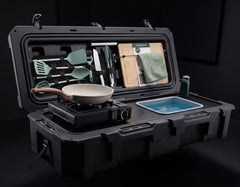
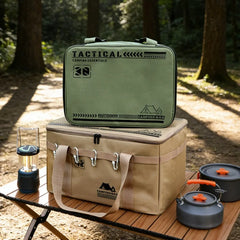
One advantage of a self-contained kitchen box here: at night, the entire kitchen — stove, cookware, utensils, wash basin — latches into a single weatherproof case you can load back into your vehicle or set beside the bear locker in under a minute. Nothing gets forgotten on the table.
Wind and Sun: Read the Site Like a Cook
Wind is the variable that ruins the most camp meals. A steady breeze strips heat off an unprotected burner and stretches boil times noticeably, which is why built-in windscreens and recessed burners matter. Orient the kitchen so the stove's most protected side faces the prevailing wind — usually with your back to the breeze as you cook — and use natural windbreaks: your vehicle, a boulder, a treeline. Just keep that 5-foot flammable-material clearance in mind if the windbreak is brush.
Sun is the quieter consideration. In summer, a kitchen facing west with no shade turns into a griddle by dinner time, softens coolers' ice retention, and leaves your food prep surface in direct sun. Morning shade matters less — most campers want sun on the breakfast station. If you can, place the kitchen where it catches morning light and afternoon shade, and keep the cooler in the shadiest spot you have, off the ground.
Water: Close Enough to Haul, Far Enough to Protect
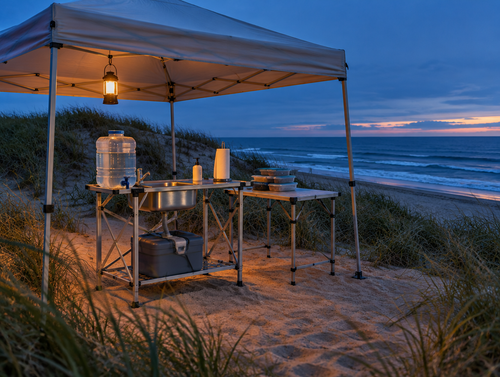
You'll carry more water for cooking and dishes than for drinking, so distance to the spigot or water source drives real effort. But the environmental rule points the other way: NPS backcountry guidance says to wash dishes — and scatter strained dishwater — at least 200 feet from any stream, lake, or water source. Set your kitchen with hauling convenience in mind, never inside that 200-foot buffer.
A camp kitchen with an onboard water tank and rechargeable faucet shortens this whole equation: you fill the tank once at the spigot, and the kitchen itself can sit wherever placement logic — not hose length — says it should. When it's time to deal with the dirty water, follow the same rules covered in our guide to where to dump camp kitchen graywater.
If your crew is bigger than the box, add a folding side table for overflow prep and staging — it keeps raw-food mess in the kitchen zone instead of migrating to the picnic table where people eat. Our camp tables range from roll-up aluminum surfaces to full cabinets with storage.


FAQ
Can I just set up my camp kitchen on the picnic table?
You can, but a standalone kitchen frees the table for eating and keeps raw food, fuel, and flame away from where kids sit. If you do cook on the table, put the stove at one end, check for level, and keep anything flammable off that half of the table.
How close to the fire ring is too close?
The National Park Service says flammable gear belongs at least 15 feet from a fire pit, and upwind. Your kitchen holds fuel canisters, paper towels, and oil — treat it as flammable gear. Close enough to shuttle food to the grate, never close enough to catch a spark.
Do I really need 100 yards of separation in a regular campground?
In a developed campground, sites are rarely 100 yards deep — you physically can't build the full triangle. What transfers is the principle: cook and store food as far from the tent as the site allows, keep the kitchen spotless, and put every scented item in your vehicle or the bear locker overnight. In backcountry bear country, hold the full 100-yard standard.
Where should the cooler go?
In the kitchen zone, in the deepest shade you have, and locked in your vehicle or a bear box overnight in bear country. Never in or beside the tent — a cooler is one of the strongest scent sources in camp.
Does placement change how fast I can set up?
Only if you let it. Do the 60-second site read first, then deploy once. A fold-out kitchen box goes from latched case to working kitchen in seconds — the full sequence is in our guide to setting up a camp kitchen in under 15 seconds — so the site read will genuinely be the longest part of your setup.
Ready to upgrade your camp kitchen?
The VOZ Camp Kitchen includes everything you need in one weatherproof case. Sets up in 15 seconds.
Shop VOZ Camp Kitchen →