Camp Kitchen Workflow: Setting Up Cook, Prep, and Wash Zones Around the Box

A home kitchen works because everything has a station: the stove heats, the counter preps, the sink cleans. A campsite is no different. The calmest outdoor meals happen when cooking, prepping, and washing each get a defined spot — and if you cook out of an all-in-one camp kitchen box, those three zones are already built into the case. Here's how to arrange them so dinner flows in one direction instead of piling up in the middle.
The three-zone model — and how a kitchen box changes it
Most camp kitchen advice tells you to build three separate stations across your site: a table for the stove, a second surface for prep, and a wash station off to the side. That's sound thinking — separating heat, knives, and dishwater is what keeps a campsite kitchen fast and safe. But it assumes you're assembling a kitchen from loose parts.
A box-style camp kitchen collapses that whole floor plan into arm's reach. The stove deck is your cook zone. The removable countertop is your prep zone. The built-in sink is your wash zone. Instead of pacing between three tables, you pivot. What doesn't change is the decision-making: which way the zones face, what belongs on each surface, and the order food moves through them. Get those three decisions right and a one-box kitchen runs like a short-order line.
Placement first: one spot decides everything
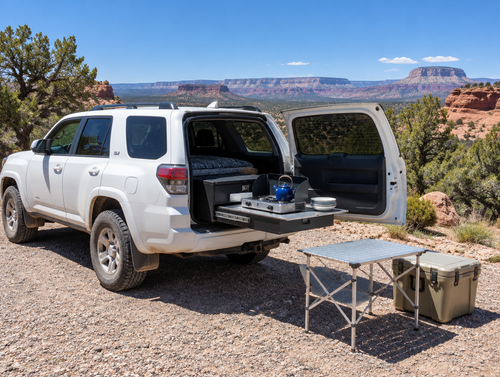
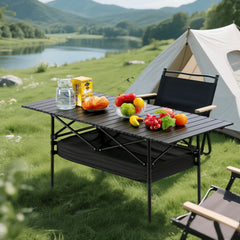
Before any zone exists, the box needs the right spot. Look for ground that's level and firm — a picnic table or a folding stand at counter height beats the tailgate for anything longer than coffee. Keep the whole kitchen at least 10 feet from your tent and set it downwind, so smoke, grease smell, and fuel fumes drift away from where you sleep, and keep the stove side at least 3 feet from dry grass or brush.
In bear country the distances get serious: the National Park Service recommends preparing and storing food 100 yards away from your tent in backcountry areas. Front-country campgrounds with bear boxes are more forgiving, but the principle holds — the kitchen is the smell, and the smell should not live where you sleep.
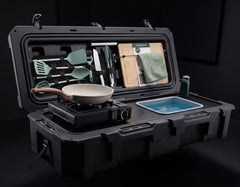
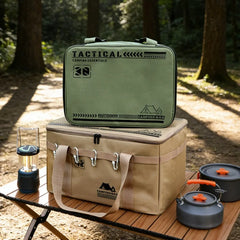
This is where a one-box kitchen pays off first: there is only one thing to place. The VOZ Camp Kitchen opens from a single 47.6-inch weatherproof case into stove deck, countertop, and sink in under 15 seconds, so you're choosing one four-foot stretch of table, not laying out three stations. (If you've never deployed one, our 30-second setup guide walks through the whole sequence.)


The cook zone: heat, fuel, and elbow room

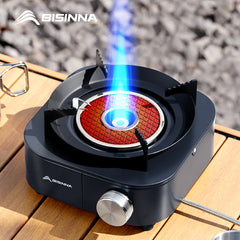
The cook zone is the stove and nothing else. The working rule from experienced camp cooks is about 18 inches of clear space on each side of the burner — enough room to land a hot pot without playing Tetris. On a box kitchen that means one discipline: the stove deck holds what's on the flame, and everything that comes off the flame moves immediately to the prep counter or a trivet, never parked half-on the burner.
Three habits keep this zone running:
- Windbreak on the windward side. Angle the open lid or a folding screen to block gusts before you fight the flame knob.
- Fuel lives low. Spare canisters go on the ground below the stove, shaded — never on the counter where they crowd prep space and pick up heat.
- Long tools within one reach. Tongs, spatula, and pot grip hang or sit on the stove side, so your other hand never crosses the flame to fetch them.
The prep zone: the lid is your counter
Prep needs more room than people expect — roughly 4 square feet of clear surface for one or two campers, and 8 or more once you're feeding four. A box kitchen's countertop covers the solo-and-couple case on its own; the trick is keeping it clear. Only three things earn a permanent spot: the cutting board in the center, the knife beside it, and a scrap bowl on the corner so trimmings never migrate toward the stove.
Run raw-meat discipline like you would at home, just tighter: raw protein gets one side of the board, and the board goes straight into the sink — conveniently two feet away — before anything ready-to-eat touches it. Spices, oil, and the salt you always lose stay in the box's top tray until called for. We covered how much cooking a lid counter can realistically handle in our lid prep-surface deep dive.
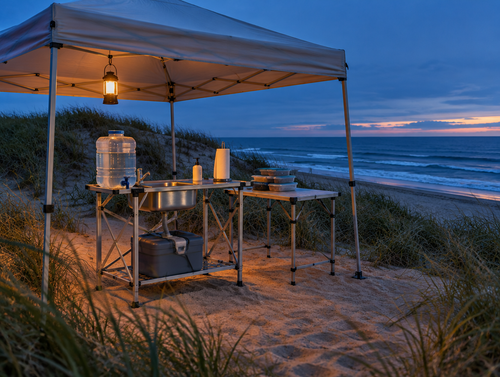
Feeding a crowd? Extend the line instead of stacking it. A folding camp table butted against the prep side of the box turns a one-cook kitchen into a two-cook kitchen without anyone reaching across the flame.


The wash zone: sink, graywater, and the downhill rule
Wash goes at the end of the line — the sink side of the box faces away from the cooler and food bins, and if your site slopes, the wash side sits downhill so a spilled basin runs away from your kitchen, not through it. Keeping a few feet between where you rinse and where you chop also stops dishwater splash from landing on tonight's ingredients.
The rules that actually matter here are federal land etiquette. The National Park Service's Leave No Trace guidance says to carry wash water 200 feet away from streams or lakes, use small amounts of biodegradable soap, strain the food bits out of your dishwater, and scatter the strained water broadly. NPS camp-cooking guidance also describes the classic three-bin sequence — wash, rinse, then sanitize in a solution of 2 teaspoons of bleach per gallon of water. A built-in sink with a rechargeable faucet makes the first two steps feel like home plumbing; the VOZ tank holds 2 gallons, which handles a typical dinner's wash-up before it needs a refill. For the full disposal walkthrough, see our guide to where camp kitchen graywater should actually go.
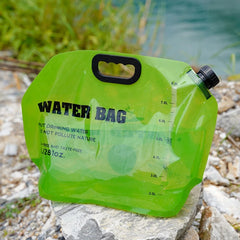
On trips past a night or two, water capacity becomes the real constraint — a collapsible jug or a tank with a spigot stationed beside the wash zone means nobody carries the kitchen's water supply across camp one kettle at a time.


The zones in motion: a taco-night walk-through

Here's the whole system running on a real dinner for four:
- 6:00 PM — Box open on the picnic table, stove downwind, tank filled, faucet primed.
- 6:05 PM — Prep zone: onions and peppers on the board, scrap bowl catching trimmings, raw beef staged on its own side.
- 6:15 PM — Cook zone: skillet on the flame. The empty board goes straight into the sink; hands get a quick rinse at the faucet.
- 6:35 PM — Serve from the counter. The skillet comes off the heat and lands in the sink to soak while everyone eats.
- 7:00 PM — Wash zone: three-bin cleanup, dishwater strained, carried out 200 feet, and scattered. Counter wiped, board dried, box latched.
Notice the direction: cooler to counter, counter to stove, stove to plates, plates to sink. Food moves one way through the kitchen and never doubles back — that single habit eliminates most of the chaos people blame on "camp cooking."
FAQ
Do I still need three zones if the box is all-in-one?
Yes — the zones are habits, not furniture. The box hands you the three surfaces pre-arranged; your job is to keep each surface doing one job. The moment the stove deck becomes a staging shelf or the counter becomes a dish rack, you're back to one-pile cooking.
Which direction should the zones run?
Whichever direction puts the stove downwind of camp and the sink at the end of the food's path. Most right-handed cooks like prep on the left of the flame and wash on the far side, but wind and slope outrank handedness.
How far from my tent should the kitchen be?
Ten feet is a sensible front-country minimum for smoke and fuel fumes. In bear country, follow the National Park Service standard: cook, eat, and store food 100 yards from where you sleep.
What if my campsite has no picnic table?
A folding camp table or stand at counter height is the fix — cooking off the ground saves your back and keeps dirt out of the food. In a pinch, a tailgate works for the box while a small side table catches the prep overflow.
Ready to upgrade your camp kitchen?
The VOZ Camp Kitchen includes everything you need in one weatherproof case. Sets up in 15 seconds.
Shop VOZ Camp Kitchen →