Camp Kitchen for a Week-Long Base Camp: The Setup That Holds Up for 7 Days

A weekend at the campsite forgives a thin setup — you can eat granola bars and cold-cut sandwiches for two days and call it roughing it. A week-long base camp does not forgive anything. Seven days in one spot means real meals, real dishes, real water, and a cooler that has to keep food safe long after the ice you packed on day one has melted. This is the kitchen that earns its place when you are settling in for the long haul.
What a Base Camp Kitchen Demands That a Weekend Setup Doesn't
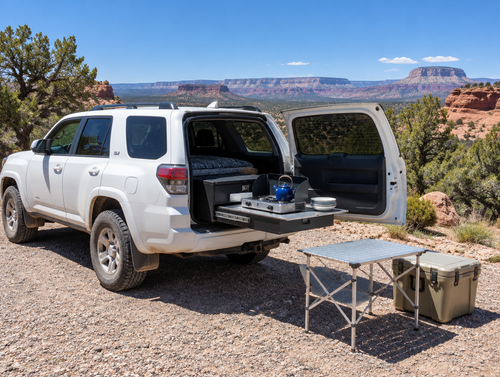
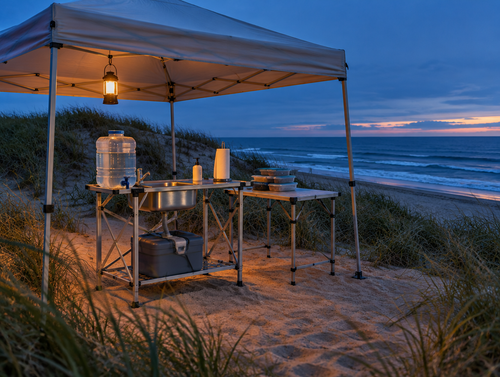
Base camping flips the math. You are not cooking to survive a couple of nights; you are running a small outdoor kitchen for 18 to 21 meals, often for a family or a group, on a single patch of dirt. That changes three things. First, throughput — you need real prep space and two burners so you can fry eggs while coffee boils, not take turns on a single flame. Second, endurance — your cold storage and water have to last days, not hours. Third, order — a setup that lives outdoors for a week has to pack down, stay organized, and keep critters out every single night.
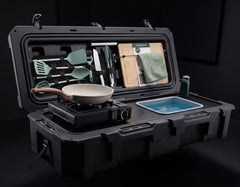
The all-in-one approach wins here because a base camp kitchen gets set up once and used hard. A complete box like the VOZ Camp Kitchen — with a built-in two-burner-friendly work surface, a sink, a USB-rechargeable faucet, and a water tank — gives you a fixed station that stays put for the week instead of a pile of gear you rebuild every meal. If you want the bird's-eye view of how a full kitchen comes together, our best camp kitchen setup guide for 2026 walks through the whole stack.


Sizing Water for Seven Days (Do the Math First)
Water is the first thing people under-pack and the hardest to fix once you are out there. For car and base camping, a widely used planning figure is about 2 gallons per person per day — roughly one gallon for drinking and one for cooking, dishes, and cleanup. That number climbs in heat or with strenuous days, so treat it as a floor, not a ceiling.
Run the math before you load the vehicle. A family of four on a 7-day base camp is looking at roughly 56 gallons at the 2-gallon rate. You will not haul that in jugs you refill at a spigot — you stage it. The practical move is a large fixed tank or several stackable containers with taps at the kitchen, plus a couple of foldable jugs you walk to the campground fill station to top off mid-week. A built-in tank paired with a touch faucet keeps a steady supply right at the prep surface so you are not hauling a 5-gallon jug every time you rinse a pot.

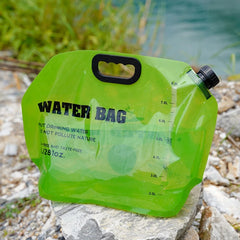
Camp water gear ranges from compact 2-gallon foldable bags to 3.4-gallon containers with built-in faucets and electric dispenser pumps. For a week-long stay, mix capacities: big containers for the bulk, foldable jugs for refills, and a pump or tap so you are not tipping heavy water by hand. Here is the range we stock:


Keeping Food Safe From Day 1 to Day 7
This is where a week-long trip gets serious. The USDA's food-safety rule is blunt: keep cold food at or below 40°F. Between 40°F and 140°F — the “Danger Zone” — bacteria multiply fastest, doubling in as little as 20 minutes. And perishable food should never sit out more than 2 hours, dropping to 1 hour when it is above 90°F outside.
Over seven days that means your cooler strategy matters more than any other piece of the kitchen. The USDA's own guidance gives you the playbook:
- Run two coolers. Keep drinks in one and perishable food in another. The drink cooler gets opened constantly, and every open lets warm air in — you do not want your raw chicken riding those temperature swings.
- Keep coolers full. A full cooler stays cold far longer than a half-empty one. Fill gaps with extra ice rather than air.
- Use block ice, not just cubes. A block of ice keeps food colder, longer. Frozen gel packs and frozen water bottles extend it further.
- Drop a thermometer inside. An inexpensive appliance thermometer in the food cooler lets you verify you are actually holding 40°F — not guessing.
For a week, plan a mid-trip ice resupply and pack so the meals you will eat last sit at the bottom. An insulated cooler bag handles drinks and the day's food near the kitchen, while a hard cooler with block ice holds the slow-burn perishables you are saving for later in the week.


The Kitchen Core: Stove, Sink, and Prep Space
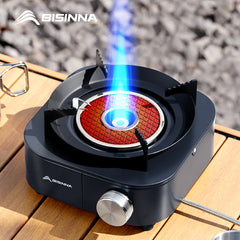
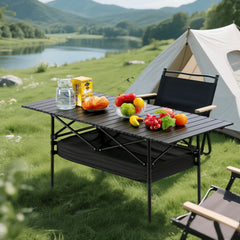
A base camp kitchen lives or dies on its core three: heat, water, and a flat surface to work on. For a week of real cooking, single-burner setups become a bottleneck fast. Two burners let you actually run a meal — a pot of pasta on one side, sauce on the other — instead of cooking in sequence and serving everything lukewarm.
The reason an integrated box shines on a long stay is that the sink, faucet, and tank live in the same footprint as the stove and prep area. You wash as you go instead of letting dishes stack into a day-three disaster. The VOZ Camp Kitchen builds the sink, a USB-rechargeable faucet, and the water tank into the case, so the whole wet-work station is ready the moment you unfold it — no rigging a basin on a folding table. Pair it with a sturdy cookware set and your hot-food workflow is covered for the week.
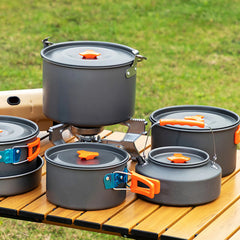
If you would rather build the cooking side piece by piece, the anchor is a dependable two-burner stove and a nesting cookware set sized to your group. Our full breakdown of the best camp kitchens of 2026 compares the complete-box route against assembling your own.
Keeping It Clean and Critter-Free for a Week
Seven nights in one spot is plenty of time to train every raccoon, mouse, and — in some regions — bear in the area to visit your kitchen. The National Park Service is explicit: in many parks you are required to store not just food but trash, scented items, and even cooking supplies and utensils in an animal-resistant container or food locker overnight. Regulations vary by park, and some require IGBC-approved hard-sided bear canisters, so always check the rules for where you are camping before you go.
Day-to-day cleanliness is the other half. Wash hands and surfaces often, scrape plates before they pile up, and keep a wash-rinse routine at the sink so grease and food scraps do not accumulate. A built-in sink and faucet make this realistic over a week — the easier cleanup is, the more consistently you will actually do it. When you break camp, drain and dry the tank and sink so they are fresh for next time.
For the full gear list that keeps a base camp kitchen organized and stocked, our 47-item camp kitchen checklist is the packing companion to this guide.
What's Included: A Week-Long Base Camp Kitchen Checklist
FAQ
How much water do I really need for a week-long base camp?
Plan for about 2 gallons per person per day for drinking, cooking, and cleanup — so roughly 14 gallons per person over a week, or about 56 gallons for a family of four. Bring more in hot weather or with active days, and identify a campground fill station so you can top off mid-trip rather than hauling all of it at once.
Will a cooler keep food safe for seven days?
Yes, if you manage it. Keep the food cooler at or below 40°F, run a separate cooler for drinks, keep both full, use block ice, and verify the temperature with a thermometer. Plan a mid-week ice resupply, and remember the 2-hour rule (1 hour above 90°F) for anything you take out to cook.
Do I need a full camp kitchen box, or can I piece it together?
Both work. An all-in-one box like the VOZ Camp Kitchen sets up once and keeps the stove, sink, faucet, and water tank in one footprint — ideal for a stay where the kitchen lives outdoors for a week. Building it piece by piece gives you more flexibility but more to organize and rebuild each meal.
How do I keep animals out of my base camp kitchen at night?
Store food, trash, scented items, and even cooking utensils in an animal-resistant container or food locker overnight, and clean surfaces so no scent lingers. Many national parks require this, and some mandate IGBC-approved bear canisters — check the regulations for your specific destination before the trip.
Ready to upgrade your camp kitchen?
The VOZ Camp Kitchen includes everything you need in one weatherproof case. Sets up in 15 seconds.
Shop VOZ Camp Kitchen →