Camp Kitchen for a Hunting Camp: A Bear-Country Setup That Cooks Anywhere

A hunting camp asks more of a kitchen than almost any other trip. You are usually deep in bear country, miles from the nearest tap, cooking in the cold and the dark around the hours you actually hunt — and sooner or later you have to deal with the meat you came for. A kitchen that works fine on a summer car-camping weekend can fall apart fast under those demands.
Why a hunting camp is a different cooking problem
Most camp-cooking advice quietly assumes a developed campground: a picnic table, a water spigot, a trash can, mild weather. A hunting camp usually has none of that. You might be on a remote forest road, a leased parcel, or a backcountry spike camp where you pack in everything and pack out everything. That turns the kitchen from a convenience into a piece of survival infrastructure. It has to carry its own water, contain its own odors, shrug off rain and frost, and lock down tight when you walk away from it for a long morning sit.
Four pressures define a hunting-camp kitchen: bears and other wildlife, scent discipline, cold weather, and game handling. Get those four right and the rest is just cooking. Get them wrong and you risk a ruined hunt, a destroyed camp, or a citation from the agency that manages the land.
Bear country is the rule, not the exception
If you hunt elk, deer, or bear across most of the western and northern U.S., you are in bear habitat, and many of those forests carry legally enforceable food storage orders. On the Superior National Forest's Boundary Waters, for example, the food storage order in effect from March 1 through November 30 requires that all food, food containers, scented items, and refuse be suspended at least 12 feet above the ground and at least 6 feet horizontally from a tree trunk — or stored in an Interagency Grizzly Bear Committee certified bear-resistant container — any time it isn't being prepared, eaten, or actively watched.
For hunters there's an extra wrinkle: game meat counts as food. Land agencies generally tell you to store harvested meat the same way you store groceries, and any carcass or animal parts left within about a half-mile of a sleeping area has to be secured. The practical lesson is that your kitchen and your storage plan have to account for the animal you hope to kill, not just the food you packed in.

The National Park Service spells out how to use a hard-sided bear container: keep it closed and locked at all times, set it on flat, level ground at least 100 feet from where you sleep, skip any attached ropes a bear could use to drag it off, and balance a few pots and pans on the lid so they clatter as an alarm if something noses in overnight. And "food" is broader than you think — bears are drawn to soap, toothpaste, lip balm, sunscreen, bug repellent, cooking oil, and even fuel. If it has a smell, treat it as bait.
Scent discipline starts at the kitchen
Bears are a safety issue; scent is a hunting issue. Deer and elk live by their noses, and a camp that reeks of bacon grease and woodsmoke broadcasts your presence across the drainage. You can't cook odor-free, but you can contain it and locate it well away from where you rest. The standard bear-country layout doubles as good scent management: keep your cooking area and your food storage a long way from where you sleep — the Park Service uses 100 feet as a baseline, and many bear-aware guides recommend arranging sleeping, cooking, and storage as a triangle with each point roughly 100 yards apart in grizzly country. Cook downwind of your tent, scatter strained dishwater far from camp, and never dry greasy cookware near your sleeping area.
This is where a closed-case camp kitchen earns its keep. When the burner, the cookware, and the leftovers all fold back into one latched box instead of sitting open on a table overnight, the smells stay contained and the cleanup is contained with them. A sealed unit won't replace a required bear canister for overnight storage, but it keeps the day-to-day grease and food smell from soaking into everything else in camp.
Cooking in the cold: the late-season fuel reality
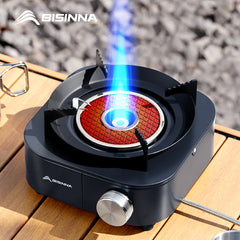
Hunting seasons run straight into the parts of the calendar campers avoid. A November elk camp or a December whitetail sit can mean cooking at temperatures where your stove simply quits — and the failure is chemistry, not a broken stove. Butane stops vaporizing right around 31°F, so a plain butane canister can go dead the morning you need a hot breakfast most. Isobutane keeps working down to about 11°F, and propane keeps vaporizing far below zero, all the way to roughly minus-43°F. For cold-weather hunting, a stove that burns propane — or at least an isobutane-propane blend — is the difference between coffee and a cold, miserable start.

If you're choosing a burner for a hunting camp, weight cold performance above almost everything. Keep canisters out of the frost overnight — tucking one inside your sleeping bag or a jacket pocket warms it enough to restart — and carry more fuel than a fair-weather trip would need, because cold stoves burn longer to boil the same pot.


Handling the game you came for
The moment that separates a hunting kitchen from any other is butchering and cooking the harvest. Wild game carries real food-safety risk, and the rules are stricter than for beef. The USDA's safe-temperature guidance puts whole cuts of venison at 145°F and ground venison at 160°F, because grinding spreads surface bacteria throughout the meat. The CDC goes further for wild game specifically and recommends cooking it to an internal 165°F to kill Trichinella parasites — and warns that freezing does not reliably kill the worms found in wild game, so thorough cooking, verified with a thermometer, is the only dependable safeguard.
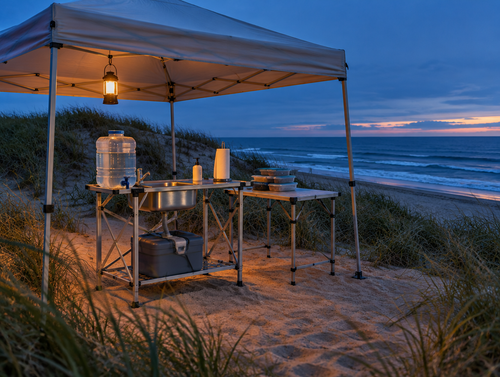
Field handling matters as much as the final temperature. The CDC advises wearing gloves while dressing and butchering game, keeping raw meat strictly separate from other food, and washing your hands, knives, and any surface that touched the carcass with soap and water. That last instruction is the one a remote hunting camp fails most often, because there's no sink — which is exactly why running water on board a kitchen is worth so much to a hunter. A dedicated cleaning surface with its own faucet, like a folding fish-and-game cleaning station, keeps the messy work off your cooking surface entirely.


What a hunting camp kitchen actually needs
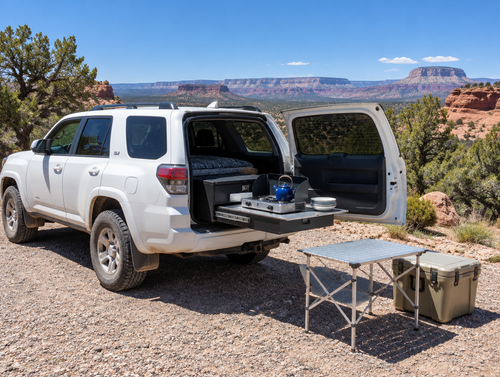
Pull those four pressures together and the spec sheet writes itself. A hunting kitchen needs a cold-capable stove, onboard water for cleanup and food safety, a contained design that locks down odors and survives weather, and enough prep surface to break down game without contaminating your meals. That's a tall order for a loose pile of gear, and it's the reason the all-in-one camp kitchen box has caught on with hunters.
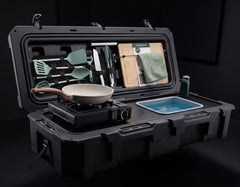
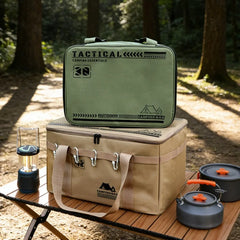
A self-contained unit like the VOZ Camp Kitchen folds a stove, a sink with a USB-rechargeable faucet, a 2-gallon water tank, cookware, and 30-plus items into a single weatherproof case that opens into a standing kitchen and latches back into one liftable box. For a remote camp with no services, that combination — water you brought, a burner, and a sealed shell — covers most of the hunting-camp checklist in one piece you can load into a truck bed or strap to an ATV. For a full breakdown of how to judge these boxes on water capacity, burner power, and build, our guide to the best camp kitchen setup for 2026 walks through what to look for before you buy.


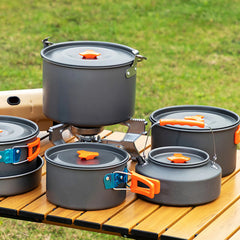
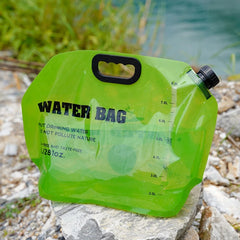
If you'd rather assemble the pieces yourself, build around the two a hunting camp can't fake: a cold-rated stove and real water storage. Just remember that in designated bear areas, neither a kitchen box nor a soft storage bag substitutes for an IGBC-certified bear-resistant container or a proper food hang — keep those as a separate part of your plan. To make sure nothing critical gets left in the garage, run your kit against our ultimate camp kitchen checklist of 47 items before you head out.
Hunting camp kitchen FAQ
Do I still need a bear-resistant container if I have a sealed camp kitchen?
In areas with a food storage order, yes. A latched kitchen box contains odors and keeps weather and small critters out, but it isn't the same as an IGBC-certified bear-resistant container. Where regulations apply, you must either use a certified container or hang all food and scented items at least 12 feet up and 6 feet from the trunk. Check the managing agency's current food storage order before your trip.
What stove works best for late-season hunting?
One that runs on propane or an isobutane-propane blend. Plain butane quits vaporizing near 31°F, while propane keeps working far below zero. For cold camps, favor propane, keep spare canisters warm overnight, and pack extra fuel because cold stoves take longer to boil.
How should I handle and cook the game I harvest?
Wear gloves while field dressing, keep raw meat separate from other food, and wash hands, knives, and surfaces with soap and water. Cook whole cuts of venison to at least 145°F and ground game to 160°F; the CDC recommends 165°F for wild game to kill Trichinella, since freezing doesn't reliably destroy it. Always verify with a thermometer.
How far from my tent should I cook and store food?
Keep cooking and food storage at least 100 feet from where you sleep, and farther in grizzly country, where many guides suggest a triangle with sleeping, cooking, and storage points about 100 yards apart. Cook downwind, and dump dishwater well away from camp.
Why does running water matter so much at a hunting camp?
Because cleanup is a food-safety step, not a luxury. After butchering game you need to wash hands, knives, and surfaces, and a remote camp has no sink. A kitchen with an onboard water tank and faucet lets you do that anywhere, which is why so many hunters prioritize it.
Ready to upgrade your camp kitchen?
The VOZ Camp Kitchen includes everything you need in one weatherproof case. Sets up in 15 seconds.
Shop VOZ Camp Kitchen →