Camp Kitchen for Solo Camping: The Minimalist Setup That Still Cooks Real Food

Cooking for one is a different problem than cooking for a crew. You don't need four burners, a stack of plates, or a 60-quart cooler — you need a tight kit that boils water fast, fries an egg without drama, and packs down small enough that setup never feels like a chore. Here's how to build a minimalist camp kitchen for solo trips that still turns out a real dinner, not just rehydrated mush.
What "minimalist" actually means for one person
Minimalist solo camping isn't about suffering. It's about cutting the redundant gear that earns its weight only when you're feeding a group. For one camper, almost every category collapses to a single item: one burner, one pot, one pan, one mug, one set of utensils, and one compact water source. The discipline is in resisting the "just in case" pile that quietly turns a clean tote into a 40-pound box you dread loading.
The payoff is real. A solo kit you can carry in one hand sets up in seconds, fits in a sedan trunk or behind an SUV's rear seats, and leaves room for the things that actually make a trip better. If you're still deciding how compact to go, our guide to portable camp kitchen size and weight walks through the trade-offs in detail.

The one-burner core
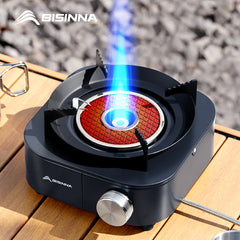
For a solo setup, a single burner does everything a two-burner does — you just cook in sequence instead of in parallel. A butane cassette stove is the easiest path: the fuel canister clicks in, ignition is push-button, and a windproof single burner in the 7,000–15,000 BTU range will boil a liter of water in roughly three minutes. That's enough heat for coffee, a one-pot pasta, or a seared piece of meat, and the whole unit packs flat into its own case.
Butane is the sweet spot for warm-weather solo trips: clean-burning, cheap, and sold at most grocery and hardware stores. The trade-off is cold performance — butane struggles below about 40°F, so shoulder-season and winter campers should plan around that or switch to a propane-capable stove. A windproof burner also matters more when you're solo, because there's no second cook to shield the flame or hold a pot lid while you dig for an ingredient.


If you ever cook for two or want more headroom, the rest of our camp stove lineup covers everything from compact cassette burners to high-output propane models.
Cookware that nests into itself
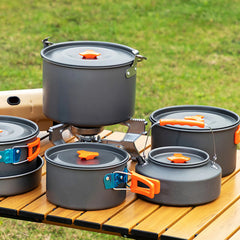
The single biggest space saver in a solo kit is cookware that nests. A two-piece set — one small pot and one fry pan with folding handles — covers boiling, simmering, and frying, and the pot doubles as your storage for the stove's lighter, a spork, and a dish cloth. Look for anodized aluminum or stainless steel: aluminum is lighter and heats fast, while stainless can go directly over an open flame and shrugs off abuse.
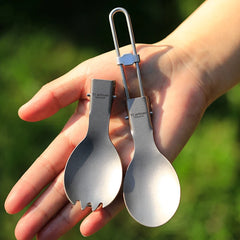
For one person, a roughly 1-liter pot is the right size. It's big enough for a generous single portion plus a hot drink, and small enough that you're not heating dead space. Add a single insulated mug that doubles as a bowl, one titanium or stainless spork, and a compact folding knife, and your entire eating kit fits in a pocket of the case.


Water and cleanup without the bulk
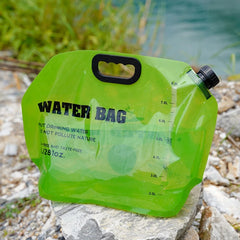
Water is the heaviest thing you'll carry, so size it honestly. A common planning baseline is about one gallon of water per person per day for drinking; once you add cooking and cleanup, two gallons per day is a safer target for a self-contained solo camp. For a weekend, a single 1.5–3.4 gallon container with a built-in spigot covers a solo camper without the sloshing weight of a full family jug.
Cleanup is where minimalist setups quietly fall apart — nobody wants to scrub a pan in cold creek water. A small collapsible sink, or even a single basin you fill from your water container, lets you wash, rinse, and pack a clean kit in a couple of minutes. Carry biodegradable soap and dump gray water at least 200 feet from any water source, per standard Leave No Trace and land-agency guidance.


The all-in-one shortcut
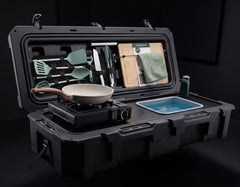
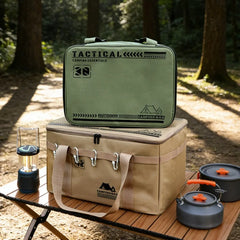
The fastest way to a dialed solo kitchen is to skip the piecemeal sourcing entirely. The VOZ Camp Kitchen packs a stove, a sink with a USB-rechargeable faucet, a water tank, prep surface, and 30-plus cooking items into one weatherproof case. For a solo camper, you simply don't unpack what you don't need — run the single burner, use one corner of the prep surface, and you've got a complete kitchen that sets up in seconds and closes back into a box you carry one-handed.
It's heavier than a bare butane stove and one pot, of course. But for car campers and overlanders who value never forgetting a utensil and never hunting for the lighter, the trade is usually worth it. The mental overhead of a solo trip drops when the entire kitchen lives in one box: nothing to assemble, nothing to leave behind on the kitchen counter at home, and one motion to pack it all back up when the weather turns. We break down how to evaluate a complete kit in our guide to the best camp kitchen setup for 2026.


A sample solo minimalist kit
If you'd rather build it yourself, here's a tight loadout that covers a one-person weekend without padding:
- Heat: one windproof single-burner cassette stove + two fuel canisters
- Cook: one ~1L pot and one fry pan, nesting, with folding handles
- Eat: one insulated mug/bowl, one spork, one folding knife
- Water: one 1.5–3.4 gallon container with spigot (about 2 gallons/day)
- Clean: collapsible basin, biodegradable soap, quick-dry cloth
- Store: one weatherproof case or tote that holds all of the above
For the full version that scales up when you bring a friend, our camp kitchen checklist of essential items lists everything worth packing.
FAQ
Is a single-burner stove really enough for solo camping?
Yes. Cooking for one rarely needs two pots going at once. You boil water for coffee, set it aside, then cook your meal on the same burner. A windproof single burner that boils a liter in about three minutes keeps the wait short.
How much should a minimalist solo kit weigh?
A bare stove-and-cookware kit can come in under five pounds, not counting water and fuel. Water is almost always the heaviest item — at roughly eight pounds per gallon, two gallons alone adds about 16 pounds, so size your container to the trip length.
Do I need a sink for solo camping?
Not strictly, but a small basin or collapsible sink makes cleanup far faster and keeps gray water contained so you can dispose of it responsibly away from water sources. With one person's dishes, even a single basin you fill from your water jug works fine.
Butane or propane for a solo stove?
Butane is lighter, cheaper, and cleaner-burning for warm-weather trips, but it loses pressure below about 40°F. If you camp in shoulder season or cold mornings, choose a propane-capable stove or keep the canister warm.
Ready to upgrade your camp kitchen?
The VOZ Camp Kitchen includes everything you need in one weatherproof case. Sets up in 15 seconds.
Shop VOZ Camp Kitchen →