Camp Kitchen for Van Life: Built-In Galley vs. Portable Box

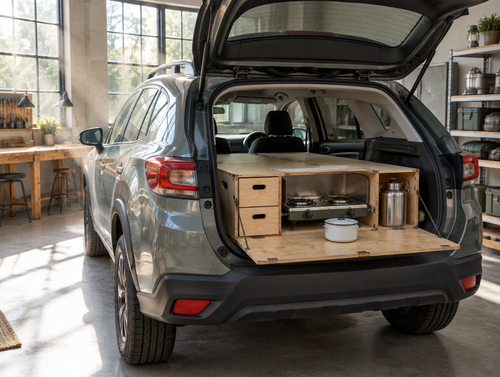
Van life sells a tidy fantasy: a butcher-block galley with a little sink, a two-burner range tucked under the window, everything built in. It looks great. It's also weeks of work, a permanent bite out of your cargo space, and a kitchen you can never take out of the van. For a lot of vanlifers, a portable camp kitchen box does the same job with none of the commitment. Here's how the two actually stack up.
The two ways to cook in a van
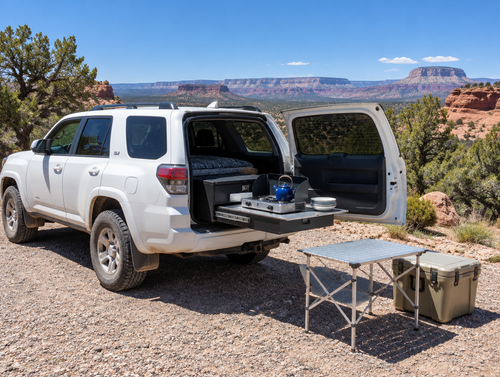
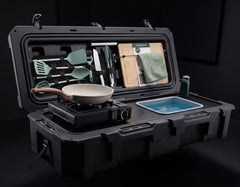
Every van kitchen lands in one of two camps. A built-in galley is fixed cabinetry screwed to the wall and floor—a countertop, a plumbed sink, a slide for a stove or fridge, all part of the conversion. A portable camp kitchen box is a self-contained case you set on the floor, a bench, or carry outside; the stove, sink, faucet, water, and utensils already live inside it. The galley becomes part of the van. The box is just a thing you own that happens to ride in the van.
That difference sounds small, but it drives almost every trade-off below: cost, build time, how much cargo room you keep, and even where it's safe to cook. If you want the wider view across trucks, vans, trailers, and RVs first, our vehicle camp kitchen guide covers every platform.

Galley vs. portable box, side by side
Here's the honest comparison most build guides skip, because they're trying to sell you on the build. A fixed galley wins on a couple of things; the box wins on most of the rest.
| Factor | Built-in galley | Portable camp kitchen box |
|---|---|---|
| Build time | Days to weeks of cutting, fitting, plumbing, wiring | None—open it and cook the same day |
| Typical cost | ~$800–$2,500 in DIY parts; around $4,000 for a basic pro-installed kitchenette | One purchase, no tools or materials |
| Permanence | Drilled and bolted into the van | Lift it out anytime |
| Cook location | Tied to the van—usually indoors | Outside, at a table, or anywhere you set it down |
| Cargo flexibility | Permanently occupies that wall | Stows when not cooking; reclaim the space |
| Rental or resale van | Modifies the vehicle | Zero modification; leaves with you |
Why vanlifers are reaching for a no-build box
The portable box has quietly become the default for a big slice of the van crowd—especially people who aren't ready to gut a van. Four reasons keep coming up:
- There's no build. A DIY galley is a real project: framing, a sink cutout, a water pump, a drain, drawer slides, finish work. A box skips all of it. You unbox it, load your food, and you're cooking on day one.
- The cost is one number. DIY galley components commonly run $800 to $2,500, and a basic professionally installed kitchenette with a small fridge and propane stove lands around $4,000. A portable box is a single purchase with no lumber, hardware, or shop time stacked on top.
- It comes out. Renting, leasing, borrowing, or planning to sell the van? You can't drill cabinetry into a vehicle you don't want to modify. A box rides in, lifts out, and moves to the next van—or into the garage—without a trace.
- You cook outside. A box is designed to be carried out the side door and set up in the open air, which sidesteps the single biggest hazard of a van galley (more on that below).
That last point is exactly why the overland and adventure-van crowd leans portable. Our roundup of the best portable camp kitchens for overlanding walks through why an all-in-one box wins when space and weight are tight.

What a portable box actually puts in your van
The reason a box can replace a whole galley is that it isn't just a stove—it's the entire kitchen consolidated into one weatherproof case. The VOZ Camp Kitchen measures 47.6 inches long, 19.3 inches wide, and 11.4 inches tall when closed, and weighs about 57 pounds loaded. It slides along a van wall or under a platform bed during travel, then opens into a full cook station. Inside you get:
Compare that to a galley, where the sink, water, stove slide, and storage are four separate sub-projects you build and plumb one at a time. The box arrives with all four already integrated, and at 47.6 inches closed it tucks against a wall in even a compact cargo van without eating your sleeping or storage zone.


The safety case for cooking outside the van
This is the part that doesn't show up in pretty galley photos. Any fuel-burning stove—propane, butane, white gas—produces carbon monoxide, an odorless, colorless gas that builds to dangerous levels fast in an enclosed space. A van is an enclosed space.
The CDC is blunt about it: never use a portable gas camp stove indoors, and never run any gasoline, propane, natural gas, or charcoal-burning device inside a home, garage, or camper. The agency estimates more than 400 Americans die each year from unintentional carbon monoxide poisoning not linked to fires, with over 100,000 emergency-department visits. You can read the CDC's guidance at cdc.gov. The U.S. Consumer Product Safety Commission likewise warns that camp stoves, grills, and lanterns should never be used in enclosed or semi-enclosed spaces.
A built-in galley quietly pushes you toward cooking inside the van, especially in bad weather—exactly the risk those agencies warn against. A portable box is built to come out the door and run in open air, so you cook where carbon monoxide can disperse. It's not just convenient; it's the safer default. (Wherever you cook, a working carbon monoxide alarm in your sleeping space is non-negotiable.)
When a built-in galley still wins
A box isn't the right answer for everyone. A fixed galley earns its keep if:
- You live in the van full-time and want a stand-up, dedicated cooking station you don't set up and break down each meal.
- You want a built-in fridge and plumbed water integrated with your electrical system, not a portable tank you refill by hand.
- Your floor plan is locked in and you've decided exactly where everything goes for the long haul.
- You genuinely need to cook inside in extreme weather and have engineered serious ventilation to do it safely.
For most weekenders, part-time vanlifers, and anyone who isn't ready to commit a van to one floor plan, though, the box covers the same cooking needs with a fraction of the cost and zero construction. If you're weighing the broader portable-box concept against the classic wooden alternative, our camp kitchen vs. chuck box comparison digs into that decision.
FAQ
Can I use a portable camp kitchen box inside my van?
You can store and prep with it inside, but you should not run a fuel-burning stove inside the van. Both the CDC and CPSC warn against using camp stoves in enclosed spaces because of carbon monoxide. The whole point of a portable box is that it carries outside easily—set it up by the side door or on a table and cook in the open air.
Is a portable box really cheaper than building a galley?
Usually, yes. DIY galley parts commonly total $800 to $2,500, and a basic professionally installed kitchenette runs around $4,000—before you count your own labor hours. A portable box is a single purchase with no lumber, plumbing, or shop time added on.
Will the box slide around while I'm driving?
It shouldn't if you secure it. Push the closed box low and against a wall or under your platform bed, and strap it to existing tie-down points or L-track. A 57-pound case rides stably once it's strapped, the same way you'd secure any heavy gear in a moving van.
Do I lose permanent cargo space with a box?
No—that's the advantage. A galley occupies its wall forever. A box stows in one footprint while you travel and lifts out entirely when you want the space back, which is handy if you also use the van for hauling, hotel trips, or daily errands.
Can I use a box if I rent my van or plan to sell it?
Yes, and this is a major reason people choose one. A box requires zero modification to the vehicle—no drilling, no plumbing, no holes—so it works in a rental or leased van and adds nothing you'd have to undo before resale. It simply leaves with you.
Ready to upgrade your camp kitchen?
The VOZ Camp Kitchen includes everything you need in one weatherproof case. Sets up in 15 seconds.
Shop VOZ Camp Kitchen →