Camp Kitchen vs. Folding Table and Bins: Which Setup Actually Cooks Better?

Almost everyone's first camp kitchen is the same: a folding table you unfold next to the car, and a couple of plastic bins you dig through to find a spatula. It's cheap, it's everywhere, and it mostly works. The question is whether "mostly works" is good enough once you've spent a few weekends fighting a wobbling table in the dark — or whether an all-in-one camp kitchen box is the upgrade that finally fixes it.
The setup most car campers already own
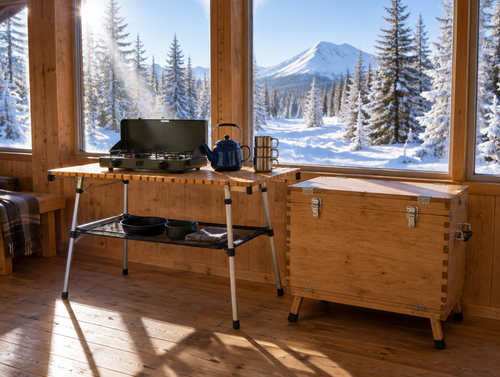
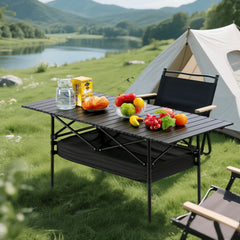
The folding-table-and-bins kitchen is the default for a reason. You grab a roll-up or fold-in-half table, throw your stove on top, and store everything else in totes that ride in the trunk. Standard camp tables land around 28 inches tall — comfortable for seated dining, but about 8 inches lower than a 36-inch kitchen counter, which is why standing over one to chop and stir gets old fast. Most pack-flat aluminum models weigh somewhere between 10 and 17 pounds on their own, before you add a single bin.
The bins do the storage half of the job. A typical two-person kit lives in one large tote for cookware and utensils plus a smaller one for food and consumables. Nothing here is wrong — it's modular, replaceable, and you can build it for under a hundred dollars. But notice that you're now managing two separate systems: a surface that does no storing, and storage that gives you no surface.


Where the table-and-bins kitchen actually shines
Before we bury it, give the DIY setup its due. It genuinely wins in a few situations:
- Lowest entry cost. A decent folding table and two totes is the cheapest way to get a functional camp kitchen, full stop.
- Infinite modularity. Cooking for two this weekend and eight the next? Add a bin. Leave the table home and eat off the tailgate. Nothing is locked together.
- Easy to replace. Crack a tote or bend a table leg and you're out twenty bucks, not a whole kitchen.
- Bins double as furniture. Hard-sided boxes can serve as a stool or an extra surface, and they stack neatly for off-season storage in the garage.
If you camp once or twice a year and store your gear loose in a closet anyway, this is probably all you need. The math changes when camping becomes a habit.

Where it breaks down at camp
The cracks show up in the field, not the driveway. The same pain points come up again and again from car campers running the table-and-bins system:
- The table rocks. Few campsites are level. A wobbling table means a tipped coffee, a sliding pan, and a stove that won't sit flat — the single most common complaint about the setup.
- You dig for everything. Bins have no internal map. Finding the can opener at dusk usually means unpacking half a tote with a headlamp in your teeth.
- Weather gets in. Open a lid in the rain or set bins on dusty ground and grit ends up on your cookware. Loosely-lidded totes aren't truly weatherproof.
- You forget things. With no fixed home for each item, something always gets left on the kitchen counter at home — usually the thing you need most.
- Multiple trips to deploy. Table out, legs locked, stove staged, bins hauled, lids off, gear sorted. It's a load-and-unload chore at both ends of the trip.
None of these is a dealbreaker on its own. Stacked together, trip after trip, they're exactly the friction that sends people looking for something better. We dug into the storage half of this problem specifically in our camp kitchen box guide.

The all-in-one camp kitchen approach
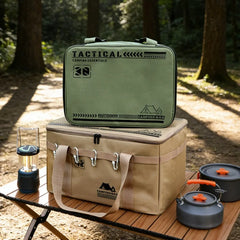
An all-in-one camp kitchen box solves the table and the bins at the same time by making them the same object. Instead of a surface plus separate storage, you get a weatherproof hard case that opens into a prep surface with your gear already inside, organized, and ready.
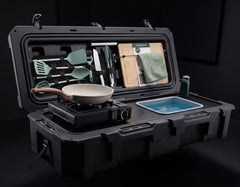
The VOZ Camp Kitchen is the clearest example of that idea. It folds a butane stove, a real sink fed by a USB-rechargeable faucet, a 2-gallon removable water tank, cookware, and 30-plus camping items into one case that weighs about 57 pounds loaded. It sets up in well under a minute, and because everything has a fixed home, there's no digging and nothing to forget — the box is the packing list. The hard shell handles dirt, rain, and the heat of hot pans the way a lidded tote never does.


The trade is real, though: you lose the loose modularity of separate pieces, and you carry one heavier object instead of several light ones. Premium boxes like GCI Outdoor's Slim-Fold Cook Station take a middle path, stacking three levels of storage racks under a stove-ready aluminum top — we break those down in our VOZ vs. GCI Outdoor comparison.
Side by side
| Folding table + bins | All-in-one camp kitchen | |
|---|---|---|
| Upfront cost | Lowest — build under $100 | Higher — one bigger purchase |
| Setup time | Several minutes, multiple steps | Under a minute, one motion |
| Organization | Dig through bins | Fixed spot for each item |
| Stability on uneven ground | Wobbles unless shimmed | Integrated legs and surface |
| Weather protection | Lidded totes leak grit and water | Sealed hard case |
| Water at camp | Add a separate jug | Built-in tank, sink, and faucet |
| Modularity | Endless — mix and match | Fixed kit, one object to carry |
| Pack weight | Light pieces, but several of them | One heavier unit (~57 lb loaded) |
Which one is right for you?
The honest answer comes down to how often you camp and how much the friction bothers you.
- Stick with table and bins if you camp a handful of times a year, your trips are casual, and budget is the deciding factor. The system works — you just manage its quirks.
- Move to an all-in-one box if you camp five or more times a year, value a fast, repeatable setup, and you're tired of forgetting gear and leveling a wobbly table. That's roughly the threshold where the time and frustration saved each trip start to outweigh the higher upfront cost.
A useful middle road: keep a lightweight folding table for extra surface and seating, but let an all-in-one box be the actual kitchen. You get a stable cook station and a fixed packing list, plus a spare table when the group grows. If you're weighing the box against a traditional wooden chuck box rather than bins, that's a different matchup — see our camp kitchen vs. chuck box breakdown.
FAQ
Is a camp kitchen box really faster than a table and bins?
Yes, mainly because there's only one thing to deploy. A folding table plus bins is several steps — unfold, lock legs, stage the stove, haul totes, pull lids, sort gear. An all-in-one box opens into its surface with the gear already inside, which is why a good one sets up in under a minute.
Can I just use bins without a table?
You can cook off a sturdy hard-sided tote in a pinch, but it's low and unstable for a stove. Bins are storage; they don't solve the work-surface problem. That's exactly the gap an integrated box closes by being both at once.
What about water — doesn't the bin setup need a separate jug?
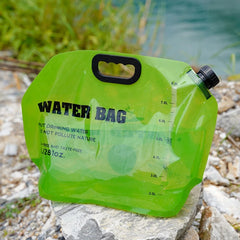
It does. The table-and-bins kitchen has no plumbing, so you add a water jug or collapsible container and a separate wash basin. A box like the VOZ Camp Kitchen builds in a 2-gallon tank, a sink, and a USB-rechargeable faucet, so hand-washing and dish cleanup happen at the station instead of at a spigot across the campground.
Is the bin setup lighter to carry?
Each piece is lighter — a folding table runs 10 to 17 pounds and bins are light when not full — but you're carrying several pieces and making multiple trips. An all-in-one box is heavier as a single object (around 57 pounds loaded for the VOZ) but it's one grab-and-go unit.
Ready to upgrade your camp kitchen?
The VOZ Camp Kitchen includes everything you need in one weatherproof case. Sets up in 15 seconds.
Shop VOZ Camp Kitchen →