Roof Top Tent Camp Kitchen: Cooking Setups That Work When You Sleep on the Roof

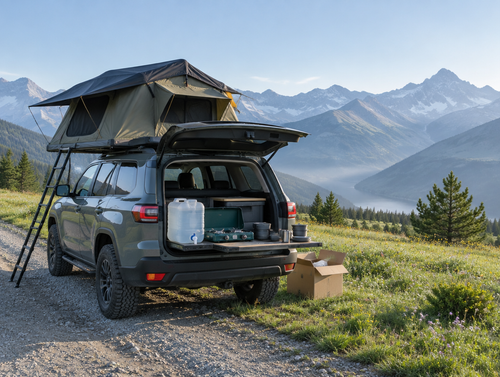
A roof top tent puts your bed on the roof — and quietly evicts your kitchen. The rack that used to carry a cargo box now carries the tent, so every burner, pot, and drop of dishwater has to ride inside the vehicle and cook at ground level. Here's how to build a cooking setup that matches the way roof top tent camping actually works.
Why a Roof Top Tent Rewrites the Kitchen Plan
Roof top tents have moved from overlanding novelty to mainstream car-camping gear. Industry research valued the U.S. roof top tent market at about $168 million in 2023 and projects it to reach roughly $287 million by 2030 — around 8% growth per year. That's a lot of campers discovering the same problem on their first trip: the tent solves sleeping and creates a kitchen puzzle.
The puzzle has three pieces:
- The roof is spoken for. A softshell roof top tent typically weighs 80–150 lbs and a hardshell 150–300 lbs, which uses up most or all of a roof rack's rated load. The rooftop cargo box that might have carried your cooking gear no longer has a home up there.
- The cargo area is crowded. Recovery gear, a fridge or cooler, chairs, clothes, and firewood all compete for the same trunk or truck bed. Whatever kitchen you bring has to be dense, stackable, and quick to dig out.
- Cooking always happens at ground level. Unlike a van with a built-in galley, nothing about a roof top tent rig is plumbed or wired for cooking. Every single night, the kitchen gets carried out, set up, used, cleaned, and put away.
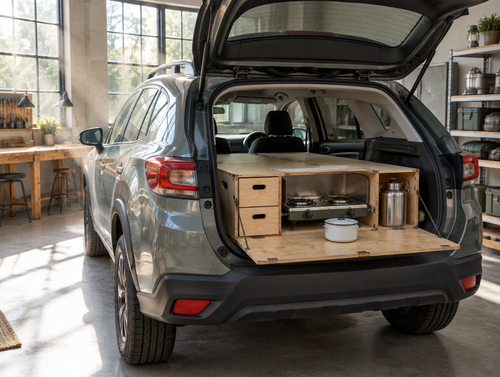
There's one genuine gift in the arrangement: most roof top tents fold up with your bedding still inside. That frees a duffel's worth of cargo space — space most campers immediately hand over to the kitchen. The constraint isn't total volume so much as shape and speed, the same math we walk through for wagons and crossovers in our guide to a camp kitchen that fits behind the rear seats of an SUV.

The Four Kitchen Layouts Roof Top Tent Campers Actually Use
Walk any overland rally and you'll see the same four cooking setups repeated under hundreds of different tents.
| Layout | Deploy effort | Where it rides in transit | Best for |
|---|---|---|---|
| Tailgate kitchen | Low — drop the gate, set the stove | Truck bed or cargo floor | Trucks and hatchback SUVs, quick meals |
| Slide-out drawer galley | Low once installed | Permanently bolted in the cargo area | Dedicated overland builds, one-vehicle owners |
| Folding table + bins | High — many carries, many steps | Loose pieces wherever they fit | Tight budgets, occasional weekends |
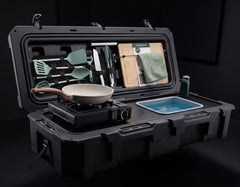
| All-in-one kitchen box | Low — one carry, opens ready to cook | One flat case in the cargo area | Frequent movers, families, mixed-use vehicles |
Each has a catch. A tailgate kitchen gives you counter height for free, but if your tent overhangs the rear of the vehicle — common on wagons and SUVs — the ladder often drops right where you want to cook, and the gate has to stay clear for tent access. A drawer galley is slick but expensive, adds permanent weight, and commits one vehicle to camping duty year-round. The table-and-bins approach costs the least up front and the most every single evening: multiple trips, loose parts, and a hunt for the spatula while your burner runs.
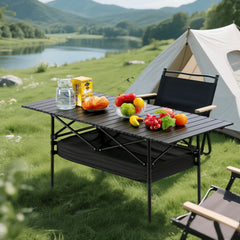
If you go the table route, at least make the table a fast one — a roll-up aluminum model pitches in a minute and stows flat against the cargo wall.


The One-Box Answer: A Ground Kitchen as Fast as Your Tent
The strongest argument for an all-in-one box is rhythm. A hardshell roof top tent deploys in a minute or two; a softshell takes a few minutes more. If your bed is ready in two minutes and your kitchen takes twenty, the kitchen is now the slowest thing in camp — and on a multi-stop route you'll feel that every night.
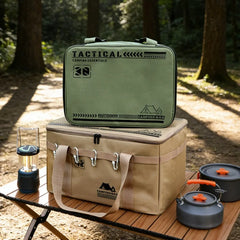
This is exactly the case the VOZ Camp Kitchen was built for. It's one weatherproof case, about 57 lbs, that opens into a working kitchen in under 15 seconds — stove, sink, USB-rechargeable faucet, water tank, and 30+ cooking items already in their places. Packed, it measures 47.6" × 19.3" × 11.4", a long flat shape that slides under duffels or stands on edge against the cargo wall instead of monopolizing the floor. One carry from the vehicle, one carry back. For the broader picture of matching a kitchen to a specific rig, our vehicle camp kitchen guide for trucks, vans, trailers, and RVs breaks down every configuration.


Camp Layout: Ladder Clearance, Awning Side, and Where the Stove Goes
With a roof top tent, the kitchen's position is dictated by two fixed features: the ladder and the awning.
- Keep the ladder lane clear. The ladder is the only way in and out of bed — including 2:00 AM trips and pre-coffee descents. Never set a stove, fuel canister, or hot cast iron where a half-awake person lands.
- Cook on the awning side. Most rigs mount the awning on the side opposite the ladder. That gives you a shaded, rain-protected cooking strip along the vehicle with the ladder lane untouched.
- Use the vehicle as a windbreak. Park with the prevailing wind hitting the ladder side, and the body of the truck shelters the burner on the awning side.
- Mind what rises. Your tent floor and mattress sit directly above the cooking zone. Set the stove far enough out from the vehicle that steam, smoke, and grease drift away from the fabric, not into it.
One hard rule: never run a stove inside the tent, inside the vehicle, or inside a zipped-up annex room. The U.S. Consumer Product Safety Commission warns against using any portable fuel-burning camping equipment inside a tent, camper, or vehicle, and reports at least 12 deaths from carbon monoxide poisoning associated with camping equipment such as grills, lanterns, and stoves since 2020. An annex is a fine changing room, gear pantry, or rain-sheltered prep station — with the stove outside at the open edge, in moving air.

Food and Water When You Sleep Above the Kitchen
Sleeping on the roof doesn't exempt you from tent rules. The National Park Service is blunt about food storage in bear country: all food, drinks, coolers, cookware — clean or dirty — and anything scented must be stored in a hard-sided vehicle with the windows up or in a bear-resistant locker when not in immediate use, and never in a tent. A roof top tent is still a tent. The nightly routine that keeps you compliant is simple: kitchen closes, kitchen goes back in the cab, doors shut, then you climb the ladder.
This is another place the one-box layout quietly wins. When the kitchen is forty loose items, "pack it all away every night" is a chore people skip; when it's one case that latches shut with everything inside, the bear-safe move and the lazy move are the same move.
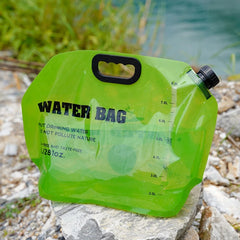
Water deserves the same planning as food. A built-in tank covers the sink for dishes and hand-washing, but carry backup capacity — a rigid jug or collapsible bag with a spigot — sized to roughly a gallon per person per day of cooking and cleanup, refilled at trailheads or camp spigots. Ours ride in the footwell behind the front seats, where the weight sits low and can't crush anything.


FAQ
Can I cook in the annex room under my roof top tent?
Not with a fuel-burning stove. The CPSC's carbon monoxide warning covers any enclosed fabric space, and an annex zipped up tight is exactly that. Use the annex for prep, storage, and shelter, and run the burner outside at the open edge where air moves freely.
Do I have to tear down the kitchen every time I want to drive somewhere?
Yes — and with a roof top tent you're already closing the bedroom to drive, so the kitchen should match that pace. A box that packs in one carry keeps a mid-day supply run from becoming a 30-minute teardown. This is the single biggest difference between roof top tent camping and a ground-tent base camp, where the kitchen can stay standing while you drive away.
Where does a kitchen box fit if my cargo area is already full?
Flat and low. A long, shallow case rides under soft duffels or stands on edge against a wheel well, and heavy items belong on the floor, not the roof — your rack is already at or near its rated load with the tent on it. If the box shape still won't work, split the difference: kitchen box in the cargo area, clothes in soft bags stuffed into the tent's fold or the back seat.
Is a tailgate kitchen enough, or do I need a table too?
For coffee and one-pan meals, the tailgate alone works fine. For a real dinner — two burners going, cutting board out, dishes staging — you'll want a second surface, because the gate fills up fast. A kitchen box with a usable lid or fold-out counter covers this without adding a separate piece of furniture to the load.
Ready to upgrade your camp kitchen?
The VOZ Camp Kitchen includes everything you need in one weatherproof case. Sets up in 15 seconds.
Shop VOZ Camp Kitchen →