Camp Kitchen for Road Trips: Cooking at Rest Areas, Trailheads, and Parking Lots (State-by-State Stove Rules)

You can cook a hot lunch at most interstate rest areas in the US, as long as the flame lives inside a gas camp stove and you pack up before anyone could mistake you for a camper. Every state writes its own rule, and a few ban outdoor cooking outright. Here is what the regulations say, plus the rest-area lunch routine that gets a road-trip camp kitchen from tailgate to plate in about 15 minutes.
Can you cook at a rest area? The short answer
Federal rules do not decide this. Title 23, Part 752 of the Code of Federal Regulations defines a rest area as a facility "for rest, relaxation, comfort and information needs" and says nothing about stoves. Each state DOT sets its own rule, in three buckets:
- Gas stoves explicitly allowed. California and Oregon name propane or gas camp stoves as permitted equipment. Idaho and New York allow fires "in a stove." Open ground fires are banned everywhere.
- Fires only in state-provided grills. Florida, Nevada, and Virginia limit fire to fireplaces or grills the state built. A portable gas stove is a gray area at best in those states, so plan on a cold lunch or a picnic-area grill.
- No flames at all. Tennessee posts "No grilling or open flames allowed at any location" alongside a two-hour parking limit.
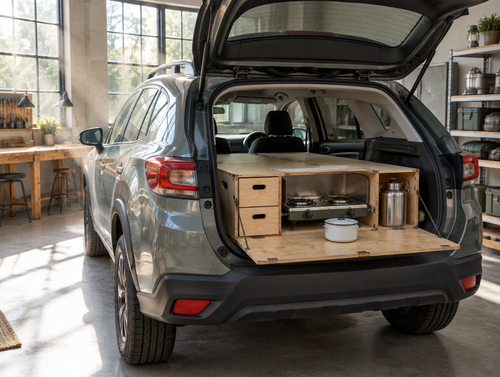
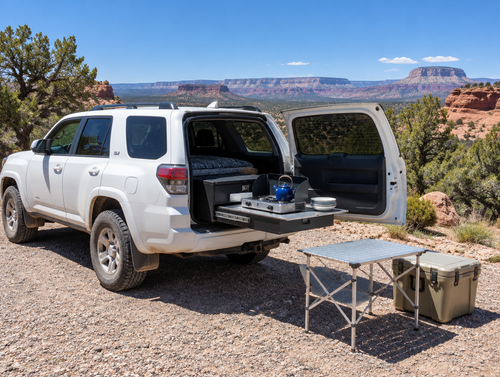
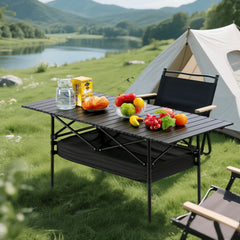
The second thing every state polices is camping. Arizona's Department of Transportation allows overnight sleeping in your vehicle, but its posted rules prohibit camping and campfires, and Arizona does not define camping. A trooper decides. Awnings, chairs, leveling jacks, and gear spread around the vehicle are the usual tells. A kitchen that opens on the tailgate and closes into one box in seconds is the opposite of a tell, which is why a box beats a fold-out table for road trips.
State-by-state stove rules at rest areas
These are the states whose rest-area regulations we read in the primary text. Individual rest areas can post shorter limits, and a posted sign always wins.
| State | Portable gas stove | Stay limit | Where the rule lives |
|---|---|---|---|
| California | Allowed. Small portable gas campstoves and charcoal hibachis may be used on the ground or designated stands. Open fires banned. | 8 hours in any 24 | 21 CCR §2205 |
| Oregon | Allowed. "Lighting a fire of any kind, other than propane or gas fueled camp stoves and grills" is prohibited. | 12 hours in any 24 | OAR 734-030-0010 |
| Washington | Not addressed. Open fires prohibited; camping and tents unlawful. | 8 hours in any 24 | RCW 47.38.020 |
| Idaho | Allowed. Fires outside "the confines of a stove, grill or fireplace" prohibited. | 10 hours on interstates, 16 on other state routes | IDAPA 39.03.50 |
| Nevada | Restricted. No fire outside fireplaces or grills in designated areas. | 18 hours in any 2-week period | NAC 408.605, 408.615 |
| Arizona | Not addressed. Camping and campfires prohibited; outdoor cooking can be read as camping. | No statewide limit | ADOT posted rules |
| Texas | Not addressed. Statute bans tents, shelters, and structures. | 24 hours | Transp. Code §545.411 |
| Florida | Restricted. Grilling only where the state provides grills in the picnic area. | 3 hours (10 for commercial drivers) | FAC 14-28.002 |
| Tennessee | Banned. No grilling or open flames at any location. | 2 hours, no overnight | TDOT posted rules |
| Virginia | Restricted. No fire except at designated areas built for the purpose. | No overnight parking | 24VAC30-51-30 |
| New York | Allowed. Fire permitted in site fireplaces, portable fireplaces, charcoal braziers, or stoves. Not within 10 feet of a tree or building. | Posted per site | 17 NYCRR 156.6 |
California, Oregon, and Idaho are the friendliest to a gas stove. Florida, Tennessee, and Virginia are where you eat sandwiches or use a picnic-area grill. Everywhere else, a stove is neither named nor banned, so keep it small, on a table or tailgate, and keep the stop short.

Trailheads and Forest Service parking: different rules entirely
A trailhead lot is public land, not a highway facility, so the table above does not apply. The rules come from the forest order or BLM field office that manages the ground, and they change with fire danger.
- California requires a permit for a gas stove. Outside a developed campground, you must carry a free California Campfire Permit to run a portable gas stove or lantern on Forest Service, BLM, or CAL FIRE land.
- Forest orders can ban stoves in specific lots. The Inyo National Forest order in effect through July 3, 2027 prohibits "using a fire, campfire, or stove fire" inside its Recreation Restriction Areas except in facilities provided at developed sites. Popular Eastern Sierra trailheads sit inside those areas.
- Fire-restriction stages change what a stove means. Stage 1 orders typically still allow a pressurized gas stove with a shutoff valve; higher stages may not. Our guide to camp kitchen stove rules during a fire ban walks through each stage.
The National Park Service adds one rule for any trailhead in bear country: cook and store food away from where you sleep, and clean up the moment you finish eating. A box kitchen helps because grease, scraps, and the cutting board go back into a sealed case rather than a loose bin.
Parking lots: retailers, truck stops, and the "don't look like camping" test
Private lots are the least regulated and the least tolerant. Walmart's overnight guidance, as reported across RV guides, comes down to one night, no awnings, no chairs, no grills. The same expectation holds at truck stops and casino lots: sleep inside, cook inside, leave nothing outside.
That makes parking lots a place for a five-minute cold breakfast. Save the burner for the rest area or trailhead. If you must boil water at a lot, a single-burner cassette stove on the tailgate is about the limit of what passes, and even that draws attention in an urban lot. We covered the lot-side version of this setup in our camp kitchen for tailgating guide.


The 15-minute rest area lunch workflow
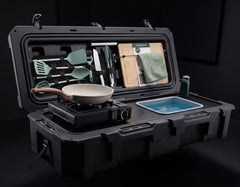
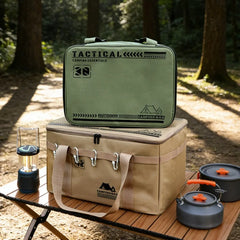
This is the routine we use with the VOZ Camp Kitchen on multi-day drives. The box weighs about 57 pounds and closes to 47.6 by 19.3 by 11.4 inches, so it rides flat in the cargo area. Setup is under 15 seconds because the stove, sink, water bag, and cutting board are already mounted inside the case. Nothing gets unpacked onto the ground, which is the whole point at a rest area.


- Minute 0 to 1: pick the spot. Park at the far end of the lot near the picnic tables, away from the truck lanes. Check the posted sign for the fire rule and time limit.
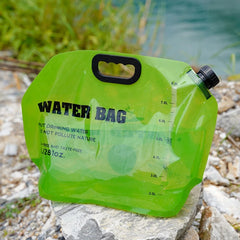
- Minute 1 to 2: open the box on the tailgate. Lid up, sink out, stove lid off, butane canister clicked in. The USB-rechargeable faucet draws from the 2-gallon water bag, so hand washing happens at the tailgate instead of a walk to the restroom.
- Minute 2 to 10: cook one-pan food. Quesadillas, eggs, or pasta from the cooler. An 8-ounce butane canister runs roughly an hour on high, so a lunch stop uses a fraction of a can.
- Minute 10 to 13: eat at the picnic table, not on the tailgate, so the vehicle never looks like a campsite.
- Minute 13 to 15: wash, drain, close. Rinse the pan in the sink, pour grey water into the restroom sink, never a storm drain or the grass. Everything nests back in the case and the lid latches.

Two food-safety numbers govern the cooler side of this routine. FDA outdoor-eating guidance says perishable food should never sit between 40 and 140 degrees Fahrenheit for more than 2 hours, or 1 hour when the outdoor temperature tops 90 degrees. On a summer drive through Nevada or Texas, the cooler stays closed until the pan is hot and leftovers go straight back on ice.
Packing a camp kitchen for a road trip
A rest-area kitchen packs differently than a campsite kitchen. The goal is fewer decisions at every stop.
- Fuel by the stop. Count planned hot meals and carry two spare canisters beyond that. Butane is sold at most grocery and hardware stores along interstates, so you never need a full case.
- A second water jug. The 2-gallon bag inside the box handles cooking and washing at a stop. Carry a second jug and refill at rest-area spigots or the sources in our guide to refilling a camp kitchen water tank on the road.
- Cold-side simplicity. Pre-cook proteins at home and vacuum-seal them so the stove only reheats.
- One trash bag, one grey-water bottle. Rest areas provide trash cans but rarely dish sinks. A capped bottle for grey water lets you leave a clean site.
- The permit folder. Print the California Campfire Permit and screenshot the rest-area rules for each state on your route.
If you are still deciding which box to build this routine around, our guide to the best camp kitchen setup in 2026 compares closed-case kitchens against fold-out tables on these road-trip criteria: setup time, footprint, and how fast it disappears back into the vehicle.
FAQ
Is it legal to use a propane or butane stove at a rest area?
In California, Oregon, Idaho, and New York, yes, by the text of the regulation. In Florida, Nevada, and Virginia, fire is limited to state-built grills and fireplaces, so a portable stove is not clearly permitted. Tennessee bans all flames. Most other states do not mention stoves, so a small stove on a table for a short stop is generally tolerated but never guaranteed.
Can I cook at a trailhead parking lot?
Usually, but check the forest or BLM order for that area, the current fire-restriction stage, and, in California, whether you hold a campfire permit. Some forest orders, like the current Inyo order, ban stove fires outside developed sites in specific zones.
What counts as "camping" at a rest area?
No state gives a precise definition. Enforcement keys on tents, awnings, chairs, gear spread outside the vehicle, and stays past the posted limit. Cooking from a closed box on a tailgate and eating at the picnic table is unlikely to read as camping. A stove on the ground with chairs around it might.
How long can I stay at a rest area while I cook?
From 2 hours in Tennessee and 3 in Florida to 8 in California and Washington, 12 in Oregon, and 24 in Texas. A hot lunch takes 15 minutes, so the limit only matters if you also plan to sleep there.
Ready to upgrade your camp kitchen?
The VOZ Camp Kitchen includes everything you need in one weatherproof case. Sets up in 15 seconds.
Shop VOZ Camp Kitchen →