Can You Use a Camp Kitchen During a Fire Ban? Stove Rules by Restriction Stage

You pull into the campground, and there it is: the "NO CAMPFIRES — FIRE RESTRICTIONS IN EFFECT" sign. Does that mean your camp kitchen stays in the truck? Almost never — and understanding exactly what each restriction stage allows is the difference between eating hot meals all week and eating cold tortillas next to a cold fire ring.
The Short Answer: A Gas Stove With a Shut-Off Valve Is Usually Legal
Fire restrictions on federal and most state land follow a standardized three-stage system, and the stages are written around one key distinction: flames you can kill instantly versus flames you can't. A campfire keeps burning after you walk away. Charcoal holds heat for hours and produces ash that blows. A pressurized-gas stove goes from cooking to completely out with a quarter turn of a valve — which is why the U.S. Forest Service exemption language in Stage 1 and Stage 2 orders specifically allows "a stove or grill that is solely fueled by pressurized liquid petroleum or pressurized liquid petroleum gas (LPG) fuels."
| Restriction level | Wood campfires | Charcoal | Gas stove with shut-off valve |
|---|---|---|---|
| No restrictions | Allowed | Allowed | Allowed |
| Stage 1 | Only in developed sites with agency fire rings | Only in developed sites with agency fire rings | Allowed |
| Stage 2 | Prohibited everywhere | Prohibited everywhere | Allowed |
| Stage 3 / closure | Prohibited — area closed to entry | Prohibited — area closed to entry | Prohibited — you can't be there at all |
That's the framework. The details per stage matter, though, because "allowed" always comes with conditions — and every forest, park, and county writes its own order. Here's how each stage plays out for an outdoor cook.
Stage 1: Campfires Retreat to Developed Sites — Your Stove Doesn't
Stage 1 kicks in when fire danger climbs. Under a typical Stage 1 order — Coconino National Forest's is a good example of the standard language — igniting, building, or maintaining any fire, including charcoal and briquettes, is prohibited except inside a developed recreation site with an agency-provided fire ring or grill structure. A rock ring at a dispersed site doesn't count. Your own portable fire pit doesn't count either.
Notice what that means for boondockers: Stage 1 hits dispersed campers hardest, because the campfire exemption only exists inside fee campgrounds. If you're cooking off-grid on BLM or Forest Service land, Stage 1 is effectively a total campfire ban for you — but your gas-fueled camp kitchen keeps working exactly as it did before. That's not a loophole; it's the design. Land managers want people to keep cooking on pressurized-gas appliances because those flames die the instant you close the valve.

Stage 2: No Campfires Anywhere — But the Stove Still Runs
Stage 2 is the escalation you're most likely to meet in August. Everything from Stage 1 stays banned, and the developed-campground exemption disappears: no wood fires and no charcoal anywhere, including inside campgrounds with steel fire rings. Typical Stage 2 orders also prohibit welding and open-flame torches, and restrict chainsaws and generators to certain hours or cleared areas.
The pressurized-gas stove exemption survives into Stage 2 almost everywhere, with the same wording as Stage 1. Olympic National Park and Olympic National Forest are running exactly this playbook right now: under restrictions in effect since June 26, 2026, all backcountry, dispersed, and beach campfires are banned, charcoal grills and anything that produces ash are prohibited — and "gas or propane camp stoves equipped with an on/off valve that can extinguish the flame immediately are permitted," provided you use them well away from flammable vegetation and forest litter. Last summer the Olympic Peninsula went further: a total campfire ban took effect August 1, 2025, and gas stoves with a shut-off valve were still the one cooking flame allowed.
One caution: a small number of extreme orders do ban even pressurized-gas flames outdoors. They're rare, but they exist, which is why checking the actual order — not a two-year-old forum thread — is part of the trip plan.
Stage 3: Closure — Nothing Is Legal Because You Can't Be There
Stage 3 isn't a stricter list of rules; it's a closure. When conditions get bad enough that Stage 2 restrictions can't manage the risk, the agency closes the forest or area to public entry entirely. No entry means no camping, no hiking, no stove debate. If your destination goes to Stage 3, the only move is a new destination.
What Makes a Stove "Fire-Ban Legal"
Read enough restriction orders and the same three requirements keep showing up. A compliant stove must:
- Run on pressurized liquid fuel or gas — propane, butane, or isobutane from a sealed canister or tank. The fuel supply physically stops when the valve closes.
- Have an on/off valve that extinguishes the flame immediately. This is the phrase nearly every order repeats.
- Produce no ash or embers. Anything that burns solid fuel — wood, twigs, charcoal, briquettes, pellets — fails this test automatically.
That last point rules out more gear than people expect. Twig-burning stoves, solid-fuel tablet stoves, and portable wood-fired pizza ovens all produce ash or embers, so they're treated as campfires under Stage 1 and banned outright under Stage 2. The exemption language covers pressurized-fuel appliances, period.
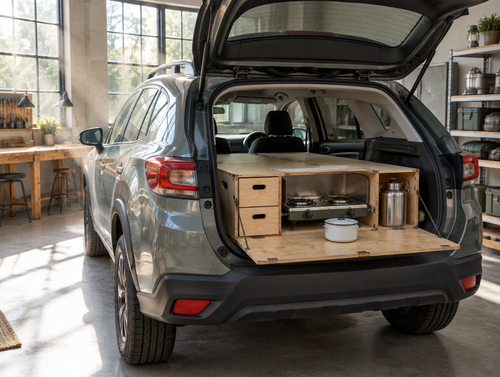
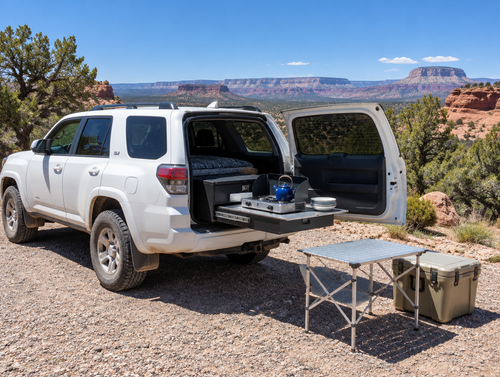
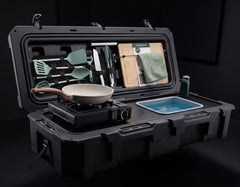
This is exactly why an all-in-one box built around a gas burner earns its keep in August. The VOZ Camp Kitchen cooks on a pressurized-gas stove with a control valve — the configuration restriction orders are written to allow — and because the sink, water tank, and USB-rechargeable faucet are part of the same case, you also have running water standing next to your only open flame. During fire season, that's not a convenience feature; it's your first response if something nearby starts to smolder.


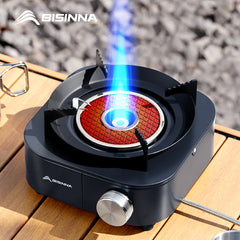
The same logic applies to standalone propane and butane camp stoves: cassette burners, two-burner propane units, and infrared gas burners all pass the pressurized-fuel-plus-valve test. What matters during a ban isn't the BTU number — it's the fuel type and the valve.


Running Your Camp Kitchen Under a Ban: Five Habits That Keep You Legal
The exemption isn't unconditional — orders consistently require gas stoves to be used in an area cleared of flammable material. Build these habits into your setup routine:
- Set up on bare ground, gravel, or a table. National Park Service guidance for the 2025 Olympic ban required nothing flammable within three feet of the stove. Dirt pad, gravel, or a metal picnic table — not dry grass or pine duff.
- Keep the clearing bigger than the flame. Sweep away needles and leaves before you light anything. Ten seconds with a boot does it.
- Mind the wind. A gust that flares your burner sideways is exactly the scenario rangers worry about. Use your stove's windscreen and orient the box so the case shields the flame.
- Never walk away from a lit burner. The whole legal theory of the exemption is that you can shut it off instantly. That only works if you're standing there.
- Keep water at the ready. A filled tank and working faucet mean you can douse a stray ember in seconds.
None of this slows you down. A box-style kitchen that deploys in under 15 seconds takes exactly as long to set up on a gravel pad as it does anywhere else — and picking that pad is the same decision you'd make anyway, covered in our guide to where to set up a camp kitchen.
Check Before You Go — and Know What a Violation Costs
Restrictions change week to week in summer, and they're set independently by each national forest, national park, state, and county — the campground side of a road can be under a different order than the dispersed land across from it. Before you leave:
- Check the Alerts page of the specific national forest on fs.usda.gov — every forest posts its current restriction stage and the signed order.
- Check the park's current conditions page on nps.gov for national parks.
- Check the county sheriff or state forestry site for private and state land — county burn bans are separate from federal ones.
Take the rules seriously, because the penalties are federal. Violating a Forest Service fire restriction order is a misdemeanor under 36 CFR 261, punishable by a fine of up to $5,000 for an individual ($10,000 for an organization), up to six months in jail, or both — and if your fire escapes, civil liability for suppression costs can run far beyond that.
FAQ
Can I use a butane cassette stove during a fire ban?
In Stage 1 and Stage 2, yes, almost everywhere. A cassette stove runs on a pressurized butane canister and shuts off with a valve, so it meets the standard exemption. The same conditions apply: clear the area around it and stay with it while it's lit.
Is a propane fire pit allowed?
It depends on the order. Many Stage 1 orders allow propane fire pits because they have a shut-off valve and produce no embers, but Stage 2 orders vary — some exempt only stoves and grills used for cooking. Read the specific order or call the ranger district; "propane" alone isn't a free pass for ambiance flames.
Can I grill with charcoal in a campground during Stage 1?
Only inside a developed recreation site, and typically only in the agency-provided fire ring or grill structure. Under Stage 2, charcoal is banned everywhere — it produces exactly the long-lived embers and ash the restrictions target. A gas grill with a shut-off valve is the fire-season substitute.
Do fire bans apply on beaches and at dispersed sites?
Yes. The 2026 Olympic restrictions specifically prohibit campfires on park beaches and at all dispersed and backcountry sites. Sand doesn't make a fire safe — wind-blown embers do the damage, not the ground under the flames.
What if the restriction changes while I'm already out there?
New orders take effect on their posted date whether or not you've seen the news. Campground hosts post notices, and rangers patrol during escalations, but the responsibility is yours — check the forest's alert page whenever you have signal, and default to stove-only cooking when conditions look dry.
- How to Set Up a Camp Kitchen in Under 15 Seconds (Step-by-Step)
- Where to Set Up Your Camp Kitchen: Placement and Safety Rules That Actually Matter
- Camp Kitchen for Boondocking and Dispersed Camping: Cooking With No Hookups
- Propane for Your Camp Kitchen: 1-lb Canisters vs. 20-lb Tank (How Much to Bring)
- Cooking With a Camp Kitchen in Rain and Wind: How to Weatherproof Your Setup
Ready to upgrade your camp kitchen?
The VOZ Camp Kitchen includes everything you need in one weatherproof case. Sets up in 15 seconds.
Shop VOZ Camp Kitchen →