Propane for Your Camp Kitchen: 1-lb Canisters vs. 20-lb Tank (How Much to Bring)

Every camp cook eventually stands in the fuel aisle asking the same question: grab a few of those small green 1-lb propane canisters, or haul the 20-lb grill tank and an adapter hose? The honest answer depends on three numbers — how much energy each bottle holds, how fast your stove drinks it, and how many days you're out. Here's the math, worked out for the way a camp kitchen actually gets used.
The Raw Numbers: What Each Bottle Actually Holds
Fuel bottles are just stored heat, and the spec that matters is total BTU — the same unit your stove's burner is rated in. A standard 1-lb (16.4 oz) propane canister holds roughly 21,500 BTU of energy. A 20-lb refill-exchange tank — the kind that runs a backyard grill — holds about 4.7 gallons of propane, or roughly 430,000 BTU. That's the whole comparison in one line: one 20-lb tank carries about the same energy as twenty 1-lb canisters.
| Container | Approx. energy | Weight full | Weight empty |
|---|---|---|---|
| 1-lb propane canister | ~21,500 BTU | ~2 lb | ~1 lb |
| 20-lb propane tank | ~430,000 BTU | ~37 lb | ~17–18 lb (tare) |
| 8-oz butane cassette | ~10,000 BTU | ~12 oz | ~4–5 oz |
Notice the weight column, because it's the hidden cost of the big tank. A 20-lb cylinder weighs around 37 lb full — the steel bottle itself is 17 to 18 lb before any propane goes in. You're carrying almost a pound of steel for every pound of fuel. The little canisters are worse per BTU at the register, but far friendlier to carry, pack, and stow.

Burn-Time Math on a Real Camp Stove
Runtime is simple division: total BTU in the bottle divided by the BTU per hour your burner consumes. A typical single-burner camp stove in the 10,000 BTU class, run wide open, empties a 1-lb canister in about two hours. Step up to a two-burner propane stove — our 17,000 BTU 2-burner with windshield is a good example — and with both burners at full blast that same canister is gone in about an hour and a quarter.


| Stove output (full flame) | 1-lb canister | 20-lb tank |
|---|---|---|
| 10,000 BTU single burner | ~2 hrs | ~43 hrs |
| 17,000 BTU two-burner (both lit) | ~1.3 hrs | ~25 hrs |
Those are worst-case, throttle-pinned numbers. Real camp cooking doesn't work that way — you boil hard for a few minutes, then simmer at a fraction of max output. Turned down to half flame, every figure in that table roughly doubles. For most families, actual burner time lands around one to one and a half hours per day: coffee and breakfast in the morning, one real dinner at night. That single assumption drives every "how much do I bring" answer below.
Propane vs. Butane: Which Fuel Does Your Stove Want?
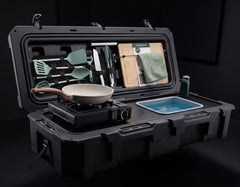
Before you count canisters, check which fuel your burner actually takes, because camp kitchens commonly involve both. The VOZ Camp Kitchen runs a drop-in cassette stove fed by 8-oz butane canisters — the slim, hairspray-shaped bottles sold at any camping aisle or grocery store. Standalone two-burner camp stoves are usually propane, fed by the green 1-lb bottles or a bulk tank.


The practical differences come down to three things:
- Cold weather. Propane boils at about −44°F, so it keeps vaporizing and burning in any weather you'd realistically camp in. Butane stops vaporizing right around 32°F — at freezing, a butane cassette stove sputters or won't light at all. For three-season car camping this rarely matters; for shoulder-season and winter trips, propane is the reliable choice.
- Energy per canister. An 8-oz butane cassette holds roughly 10,000 BTU — about half the energy of a 1-lb propane bottle. Budget accordingly: on a cassette burner, figure one canister per day of normal cooking, and pack one extra.
- Packability. Butane cassettes are lighter and slimmer than propane bottles, which is exactly why cassette stoves are the standard for box kitchens — the stove and several days of fuel stow flat inside the case.
There's no wrong answer here — it's one fuel logic for the built-in cassette burner, another for a standalone propane stove, and plenty of campers run both on the same trip.
What Fits Inside the Box (and What Rides in the Truck)
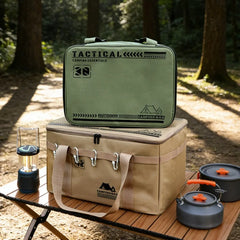
Fuel storage is where the two formats really separate. Butane cassettes and 1-lb propane canisters tuck inside a camp kitchen box alongside the cookware — the whole kitchen, stove and fuel included, moves as one carry. Our full kit breakdown shows how the stove and canister storage share the case with the sink, faucet, and 30-plus other pieces.
A 20-lb tank is a different animal. At ~37 lb full it weighs more than many loaded camp kitchen boxes, it can't stow inside anything, and it wants to ride upright and secured in the truck bed or cargo area. That's not a knock — for a week-long base camp it's the cheapest, longest-running fuel supply you can bring. It just means the tank is its own piece of cargo with its own spot in the packing plan, not part of the kitchen.

Adapter Hoses, Refills, and What's Actually Legal
Running a canister-style propane stove off a 20-lb tank takes a bulk-tank adapter hose — sold as a "1-lb to 20-lb converter," with the small-canister fitting on the stove end and a QCC1/Type 1 fitting on the tank end. Two rules of thumb: buy a hose rated for propane at the length you need rather than daisy-chaining adapters, and if your stove has a built-in regulator (most canister camp stoves do), use a plain hose, not a second regulator stacked on top.
One thing you should not do: refill the disposable green 1-lb bottles from a big tank. Those are DOT-39 single-use cylinders, and the U.S. Department of Transportation explicitly warns never to refill them — they aren't built for repeated pressurization, and transporting refilled disposables is a federal violation. If you like the small-bottle format but hate throwing steel in the trash, buy purpose-built refillable 1-lb cylinders. They're DOT-certified for refilling, cost a few canisters' worth up front, and pay for themselves quickly since a bulk-tank refill costs a fraction of buying disposables one at a time.
How Much to Bring: Weekend vs. Base Camp
Put the burn math and the trip length together and the answer falls out:
- Weekend, solo or couple, cassette or single-burner stove: two 8-oz butane cassettes or one 1-lb propane canister covers 2–3 hours of total burner time. Bring one spare — a cold morning or a windy boil can double consumption.
- Weekend, family of four, two-burner propane stove: two to three 1-lb canisters. Both burners running through breakfast and dinner will finish the first canister sometime on day two.
- 4–7 day base camp, cooking every meal: this is 20-lb tank territory. At real-world output you're drawing maybe 15,000–20,000 BTU per day of actual cooking, so a 430,000 BTU tank runs a two-burner kitchen for two to three weeks — one tank covers the whole trip with a huge margin, for less than a week's worth of disposables.
- Mixed setup (box kitchen + standalone stove): count each stove separately — butane cassettes for the box's burner, propane for the standalone — and always carry one spare of each. Fuel is the one supply you can't improvise at a remote site.
Whatever you bring, store canisters out of direct sun, never inside a hot closed vehicle, and pack empties out — most transfer stations accept fully-emptied 1-lb cylinders in metal recycling, but rules vary by county, so check locally.
FAQ
How many 1-lb canisters equal a 20-lb tank?
About twenty, in energy terms: ~430,000 BTU in the big tank versus ~21,500 BTU per canister. The tank is dramatically cheaper per BTU; the canisters win on weight, packability, and not needing a hose.
Can I refill the green 1-lb bottles from my grill tank?
No. They're DOT-39 single-use cylinders, and the Department of Transportation warns against refilling them — the seals and walls aren't designed for it, and transporting refilled disposables is illegal. Buy DOT-certified refillable 1-lb cylinders instead; those are made for exactly this.
Does propane work in winter?
Yes — propane keeps vaporizing down to about −44°F, which is why it's the cold-weather standard. Butane is the fuel that quits: below about 32°F a butane cassette stove loses pressure and won't burn properly, so pack propane for freezing trips.
Can a 20-lb tank live inside my camp kitchen box?
No — at ~37 lb full it's far too big and heavy for any box kitchen, and you wouldn't want the weight in there anyway. Small canisters ride inside the case; the big tank gets strapped upright in the vehicle and connects at camp via an adapter hose.
Is butane or propane cheaper to run?
Per BTU, bulk propane from a 20-lb refill is the cheapest option by a wide margin, disposable 1-lb propane bottles cost several times more per BTU, and 8-oz butane cassettes land in a similar premium range. For occasional weekends the convenience difference outweighs the dollars; for long trips the tank wins.
- Camp Kitchen Kit: Everything That's Included (and Why It Matters)
- Camp Kitchen Stove BTU: How Much Power Do You Actually Need?
- Single-Burner vs. Two-Burner Stove: Which One Belongs in Your Camp Kitchen?
- Cold-Weather Camp Kitchen Care: What Freezing Actually Breaks
- The Camp Kitchen Pack-Up Routine: Break Camp in 20 Minutes
Ready to upgrade your camp kitchen?
The VOZ Camp Kitchen includes everything you need in one weatherproof case. Sets up in 15 seconds.
Shop VOZ Camp Kitchen →