Can You Hook a Camp Kitchen Sink to a Garden Hose, Campground Spigot, or RV Outdoor Shower?

Yes, you can run a garden hose to a camp kitchen sink. But whether you should hook it up straight to the faucet depends on how that sink gets its water. A hose-fed sink and a tank-fed sink need different fittings, and the tank-fed kind usually does better with a hose that refills it than with one that's plumbed in.
First, Know What Kind of Sink You Have
Portable camp sinks get their water in one of three ways, and that decides everything else:
- Pressure-fed (hose-ready): The faucet has a garden-hose inlet and runs on the water pressure from the spigot or the RV. Fish-cleaning tables and some RV outdoor kitchens work this way.
- Pump-fed from a tank or jug: A small electric or hand pump pulls water from a container and pushes it to the faucet. Most all-in-one kitchen boxes use this design.
- Gravity or foot pump: A jug with a spigot, or a foot pedal at the base of a wash station.
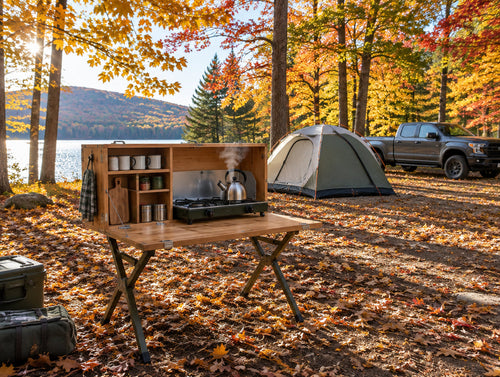
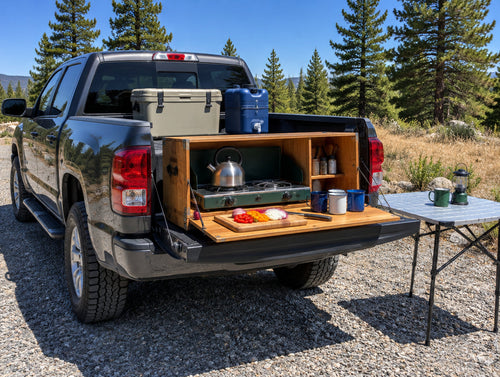
The VOZ Camp Kitchen is the second type. Its collapsible sink is fed by a USB-rechargeable electric faucet that draws from a removable 2-gallon tank, and the product page doesn't list a pressurized hose inlet. So the answer for a box like this is to use the hose for refills, not to plumb it in. We explain why below. If you're still deciding whether built-in running water matters to you, start with our overview of the camp kitchen with sink and faucet.


Why You Shouldn't Push Spigot Pressure Into a Pump Faucet
A pump faucet is built to pull water out of an open container at roughly zero pressure. A campground spigot pushes hard. RV water pressure regulators are sold to protect hoses, pumps, and plastic lines from inconsistent park pressure, and they usually cut it to 40 to 50 PSI. One common plastic regulator is rated for inlet pressure up to 120 PSI, which tells you how high some hookups can run. In one independent test, a regulator brought 115 PSI down to 47 PSI.
A small battery faucet and its thin intake tube aren't made to hold back that kind of pressure. If you force a hose onto the intake, the likely results are leaks at the joints, a tank that overflows, or water running through the faucet when it's switched off. It is also a modification the product page doesn't describe, so treat it as unsupported.
The better way to get "unlimited" water at a hookup site is to keep the tank and use the hose as a refill line:
- Pull the removable tank, fill it from the spigot or a drinking-water hose, and put it back.
- For long dish sessions, keep a second filled jug next to the box and swap it in when the faucet slows down.
- Do the big jobs, like rinsing a cooler or hosing off a muddy grill grate, straight from the spigot or hose. Don't push them through the kitchen sink.
For more on topping off away from hookups, see where to refill your camp kitchen water tank on the road.

If You Want a True Hose Hookup: The Fittings That Matter
If you use a sink that's actually made for hose pressure, or a separate prep table with its own faucet, these are the parts that matter.
| Part | What it does | What to check |
|---|---|---|
| Garden hose thread (GHT) | Standard US hose connection | 3/4" GHT is a straight thread at 11.5 threads per inch. It won't seal on 3/4" NPT pipe thread, which is tapered at 14 TPI. Use a GHT-to-NPT adapter instead of forcing it. |
| Pressure regulator | Limits incoming pressure | Most RV units are preset to 40 to 50 PSI. Put it at the spigot end so the whole hose is protected. |
| Backflow protection | Stops dirty water from being pulled back into the supply | A hose-bibb vacuum breaker on the spigot, or a hose with a built-in backflow preventer |
| Drinking-water-safe hose | Carries water you'll cook and wash with | Labeled for drinking water, lead-free on the whole hose (not just the couplings), and certified to NSF/ANSI 61 or 372 |
| Shutoff valve or quick-connect | Lets you stop flow at the sink | Remember that a closed valve at the hose end keeps the whole hose under pressure |
Our 42.5" Fish Cleaning Station is a good example of a hose-fed design. It's a folding table with a stainless prep surface, a garden-hose faucet hookup, and a drain you can run to a hose or bucket. Set it next to a kitchen box and you get a pressurized rinse station for fish, produce, and muddy gear, while the box's tank-fed faucet handles dishes and hand-washing.


Backflow: The Part Most People Skip
Backflow means water running the wrong way, out of your sink and hose and back into the supply line. The EPA's cross-connection control guidance says many backflow incidents have involved garden hoses attached to spigots without a vacuum breaker. It also says backflow can happen when a hose is left connected to an open spigot while the valve at the hose end is closed.
At camp, the classic mistake is letting the hose end drop into a sink full of soapy dishwater. If the pressure in the line dips, that water can be siphoned back up the hose. Two habits prevent it:
- Keep an air gap. Plumbing guidance says the outlet should sit at least twice the supply pipe's diameter above the basin's flood rim, and never less than 1 inch. For a hose, that means clipping the end above the rim and never letting it rest in the water.
- Use a vacuum breaker. It screws onto the spigot and stops siphoning. Pick one that drains, because one left full of water can freeze and damage the spigot in cold weather.
The drain side counts too. A hose-fed sink can run far more water than a 2-gallon tank, so your graywater jug fills much faster. Size the jug and drain hose for that with our camp kitchen sink graywater setup guide.

Campground Spigots and RV Outdoor Showers: What's Allowed
Campground spigots. Check the rules before you connect anything. Some public campgrounds don't allow it at all. The Blue Ridge Parkway campground regulations say hoses may not be connected to water hydrants, and a U.S. Forest Service campground handout also says not to hook hoses to water spigots. Many parks also ban washing dishes at the spigot. Shenandoah's rules, for example, say to wash dishes in a basin at your campsite, not at spigots or in restrooms. At sites like these, fill a jug or your tank and carry it back. That's exactly what a tank-fed kitchen box is designed for.
Full-hookup RV sites. If you have a dedicated water hookup, you can usually leave a hose connected through a regulator. The fittings rules above still apply.
RV outdoor shower ports. In Good Sam forum threads, RV owners describe hooking a folding table-and-sink to the outdoor shower connection. One owner put a quick-connect garden hose fitting on each end of a short hose between the RV and the sink. Many outdoor shower ports use a brand-specific quick-connect, and adapters exist that turn it into a female garden-hose thread. Before you buy one, check whether your port takes a 3/4" quick-connect or a 1/2" shower hose. Keep these in mind:
- The shower port runs on your RV's onboard pump or city-water connection. When the onboard pump runs it, every rinse comes out of your fresh tank.
- The shower valve usually mixes hot and cold. Keep it on cold unless you know the sink and its fittings can handle hot water.
- The same pressure warning applies. A shower port can feed a hose-fed sink, but it shouldn't be plumbed into a battery-pump faucet's intake.


FAQ
Can I connect a garden hose directly to my camp kitchen faucet?
Only if the faucet is made for hose pressure and has a garden-hose inlet. Tank-fed boxes with an electric pump faucet, like the VOZ, are designed to pull from their own tank. Use the hose to refill the tank instead.
Is a regular garden hose safe for camp kitchen water?
Use a hose labeled for drinking water. An Ecology Center study of garden hoses found that a California Prop 65 warning on a hose likely means it contains lead, and that "lead-free" should cover the whole hose, not just the couplings. Run water through the hose for a bit before using it, and store it off the ground.
Do I need a pressure regulator just to fill a tank?
For quick fills from an open hose end, it isn't strictly needed. For any setup where the hose stays connected and pressurized, it's cheap insurance. Most RV regulators hold the line at 40 to 50 PSI.
What adapter do I need for a spigot with pipe threads?
A GHT-to-NPT adapter. Garden hose thread and pipe thread have different pitches, and pipe thread is tapered, so they won't seal on each other without one.
To see everything that comes in the box besides the sink, including the stove, tank, and utensils, read our breakdown of what's included in a camp kitchen kit.
- Camp Kitchen Kit: Everything That's Included (and Why It Matters)
- Where to Refill Your Camp Kitchen Water Tank on the Road
- Camp Kitchen Sink Graywater Setup: Drain Hose, Jug Size, and Keeping It From Smelling
- Can You Drink the Water From Your Camp Kitchen Tank? Potability, Safety, and Filters
- Camp Kitchen Faucet or Water Pump Not Working? Troubleshooting Guide
Ready to upgrade your camp kitchen?
The VOZ Camp Kitchen includes everything you need in one weatherproof case. Sets up in 15 seconds.
Shop VOZ Camp Kitchen →