Will Your Stove Melt Your Camp Kitchen? Heat Damage, Heat Shields, and Safe Stove Placement on the Box

A camp stove sits a few inches above the lid of your kitchen box for an hour every evening, so it is fair to ask whether that plastic will eventually warp, bubble, or melt. Usually it won't. But there are three specific setups that do cause damage, and every one of them is easy to avoid once you know what it looks like.
Will a Camp Stove Really Melt a Camp Kitchen Box?
The short answer: a stove that is used the way its maker intended almost never cooks the surface under it. Hot air and flame go up, not down. Campers who have tested this the hard way back that up. One van-lifer ran a propane grill on a white plastic folding table for three years without a problem, and reported that the tabletop stayed barely warm under it, because the grill stood on its own one-inch plastic feet.
The problems show up at the edges. On a long-running Backpacking Light thread about protecting surfaces under stoves, one hiker melted the plastic top of a folding camp table and damaged the varnish on a picnic table with a small backpacking stove. Another forum member who looked at the damage noted that it never spread past the footprint of the stove base, and concluded that the hot metal touching the surface was doing the harm, not the flame.
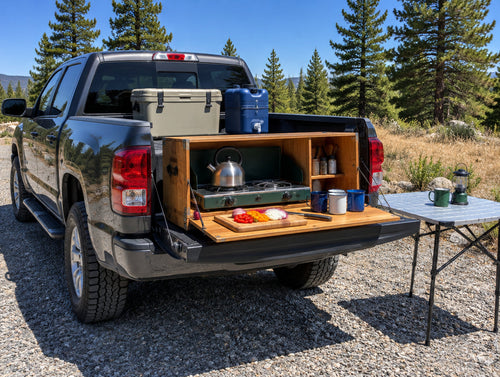
That matters for a camp kitchen box. Most modern boxes are molded plastic, and the stove usually goes straight onto the lid or a stove platform. If you are still deciding whether your stove belongs on top or inside, start with our guide on whether your stove fits a camp kitchen box. This article is about what happens once it is sitting there and lit.

How Much Heat Can Camp Kitchen Plastic Take?
Many camp kitchen cases, including the shell of our own box, are made of LLDPE (linear low-density polyethylene). It is tough and cold-tolerant, but it is still a thermoplastic, and it has three temperature limits worth knowing:
| Threshold | Typical LLDPE value | What it means at camp |
|---|---|---|
| Melting point | About 252–264°F (122–129°C), per Dow resin datasheets | The surface turns glossy, sags, or fuses to whatever is touching it |
| Vicat softening point | Roughly 201–252°F (93–122°C), depending on grade | A hot stove foot starts pressing a dent into the surface |
| Heat deflection under load | About 122°F (50°C) at 66 psi for one ExxonMobil grade | A heavy, hot object left in one spot can slowly warp a panel |
None of those numbers is close to flame temperature, which is the point. Any stove part that gets hotter than boiling water and touches the plastic is a candidate for damage. That means a stove base heated by a reflected pan, a drip tray full of hot grease, or a pot set down off the burner. Lab values vary by resin grade, so treat the table as a guide to where trouble starts, not a guarantee for any particular box.
The Three Setups That Actually Cause Heat Damage
1. Hot metal touching plastic
Low-profile stoves with no feet, stoves with a bent or missing foot, and small canister stoves that sit flat all put a hot metal plate straight onto the lid. The fix is clearance, not insulation alone.
2. Heat bounced back down
Oversized pans and wraparound windscreens trap heat and push it back toward the stove body. That heats the base, the surface under it, and the fuel. On a butane cassette stove this is a safety problem, not just a cosmetic one. Singapore's consumer product safety agency warns that pans larger than the manual allows concentrate heat back toward the gas canister. Health Canada says an overheated butane canister can suddenly vent gas and cause a flash fire, and it has logged 13 incidents involving explosions, uncontrolled flames, or flash fires with enclosed-canister stoves since 2013. Several stove manuals also tell you not to use add-on windscreens that can overheat the canister.


3. A second heat source next door
Health Canada's advice is never to place a stove near other heat sources or run stoves side by side. On a camp kitchen box that usually means a griddle next to a cassette burner, or a hot Dutch oven parked beside the stove. Leave space, and give the hot pot a trivet instead of the lid.
Heat Shields That Work (and the Ones That Don't)
A heat shield is just a barrier that keeps hot metal off the plastic and spreads whatever heat gets through. Here is how the common options compare:
- The stove's own feet. This is the best shield you already own. Check that all four are present and seated before every trip.
- Silicone or fiberglass heat mats. These are the most popular add-on. One camper on a van-life forum uses a 24.5 by 16.5 inch silicone mat rated to 480°F. Cut or buy one at least an inch wider than the stove base on every side.
- Thin metal diffuser plate. A sheet of aluminum or stainless under the stove spreads heat sideways. It works best combined with a mat underneath, so the plate is not touching plastic directly.
- Cement tile backer board. At 1/4 inch it is cheap and fireproof, but heavy and crumbly in a packed box.
- Heavy-duty aluminum foil. Doubled foil reflects heat and is better than nothing in a pinch, but it tears and does nothing for direct contact.
- What to skip: closed-cell foam pads (forum users report them scorching), towels, cardboard, and anything that can catch a grease drip and burn.

Safe Stove Placement on the Box: A Checklist
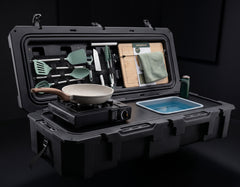
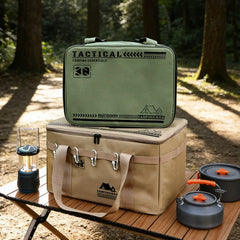
A box like the VOZ Camp Kitchen has an LLDPE work surface and a stove platform for your butane or propane burner. These steps keep that surface looking new. Everything that ships in the box is laid out in our camp kitchen kit breakdown.


- Stove on its feet, box on level ground. A tilted box lets the stove creep, and a slid-off foot means metal on plastic.
- Grate right side up. Health Canada specifically warns to use the cooking grate with the pot supports facing up. Flipped supports put the pan too close to the burner and send heat down into the stove.
- Pans that fit the grate. Health Canada says to use only pots and pans that fit the stove's grate so they do not cover the canister. If your manual lists a maximum pan size, follow it.
- Open airflow. Keep the sides of the stove open. Do not box it in with gear, bins, or a homemade wraparound shield.
- Nothing flammable within reach. Spare canisters, paper towels, and the fuel bag go on the far end of the box, not beside the burner.
- Hot pots go on a trivet. A pan pulled straight off a high flame is the single most likely thing to leave a ring on the lid.
- Let it cool before closing. Packing a hot stove into a closed plastic box traps the heat against the walls.
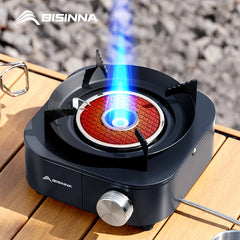
If you are shopping for a burner to pair with your box, pick one with a wide, stable base and real feet. Stoves with a built-in windshield keep the flame steady without an add-on screen wrapped around the canister.


How to Check for Heat Damage After a Trip
Heat damage to polyethylene shows up as small changes before it becomes a hole. At the end of a trip, run your hand over the stove zone and look for:
- A glossy or shiny patch in a dull matte surface, which means the plastic got soft and smoothed out.
- Foot-shaped dimples where the stove legs sat.
- A shallow dish or warp in the lid. Lay a straightedge across it.
- Bubbling or discoloration on the stove itself. One Backpacking Light poster noted that the stove itself is what usually shows bubbled heat damage underneath.
Grease baked onto a hot surface makes every one of these worse, so wipe the stove zone after each meal. Our step-by-step degreasing guide, linked at the end of this article, covers both the stove and the box surface. A small dimple is cosmetic. A warp that keeps the lid from sealing is worth fixing before the next rainstorm.

FAQ
Do I need a heat shield under a two-burner propane stove?
Usually not, if the stove stands on all four feet and you use pans that fit the grate. A mat is cheap insurance for long simmering sessions, griddles, and stoves with short or missing feet.
Can I put a windscreen around a butane cassette stove on my camp kitchen?
Not a full wraparound screen. Trapped heat raises the canister temperature, and several manufacturers warn against windscreens that can overheat it. Use a stove with a built-in windshield or a partial screen that leaves the canister side open.
Can I fix a heat dent in a plastic camp kitchen lid?
Shallow cosmetic dimples can usually be left alone. If the lid has warped enough to break its seal, contact the manufacturer before trying a heat gun. Reheating polyethylene unevenly can make the warp worse.
Is hot sun as bad for the box as a stove?
No, but it adds up. A box already baking in summer sun starts closer to its softening range before you light the stove. Our sun and UV damage guide, linked below, covers the long-term side.
Ready to upgrade your camp kitchen?
The VOZ Camp Kitchen includes everything you need in one weatherproof case. Sets up in 15 seconds.
Shop VOZ Camp Kitchen →