
How to Clean and Degrease Your Camp Kitchen Stove and Burners

A camp kitchen stove lives a harder life than the range at home: bacon grease, boil-overs, and campsite dust all land on a burner that then gets folded into a closed case and hauled down a washboard road. Here is how to degrease the burner, drip tray, and stove bay without wrecking the finish, and how to tell when a dirty burner has become a safety problem.
Why a Stove Inside a Box Gets Dirtier Than a Standalone One
A standalone camp stove airs out on the picnic table overnight and rides home in the open. A stove built into a kitchen box shares a sealed case with your sink, water tank, cutting board, and utensils, so every drip of grease still on the burner when you shut the lid stays there, warm and dark, until the next trip. Grease also holds onto dust, which is why a lightly splattered burner comes out of storage with a sticky brown crust.
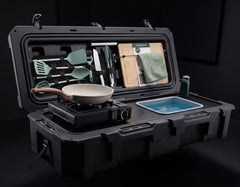
The VOZ Camp Kitchen makes this easier than most because its single-burner butane stove is a separate, removable component rather than a burner bolted to the case. You lift it out, clean it at a utility sink, and let it dry on its own while you wipe down the box.


What a Dirty Burner Is Telling You
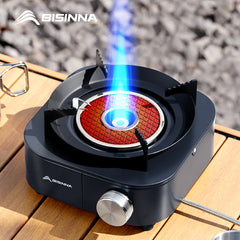
Before you pull anything apart, look at the flame. A clean butane or propane burner burns steady blue with small, even tips at every port. A burner that needs cleaning usually shows one of three signs:
- Yellow or orange flame. Yellow almost always means the fuel is not getting enough combustion air. Grease and food debris around the burner ports restrict the flow of gas and air, and the unburned carbon glows yellow in the heat. Camp Chef's support guidance notes that even a new burner can be clogged by dust from transit.
- Uneven or missing flame tips. If one side of the ring burns tall and the other is dead, the ports on the dead side are blocked.
- Igniter clicks but nothing lights. A piezo electrode coated in grease can lose its spark entirely.
A sooty, yellow flame is not just a cooking annoyance. Incomplete combustion produces more carbon monoxide, and the CPSC reports that since 2020 at least 12 people have died from carbon monoxide poisoning associated with camping equipment, including stoves. The fix for a yellow flame is cleaning, never running the stove in an enclosed space to "burn it off." The CDC is blunt about it: never use a portable camping stove inside a home, tent, or camper.

Step-by-Step: Degreasing the Burner and Drip Tray
This is the full deep clean, worth doing at the end of the season or any time the flame turns yellow. Budget about 45 minutes, most of it soaking time.
- Cool completely and pull the fuel. Let the stove reach room temperature, then release and remove the butane cartridge. Cassette-stove manufacturers put this first in their care instructions for a reason. On a propane stove, disconnect the hose and regulator.
- Remove the pan support and drip tray. On most cassette stoves the grate lifts straight off and the enamel drip tray slides out. They catch most of the mess and are the only parts that should ever be submerged.
- Soak the grate and tray. Hot water and a squirt of dish soap in a bin or a large plastic bag. Everbeam's burner guide recommends at least 30 minutes of soaking before you scrub. For baked-on carbon, drain the bin, coat the spots with a paste of baking soda and a little water, and let that sit another 30 minutes before scrubbing with a nylon brush.
- Brush the burner head dry. Do not soak the burner assembly itself. Use a dry, stiff brush (an old toothbrush or a small brass brush) to knock crust off the burner cap and out of the port slots. The Gasmate CS400 cassette-stove manual calls for scrubbing the burner head with a dry brush at least once a year and checking that every port is free of obstruction.
- Clear the ports with a paper clip. Straighten a paper clip and push it through each port, the same tool Camplux's cleaning guide uses. Metal only: a wooden toothpick can snap off inside the port.
- Wipe the piezo electrode. Dab a cotton swab in rubbing alcohol or white vinegar and clean the ceramic tip and the metal point it sparks against. Grill-igniter guides put the working spark gap at roughly 1/8 to 1/4 inch; if the electrode got bent in transport, ease it back with needle-nose pliers.
- Wipe the body, never hose it. A cloth wrung out in warm soapy water handles the housing, control knob, and cartridge bay. Cassette stoves carry a valve, regulator, and over-pressure cutoff inside the body, and a hose puts water where it does not belong.
- Dry everything upside down. Rinse the grate and tray, then air-dry every part. Camplux recommends turning a stove upside down to drain for at least one hour before use. Water left inside a stove causes rust and can interfere with fuel flow at the burner.

If you run a second stove beside the box for two-pan dinners, the same routine applies to any of the camping stoves we carry. Propane models add one step: after reconnecting the regulator, brush soapy water over the connection and watch for growing bubbles before you light it.


Which Cleaners Are Safe, and Which Ones Eat the Finish
The mistake that ruins the most camp stoves is reaching for a heavy-duty degreaser. Most spray oven cleaners are sodium hydroxide, which dissolves grease beautifully and also etches and pits bare aluminum on contact. Blain's Farm & Fleet's stove-care guide says plainly that oven and engine cleaners damage the paint and metal on a camping stove. Here is what works on each material you will find on and around a box-mounted burner.
| Cleaner | Safe on | Keep away from |
|---|---|---|
| Dish soap and warm water | Everything: enamel tray, grate, painted housing, polyethylene case | Nothing, but it will not lift baked-on carbon alone |
| Baking soda paste | Enamel drip tray, steel grate, stainless surfaces | Non-stick pan coatings (it is a mild abrasive) |
| White vinegar (50/50 with water) | Stainless steel, burner cap, piezo tip, enamel | Cast iron grates (strips seasoning); rinse off steel promptly |
| Rubbing alcohol | Piezo electrode, greasy control knobs | Painted surfaces if left to sit |
| Oven or engine cleaner (lye) | Nothing on a camp stove | Aluminum, paint, enamel, plastic: etches, discolors, pits |
| Chlorine bleach | Nothing on a camp stove | Stainless steel: chloride pitting and corrosion |
| Steel wool or steel brushes | Cast iron only | Stainless: embeds steel particles that later rust |
The bleach and steel-wool rules apply to the stainless hinges on a camp kitchen case just as much as to a stainless grate.
Cleaning the Stove Bay Inside the Case
This is the part no standalone-stove guide covers. Once the stove is out, look at where it sat. On a box like the VOZ, the stove bay is molded food-grade polyethylene, the same material as the rest of the 25-gallon case, and it sits inches from the sink and the 2-gallon water tank. Grease that ran down the stove ends up here, along with sink splash.
- Use soap, not solvents. Polyethylene shrugs off dish soap and diluted vinegar; published chemical-resistance charts rate low-density polyethylene as resistant to acetic acid at household strength. Skip acetone and other solvents.
- Get the corners. Grease pools in the low corners of the bay and along the hinge line. A bottle brush reaches what a sponge slides over.
- Check the sink side. A film of grease on the wall between the stove bay and the sink is why a washed sink still smells like last week's sausages. Our guide to cleaning the camp kitchen sink and water system covers the tank, pump, and faucet line.
- Dry before you close. Prop the lid open until the bay is bone-dry. Sealing damp polyethylene against a steel grate is how rust spots start on the grate and mildew starts in the case.
Then reassemble: drip tray seated, grate on, cartridge out, stove back in its slot. Cassette-stove manuals recommend storing the cleaned stove in its case in a dry place away from sunlight, which is exactly what a closed kitchen box provides once it is dry inside. The routine for the rest of the kit is in our post-trip camp kitchen cleaning guide, and the full inventory of what rides beside the stove is in everything that's included in the camp kitchen kit.
Clean It or Replace It? Reading the Wear
Cleaning solves flame problems most of the time, but a few things you find with the stove apart mean parts, not scrubbing:
- Cracked or flattened O-ring at the cartridge seat. Energy Safe Victoria's butane-cooker alert tells owners to check seals and O-rings for cracks before use. A damaged seal leaks, and no amount of degreasing fixes it.
- Burner head that will not clear. If ports stay blocked after a paper clip and a dry brush, or the cap is rusted through, replace the burner assembly rather than drilling ports larger.
- Heat-discolored cartridge cover. Browning or bubbled paint over the cartridge bay means the canister has been running hot, usually because a pan wider than the stove's rated size was reflecting heat back onto it. Fix the pan size first.
FAQ
How often should I deep-clean a camp kitchen stove?
Wipe the grate and drip tray after every cooking session, and do the full degrease at the end of each season or whenever the flame turns yellow. Camplux suggests the full clean "a time or two per year" for a stove in regular use, and a stove that lives in a closed box should not go longer than that.
Can I put the stove grate and drip tray in the dishwasher?
An enamel drip tray and a stainless grate usually survive it, but a bare-steel or cast-iron grate will flash-rust and painted parts can chip. Never put the stove body in the dishwasher.
Is it safe to clean the burner with the butane cartridge installed?
No. Release and remove the cartridge first, every time. Cassette-stove instructions put releasing the cartridge ahead of any cleaning step, because pushing a wire through burner ports or flexing the igniter with a live cartridge seated risks a gas release next to a spark source.
Will vinegar or soap hurt the plastic case around the stove bay?
No. Low-density polyethylene is rated resistant to household-strength acetic acid, and dish soap is harmless to it. Keep solvents, oven cleaner, and long open-lid sun exposure off the case; the last one is a UV problem rather than a cleaning one.
- Camp Kitchen Kit: Everything That's Included (and Why It Matters)
- How to Clean Your Camp Kitchen After a Trip (So It Lasts for Years)
- How to Clean a Camp Kitchen Sink and Water System (and Prevent Mold)
- How to Keep a Camp Kitchen From Rusting: Weatherproofing That Actually Works
- Butane vs. Propane for Your Camp Kitchen Stove: Which Fuel Wins?
Ready to upgrade your camp kitchen?
The VOZ Camp Kitchen includes everything you need in one weatherproof case. Sets up in 15 seconds.
Shop VOZ Camp Kitchen →