Winter Camp Kitchen: How to Cook Outside in Snow and Freezing Temperatures

Cooking outside in snow is less about toughness and more about physics: fuel that will not vaporize, water that turns solid, and a stove that sinks into the drift you set it on. Here is how to keep a portable camp kitchen working when the thermometer drops below freezing.
Why your stove loses power the moment it gets cold
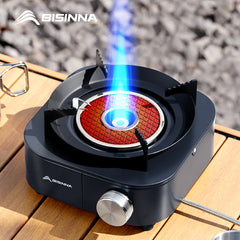
Every canister and cassette stove runs on liquefied gas that has to boil inside the can to become the vapor the burner needs. That boiling point is the whole story in winter. Butane boils at about 31°F, isobutane at about 11°F, and propane at roughly -43°F. Set a pure butane cassette in 20°F air and the liquid inside simply stops turning into gas, so the flame sputters and dies even though the can still feels heavy.
It gets worse while you cook. Vaporizing liquid fuel pulls heat out of the canister, so a can that started at 40°F can chill itself well below the air temperature within a few minutes of running on high. Frost on the outside of a cassette is the visible sign that your fuel is now colder than the weather.
Blended canisters are a partial fix, not a cure. Most blends are 70 to 80 percent butane or isobutane with the balance propane. Propane boils off first, so the can runs strong early, then weakens as the remaining butane-heavy liquid refuses to vaporize, and it can quit with fuel still inside.
If you must run butane or a blend in marginal cold, warm the can, not the stove. Keep the canister inside your jacket until the moment you cook, rotate two cans so one is always warming in a pocket, or stand the can in a shallow dish with an inch or two of cool water. Liquid water at 33°F is still much warmer than a frosted canister. Never use hot water, never point a second flame at a can, and never set it on the stove's heat reflector.
The everyday trade-offs between the two fuels are covered in our butane vs propane stove comparison. In winter the decision is simpler: below freezing, bring propane.
Butane vs propane below freezing: a practical comparison
| Fuel | Boiling point | Usable down to | Winter note |
|---|---|---|---|
| Butane (8-oz cassette) | 31°F | About 35°F | Works only if the can is kept warm; self-cooling kills it fast |
| Isobutane / propane blend | 11°F (isobutane) | About 15°F | Propane fraction burns off first, so the last third of the can is weak |
| Propane (1-lb or 20-lb) | -43°F | Well below 0°F | Pressure drops with temperature but the burner keeps lighting |
Propane is not immune to cold, just far more tolerant. A 20-lb tank sits at roughly 145 psi at 70°F, about 78 psi at 50°F, and around 24 psi at 0°F. The regulator still delivers usable gas, but a near-empty tank has less liquid to vaporize from and struggles first. Keep winter tanks at least one-third full and set them on an insulated pad, not directly on snow.
Expect longer boil times and shield the burners. A 17,000-BTU two-burner with a built-in windshield shrugs off a cold morning, while a bare single burner spends much of its heat warming the wind. A BTU is the energy needed to raise one pound of water by 1°F, so every BTU the wind steals is water that stays cold longer.


Building a snow platform that will not sink, tip, or melt out

Snow is a terrible stove base. It is soft, it melts under any heat, and a tilted stove means a tilted pot. The fix is to build a small kitchen instead of balancing on a drift:
- Stomp, then wait. Pack the kitchen footprint with boots or snowshoes, then give it about 30 minutes to harden before setting anything on it.
- Dig a pit with a counter. In deep snow, excavate a pit three to four feet deep and leave a raised block in the middle as a table. Cut benches into the walls so cooks sit out of the wind at counter height.
- Insulate under the stove. A square of plywood, a closed-cell foam pad wrapped in foil, or even flattened cardboard under the stove stops the burner from melting a crater beneath itself and keeps the fuel tank off the snow.
- Put the windscreen on the upwind side. A trench or snow wall that blocks wind at pot height does more for boil times than any extra BTU.
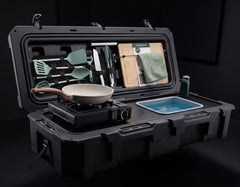
A box-style camp kitchen changes this math. The VOZ Camp Kitchen stands on its own legs, so the burner, sink, and prep surface sit at waist height above the snow on four small footprints that are easy to level with a foam pad or flat rock under each leg. The rotomolded LLDPE case is the same material as hard coolers and is built for cold use. You still want a windscreen, but you skip the kneeling-in-slush part entirely.


Water tank management: keeping two gallons liquid

Water expands about 9 percent when it freezes, enough to split a full tank or crack a pump. The tank in a portable camp kitchen holds around two gallons, and that is a lot of ice to thaw at 7:00 AM.
- Never store a full tank overnight below freezing. Drain it into an insulated jug or bring the removable tank into the vehicle or tent vestibule. Leaving it one-third full with room to expand is the fallback if you cannot move it.
- Bury it or blanket it. Snow is a good insulator. A jug packed into a drift, or a water container wrapped in a blanket inside a cooler, will stay liquid far longer than one sitting on a table in moving air.
- Store bottles and jugs upside down. Ice forms at the surface first, so an inverted container keeps the spout end free of ice.
- Empty the pump line. A USB faucet pump has a small volume of water in its tubing. Run it dry for a few seconds after the last use so residual water cannot freeze in the impeller.
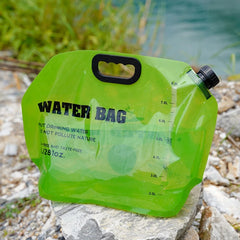
The faucet's lithium-ion battery is the other cold-sensitive part. Li-ion cells deliver roughly half their rated capacity at 0°F compared with room temperature, and they should not be charged below 32°F. Charge the faucet in the vehicle and keep it in a pocket until you are ready to wash. A 13-liter jug with a gravity tap is a useful winter backup because it has no electronics, and a soft fold-up water bag can spend the night inside a sleeping bag. The National Park Service's winter guidance makes the same point about keeping water and food in insulated containers, and reminds winter campers that cold-weather exertion dehydrates you faster than it feels.


Melting snow when the tank runs dry
Snow is mostly air. A typical snowfall runs about 10 inches of snow to 1 inch of water, and dry powder can be 25 to 1 or worse. A pot packed with snow yields a puddle, and producing a liter of water from snow takes roughly twice the fuel of heating a liter you already have.
Two habits make this bearable. Start with a splash of liquid water in the pot so the bottom does not scorch, then add snow in small handfuls as the level drops rather than filling the pot once. Take snow from a clean drift away from the camp trail, and bring the meltwater to a rolling boil for one minute, or three minutes above 6,500 feet, before drinking it. Budget extra propane accordingly. Once you have hot water, pour it into a thermos or insulated bag so the next pot starts warm, and refill the kitchen tank from that reserve instead of melting fresh snow every meal.
Carbon monoxide, wind, and the shelter problem
Every winter the temptation is the same: pull the stove into the tent vestibule or the back of the SUV to get out of the wind. The CDC's guidance is blunt about it. Never use a gas camp stove indoors, and that includes tents, vehicles, and any enclosed shelter. Carbon monoxide is odorless, and cold air makes people close doors and flaps that would otherwise vent it.
Instead, take the wind away from the stove rather than the stove out of the wind. A tarp or canopy open on at least two sides, a snow wall on the upwind edge of the kitchen pit, or a three-sided windscreen around the burner all cut heat loss without trapping exhaust. At a plowed car-camping site, park upwind and cook on the vehicle's lee side. The best camp kitchen setup guide covers the tarp and canopy layouts that pair with a box kitchen in every season.
FAQ
Can I use a butane cassette stove in the snow at all?
Yes, down to roughly 35°F if the can is kept warm and swapped often. Below that the butane will not vaporize reliably, and once you get under about 15°F even isobutane blends fail. For real winter trips, run propane.
Will a 1-lb propane cylinder work at 0°F?
It will light and burn, but pressure drops to roughly a sixth of what it was at 70°F, so expect a weaker flame and longer boil times. Keep spares in a warm pocket, use a windscreen, and swap cylinders before the current one runs dry.
How do I keep the water tank from freezing overnight?
Drain it or bring it inside the vehicle. If neither is possible, leave it no more than one-third full with the cap loose, wrap it, and pack snow around it. Store any bottles upside down.
Is it safe to cook under a tarp in winter?
A tarp or canopy open on two or more sides is fine and is the right way to block wind. A closed tent, a vestibule with the door zipped, or a vehicle is never acceptable for a gas stove because of carbon monoxide.
Does the cold hurt the camp kitchen itself?
Cooking in the cold is not the issue. Storing it wet, or leaving water in the tank and pump to freeze, is. Our winter care guide covers draining, drying, and off-season storage so the kitchen is ready for the next trip.
Ready to upgrade your camp kitchen?
The VOZ Camp Kitchen includes everything you need in one weatherproof case. Sets up in 15 seconds.
Shop VOZ Camp Kitchen →