
Can You Use a Camp Kitchen Stove Indoors or in a Garage? CO Safety Explained

Every winter storm and rained-out weekend brings the same question: the camp kitchen is packed and ready, so why not fire up the stove in the garage with the door cracked? The answer is no, and the reasons are more specific than a warning label. Here is what federal safety data and tent-stove studies actually say, how fast carbon monoxide climbs in a closed space, and where you can run a camp kitchen stove without gambling.
The Short Answer: Outside, and Not Just Barely Outside
The CDC's rule for camp stoves is one sentence long: never use a portable gas camp stove indoors. The same guidance covers charcoal grills and generators, and it spells out where "indoors" ends. Do not run any of these devices inside a home, basement, or garage, and do not run them outside less than 20 feet from a window, door, or vent, according to the CDC's carbon monoxide page. That 20-foot buffer is the part most people skip. A stove on the back step with the kitchen window open behind it is technically outside, but the exhaust has a direct path into the house.
The U.S. Consumer Product Safety Commission goes a step further for garages. Its winter-storm guidance says not to cook on a charcoal grill in a garage even with the garage door open, and tells generator owners to stay off porches and carports entirely. A gas camp stove makes far less carbon monoxide than a generator or a charcoal fire, but the geometry that traps exhaust under a roof is the same, so the same list of places applies.

Why a Camp Stove Is Not the Same as Your Kitchen Range
The obvious objection is that millions of homes cook on gas ranges every day. The difference is what surrounds the flame. A household range is an indoor appliance under a hood that pulls combustion gases outdoors, in a room with code-required air exchange. A camp kitchen stove is an outdoor cooking appliance with no hood, no vent, and no expectation of dilution beyond open sky.
Even the indoor appliance is not perfectly clean. The EPA reports that air near a properly adjusted gas range often carries 5 to 15 parts per million of carbon monoxide, and a poorly adjusted one can push past 30 ppm, with a hood and a whole house of air to dilute into. Put a burner rated for open air in a two-car garage, remove both the hood and the dilution, and the room has nowhere to send the gas.
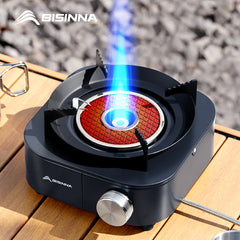
Butane cassette stoves are the usual exception people bring up, because some are approved for restaurant tabletop use. Iwatani, for instance, states that its butane stoves carry CSA approval for indoor use in commercial restaurants. A commercial kitchen has mechanical ventilation sized by code. Your garage does not. A cassette stove is the cleanest-burning option in a camp kitchen box, but a restaurant approval does not turn a garage into a restaurant.


How Fast CO Builds Up: Real Numbers From Stove Tests
The best data on camp stoves in enclosed spaces comes from tent studies, because tents are the closed space campers actually cook in. A 2023 study in Wilderness & Environmental Medicine ran three isobutane/propane canister stoves inside a three-season tent while heating a pot of water, logging carbon monoxide every minute for 15 minutes. Levels passed 100 ppm within a few minutes, and the dirtiest stove averaged 117 ppm higher than the cleanest. The authors' conclusion was blunt: these stoves can produce unsafe CO levels and should not be used in enclosed spaces.
An earlier 2013 study in the same journal tested liquid-fuel stoves and found that tent design mattered as much as fuel. White gas peaked at a mean of 60.5 ppm in a three-season tent and 154.5 ppm in a four-season tent; unleaded gasoline hit 102.9 ppm and 210.6 ppm in the same tents. The tighter the enclosure, the faster the number climbed. A garage with the door down is far tighter than any four-season tent.
Here is how those readings compare to the exposure limits used by federal occupational health agencies, taken from the NIOSH Pocket Guide to Chemical Hazards:
| Carbon monoxide level | What it means |
|---|---|
| 0.5 to 5 ppm | Typical home without a gas stove (EPA) |
| 35 ppm | NIOSH recommended limit, averaged over an 8-hour shift |
| 50 ppm | OSHA permissible limit, 8-hour average |
| 100+ ppm | Reached within minutes by canister stoves in a three-season tent (2023 study) |
| 200 ppm | NIOSH ceiling, not to be exceeded at any time |
| 1,200 ppm | NIOSH "immediately dangerous to life or health" |
Notice the gap between what a worker may breathe over a full shift and what one stove produces in a tent in a quarter of an hour. Dinner takes longer than 15 minutes, and usually involves a second burner and a kettle.
The Garage Problem: Why "Door Open" Does Not Fix It
A garage is the worst of the indoor options because it lies to you. It feels like outside: concrete floor, big door, no carpet. But carbon monoxide does not care about flooring. An Oak Ridge National Laboratory case study of an attached garage found that high CO concentrations remained in the garage even though the overhead door had been open while a car warmed up, and that pressure differences between the garage and the house then forced the gas indoors through the connecting door and every gap around it, where it lingered for hours.
That pressure difference is not rare. A furnace, a bathroom fan, a clothes dryer, or a range hood all pull air from wherever it is easiest to get, and an attached garage is the easiest source. The CDC's advice to never idle a car in an attached garage, even with the door open, exists because of this leak path, and it applies just as well to a burner on a workbench.
The death statistics reflect it. CPSC's most recent full report on non-fire carbon monoxide deaths counted an estimated 250 tied to consumer products in 2019, three quarters of them at a home location, a category that includes detached garages, sheds, campers, and tents. Charcoal grills averaged 11 deaths a year from 2017 through 2019; grills and camp stoves averaged 5. More than half of all deaths fell in November through February, when people drag outdoor gear inside to cook or stay warm.

Where You Can Safely Run a Camp Kitchen Stove
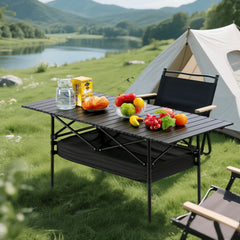
The practical rule: open sky overhead or a roof with at least two fully open sides, a stable surface, and 20 feet between the burner and any window, door, or vent into a living space. That describes a driveway, patio, deck, backyard, campsite picnic table, or tailgate. It rules out a garage with the door up, an enclosed or screened porch, a shed, a van, a camper, and a tent, vestibule included.
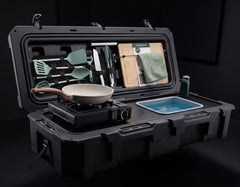
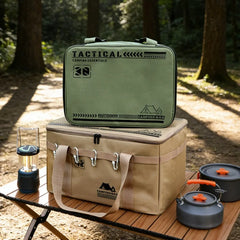
This is where a self-contained camp kitchen earns its keep over a pile of loose gear. The VOZ Camp Kitchen packs the butane stove, sink, 2-gallon water tank, faucet, and utensils in one 48-by-19-inch case weighing about 57 pounds loaded, so moving the whole cooking station from the garage shelf to the driveway is one carry, not a dozen trips. Setup takes seconds, which removes the main excuse for cooking wherever the box is stored; the camp kitchen setup guide walks through the sequence.


Two habits close the remaining gaps. Cook with the stove on the far side of you from doors and windows, so wind carries exhaust away from the house. And treat weather as a reason to move the stove, not to bring it inside: a high-pitched tarp or a wall-less canopy keeps rain off the burner without trapping gas. The same pressurized-gas stoves that stay legal under most fire restrictions are still strictly outdoor appliances, and the placement rules in the fire ban stove rules guide assume open air.
A CO Alarm Is a Backstop, Not Permission
Some people reason that a carbon monoxide alarm on the garage wall makes indoor cooking safe. It does not, and the reason is built into how alarms are certified. The UL 2034 standard residential CO alarms are tested to, described in a CPSC conformance report, deliberately delays the alarm to prevent nuisance trips. At 70 ppm the alarm must stay silent for at least 60 minutes and may take up to 240. At 150 ppm it waits 10 to 50 minutes. Only at 400 ppm must it sound within 4 to 15 minutes. A stove pushing a garage past 100 ppm can run through an entire dinner before a compliant alarm makes a sound.
Alarms still belong in the house, on every level and outside each sleeping area, which is where NFPA 72 puts them. Their job is to catch a furnace leak or a neighbor's generator, not to referee a cooking session. If one sounds while a stove is running anywhere near the house, shut the burner off, get everyone outside, and call for help before going back in. CPSC lists the symptoms to watch for as headache, dizziness, weakness, nausea, vomiting, sleepiness, and confusion, and warns that CO poisoning is easily mistaken for a cold or the flu.
FAQ
Can I use a butane cassette stove indoors if the manufacturer says it is approved?
Restaurant approvals assume commercial ventilation. In a home, the CDC guidance still applies: no portable gas camp stove indoors. If you genuinely need an indoor backup, a countertop electric burner on a power station is the only option that produces no combustion gas at all.
Is cracking a window or opening the garage door enough ventilation?
No. The Oak Ridge garage measurements found gas lingering even with the overhead door fully open, and the tent studies show CO passing 100 ppm within minutes in a shelter with far more air leakage than a garage. A single opening does not create airflow; it creates a place for gas to pool.
What about cooking in a camper, van, or RV?
Camper and RV ranges that came from the factory are installed appliances with their own venting rules. A portable camp kitchen stove is not, and the CDC lists campers alongside homes and garages as places never to run one. Cook outside the vehicle at the tailgate or a side table.
What do I do when the power is out and it is 20 degrees outside?
Carry the box to the driveway, cook fast, and bring the food back in. That is the whole plan behind using a camp kitchen as an outage station, and the emergency power-outage camp kitchen guide covers fuel, water, and food-safety numbers for that scenario.
- How to Set Up a Camp Kitchen in Under 15 Seconds (Step-by-Step)
- Camp Kitchen as an Emergency Kitchen: Your Power-Outage Cooking Station
- Can You Use a Camp Kitchen During a Fire Ban? Stove Rules by Restriction Stage
- Where to Set Up Your Camp Kitchen: Placement and Safety Rules That Actually Matter
- Butane vs. Propane for Your Camp Kitchen Stove: Which Fuel Wins?
Ready to upgrade your camp kitchen?
The VOZ Camp Kitchen includes everything you need in one weatherproof case. Sets up in 15 seconds.
Shop VOZ Camp Kitchen →