Soft-Sided Camp Kitchen Bag vs. Hard Camp Kitchen Box: Which Holds Up Better?

A soft camp kitchen bag and a hard camp kitchen box both promise the same thing: everything you cook with, in one place, ready to grab. After a few seasons of rain, rough roads, and curious mice, they don't hold up the same way, and that gap matters more than the price tag.
The Short Answer
If your kitchen rides in a vehicle and you camp more than a couple of times a year, a hard box holds up better. It handles crushing, standing water, and rodents in ways fabric can't. A soft bag still makes sense when weight, flat storage at home, or a carry from the parking lot to a walk-in site matters more than protection.
Here is how the two compare on the things that actually wear out a camp kitchen:
| Test | Soft-sided bag | Hard box |
|---|---|---|
| Crush (gear stacked on top) | Walls fold in; contents take the load | Shell takes the load; contents stay put |
| Rain on the lid | Depends on coating, seams, and zipper | Depends on lid seal and latches |
| Puddle under the case | Fabric floor wicks and soaks | Plastic floor sheds water |
| Sag under load | Bottom bows unless it has a frame | Holds its shape; doubles as a surface |
| Rodents | Fabric and zippers can be chewed | Thick plastic with a tight lid resists |
| Weight and storage at home | Light; some fold flat | Heavier; takes the same space empty |
Crush and Sag: What Happens in a Packed Vehicle
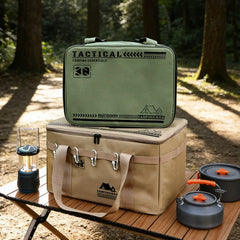
The first failure most soft bags show isn't a tear. It's shape. Load a fabric kitchen bag with a stove, a pan, and a few jars, then set a cooler on top in the trunk, and the walls give way. The pressure goes straight into whatever is inside: bent stove legs, cracked spice bottles, a crushed egg carton. Reviewers who favor hard shells make exactly this point, that a rigid case keeps food from being crushed in a fully packed vehicle.
Soft bags have a real advantage here too: fabric walls cushion contents and cut down on rattling over washboard roads. But that cushioning only works when nothing heavy sits on top. Once you stack gear, the rigid box wins.
Sag is the slow version of the same problem. A soft bag carried by its handles bows in the middle, and over time the base stitching and handle attachment points take the strain. A hard box has no such failure point. It also turns into furniture at camp: a flat, stable lid you can prep on or set a stove beside, which a slumped bag can't offer.

Weather: Rain From Above, Water From Below
Rain is where marketing words get slippery. "Waterproof" on a fabric bag usually means coated fabric that sheds a shower. Water gets in where the bag isn't fabric at all: zippers, stitched seams, and the floor. Taped seams and a heavy coated shell help a lot, which is why our own waterproof camping storage bag uses both. Even so, a fabric bag sitting in a puddle for an hour is a different test than a fabric bag in a passing shower.


Hard boxes have their own weak spots: the lid gasket, the latches, and any vents or pass-throughs. A useful way to think about protection levels comes from the IP rating system defined in IEC 60529, where IPX4 means resistance to splashing from any direction and IP67 means dust-tight and able to survive brief immersion. Most camp kitchen cases, soft or hard, aren't formally rated, so think in those terms anyway: is this a splash-proof container or a sit-in-a-puddle container? A plastic floor sheds standing water. A fabric floor eventually wicks it.
We go deeper on lids, seals, and storm-proofing in are camp kitchen boxes waterproof in the rain.
Rodents: The Test Nobody Plans For
Mice don't care how nice your bag is. A mouse can get through an opening about a quarter inch wide, according to National Park Service guidance on sealing gaps, and a zipper left slightly open is a bigger door than that. Fabric itself can be chewed, too. A soft kitchen bag left in a tent vestibule or on a picnic table overnight with food in it is an invitation.
Public health guidance is consistent here. The CDC's hantavirus prevention advice tells people to keep food in containers rodents can't get into, such as sealed metal or durable plastic, and its guidance for campers specifically recommends rodent-proof containers. Park pages make the same point for the backcountry, listing hard-sided tubs and canisters among the acceptable options. A thick plastic box with a latched lid is the closest a camp kitchen gets to that standard without a dedicated canister.
One caveat: no camp kitchen box replaces a bear locker or an approved bear canister where those are required. Follow the rules of the campground you're in.
Sun, Age, and Long-Term Wear
Ultraviolet light breaks down synthetic fabric over time. Research on nylon webbing found that accelerated UV weathering cut tensile strength by roughly 20% for colored webbing, and that molecular damage showed up before any visible change on the surface. In plain terms, a bag that has lived on a sunny roof rack for several summers can look fine and still be weaker at the handles and seams than it was new.
Plastic cases age too, but a thick-walled, UV-stabilized shell spreads load across the whole box instead of concentrating it at a few stitched points. When a hard box does fail, it's usually a latch or hinge, which is a part you can often replace. When a soft bag fails, it's usually a seam or zipper, and that's often the end of the bag.

Where a Hard Camp Kitchen Box Fits In
The classic hard option is the plywood chuck box, and its modern descendant is a molded plastic case built around the kitchen itself. If you're new to the format, start with our guide to the camp kitchen box and modern chuck box.
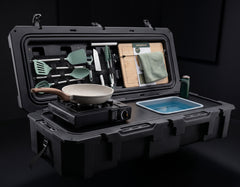
Our VOZ Camp Kitchen is one example of that approach. It's built in a 25-gallon case made of food-grade LLDPE with stainless bar hinges and UV protection, and it carries a single-burner butane stove, a frypan, a foldable sink with a USB-rechargeable faucet, a 2-gallon water tank, a cutting board, an LED light, and utensils. The trade-off is the one this whole article is about: the case measures 47.6 x 19.3 x 11.4 inches and weighs about 57 pounds, so it's a vehicle-based kitchen, not something you carry half a mile to a walk-in site.


Plenty of campers run both. They keep the hard box as the base kitchen in the truck, and a soft bag for the extras that don't mind a little squeeze, like towels, paper goods, and the tablecloth.
FAQ
Is a soft camp kitchen bag waterproof?
Some are water-resistant, with coated fabric and taped seams that shed rain. Zippers and fabric floors are the usual leak points, so don't leave a soft bag sitting in standing water.
Do hard camp kitchen boxes keep mice out?
A thick plastic or metal box with a tight-fitting, latched lid is the kind of container public health agencies recommend for keeping food away from rodents. Check that the lid closes fully with no gaps.
Which is better for car camping?
For most car campers who go out regularly, a hard box. It survives being packed under other gear, sheds water, and doubles as a prep surface at camp.
When does a soft bag make more sense?
When you carry your kitchen a long way from the car, camp only occasionally, or need something that folds flat in a small apartment closet.
- What Is a Camp Kitchen Box? The Modern Chuck Box Explained
- Camp Kitchen Box vs. Camp Chef Sherpa Table & Organizer: Which Cook Station Wins?
- Camp Kitchen Box vs. Plastic Storage Bins: Is the Upgrade Worth It?
- How Much Weight Can a Camp Kitchen Box Hold? Standing, Sitting, Stacking, and Using the Lid as a Table
Ready to upgrade your camp kitchen?
The VOZ Camp Kitchen includes everything you need in one weatherproof case. Sets up in 15 seconds.
Shop VOZ Camp Kitchen →