

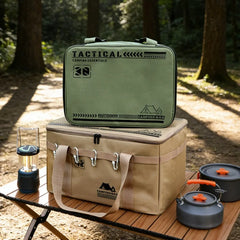
How Much Weight Can a Camp Kitchen Box Hold? Standing, Sitting, Stacking, and Using the Lid as a Table

Some camp kitchen brands advertise a weight capacity, and buyers reasonably want to know if they can sit on the box, stand on it, or pile other gear on top of it. The honest answer depends on which surface you're loading, how the weight gets there, and whether anyone has actually tested it.
What a "Weight Capacity" Number Actually Measures
Look closely at load ratings in this category and you'll see they rarely describe the box itself. Trail Kitchens, for example, states a 300 lb load capacity "for erected table," meaning the leg-and-table system set up for cooking, not the closed case. Its Camp Kitchen with Stove weighs 51 lb with legs, stove, shelf and drawer, and puts the table at 32 to 34 inches.
Storage boxes built for overlanding usually skip a number altogether. Front Runner's Wolf Pack Pro page talks about impact-resistant plastic and a nesting design where "the top box fits snugly into the lid of the box below," but it doesn't list a standing or stacking load. We don't list one for the VOZ case either. When nobody publishes a rating, assume the box isn't rated for that job.
Before you trust any number, sort your use into one of these loads:
| Load type | What it looks like | How hard it is on the box |
|---|---|---|
| Static, spread out | Cooler, water jug or duffel resting flat on the closed lid | Lowest. Weight goes down through the walls |
| Static, concentrated | Cast-iron Dutch oven sitting in the middle of an open countertop | Moderate. All the force lands on one small area |
| Dynamic | Someone dropping into a seat, or stepping up on the box | Highest. The impact can be well above the person's body weight |
| Sustained over time | Gear stacked on the box for a week in a hot truck bed | Adds up. Plastic slowly deforms under steady load |
Closed Lid vs. Open Prep Surface
A closed, latched case is the strongest shape the box will ever be in. The lid sits on four walls, the latches hold it down, and a flat load spreads into those walls and then the ground. That's why a packed duffel or a soft cooler resting on a closed case is usually fine.
An open prep surface works differently. When you use the lid or a removable countertop as a counter, the load depends on how that panel is supported: along its edges, on a hinge, or on a couple of brackets. A 12-inch skillet full of food, a full water jug and a cutting board are normal loads there. A person leaning their full weight on one corner is not. We covered the practical setup (zones, food safety, keeping the board from sliding) in our guide to using the lid as a prep surface. The rule for loads is simpler: keep heavy items over the walls or supports, not in the middle of the span.

Material matters too. Polyethylene is viscoelastic, which is a fancy way of saying it creeps: under a steady load it keeps deflecting slowly over time instead of settling at one fixed amount. Heat speeds that up. A lid that barely flexes under a cooler at dawn can take a slight dip after a week of the same load in the sun. Usually that dip goes away once you take the weight off, but don't use the lid as a long-term shelf.
Sitting on a Camp Kitchen Box
Most people who ask "can I sit on it" really mean "will it survive my kids sitting on it at dinner." Sitting is harder on a box than it looks for two reasons.
- The load is concentrated. Your weight lands on an area about the size of your hips, not spread across the lid.
- The load arrives fast. Plopping down hits the lid harder than sitting gently, and a kid bouncing on it is harder still.
If you do sit on a closed case, sit near an end, where the lid rests on two walls that meet at a corner, not in the middle of a long span. Keep the latches closed so the lid can't shift. Never sit on an open lid or an extended countertop. Those panels are made to hold cookware, not people. And if the case has a sink, faucet or stove inside, anything heavy pressing the lid down also presses on whatever is packed right under it.
The better fix is cheap: bring a chair. If you keep using the box as a bench because you're short on surfaces, that usually means you need a small side table, not a stronger box.


Standing on It to Reach a Roof Rack
This is the one to take seriously. A camp kitchen box is about the height of a step stool, and it's always right there at the tailgate when you need to grab something from a roof rack or a rooftop tent bag. It's still a bad step stool.
Real ladders are engineered with a large safety margin. OSHA's ladder standard requires portable ladders to support at least four times their maximum intended load (3.3 times for extra-heavy-duty metal or plastic ladders). A storage box has no such requirement. OSHA's rules also specifically say not to use boxes, barrels or other unstable bases to gain extra height. Read the requirements in OSHA 1910.23.
Short falls are not harmless, either. A CDC analysis of work-related ladder falls found that falls of 6 to 10 feet made up half of the nonfatal injuries treated in emergency departments. In 2011 alone, work-related ladder falls led to an estimated 34,000 ER-treated injuries (CDC MMWR). Add a box lid that can flex, rounded edges and uneven campsite ground, and you have a real ankle-rolling risk even at knee height.

For roof access, use a folding step ladder, a door-sill step, or the rear tire. Keep the kitchen box for cooking.
Stacking: What It Does to Latches and Hinges
Stacking is the most common real-world load, and it's usually fine. Just know which parts do the work.
- Lid and walls: A box stacked squarely on a closed case pushes straight down through the walls. That's the easy part.
- Latches: Latches hold the lid closed. They don't carry weight. Problems start when a stack shifts sideways on a bumpy road, because the top box pulls on the lid edge and strains the latch. Strapping the stack together, or using boxes designed to nest, keeps the load vertical.
- Hinges: Hinges carry no load while the box is closed. They take the most abuse when someone tries to open the bottom box without unstacking it. Prying a loaded lid up against the weight of a second box levers directly against the hinge pins. Always unstack first.
Stack the heaviest box on the bottom, match footprints as closely as you can so edges line up with walls, and don't leave a hot, sun-baked stack sitting for days if you can avoid it. If you're ever working on hardware that's already bent, our latch and hinge repair guide walks through the fixes.
Truck Beds and Cargo Areas: Gear Weight Tolerance
In a vehicle, there are two limits to think about: what the box can hold and what the vehicle can carry.
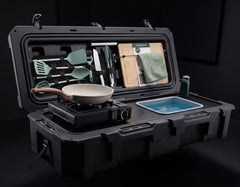
Start with the box's own weight. The VOZ Camp Kitchen weighs about 57 lb fully packed. That includes its stove, collapsible sink, USB-rechargeable faucet, 2-gallon water tank and 30+ cooking items in a 47.6 by 19.3 by 11.4 inch LLDPE case with stainless bar hinges and three latches (the full list is in our camp kitchen kit breakdown). Water weighs about 8.34 lb per gallon, per the U.S. Geological Survey, so a full tank adds almost 17 lb. Traveling with the tank empty is the easiest way to cut weight.


Then check the vehicle. Federal rules require a Tire and Loading Information placard, usually on the driver's door jamb, stating that the combined weight of occupants and cargo should never exceed a set number of pounds. A loaded kitchen box, a cooler, water jugs and a rooftop tent all count toward that number, along with every passenger. NHTSA's tire safety page explains how to read the placard.
Inside the bed or cargo area:
- Lay the box flat on its base, not on its side. Stacking a cooler on a case lying on its side puts the load on the lid and hinges.
- Put dense, heavy items (fuel canisters, cast iron, water) on the floor of the bed, not on top of the kitchen box.
- Strap the box to tie-down points so it can't slide into the tailgate on a hard stop. A box that shifts under a load is where latch damage usually starts.
FAQ
How much weight can a camp kitchen lid hold?
That depends on the model and whether the lid is closed or open as a counter. Ratings like Trail Kitchens' 300 lb apply to the set-up table system, not the closed case. If your box doesn't have a published rating, stick to cooking loads on the open surface: pots, jugs and cutting boards.
Can I use my camp kitchen box as a step stool?
No. Storage boxes aren't built to ladder standards, and OSHA's rules specifically warn against using boxes to gain height. Use a folding step or a proper ladder to reach a roof rack.
Is it OK to stack a cooler on my camp kitchen box?
Yes, if the box is closed, latched and lying flat, and the stack is strapped so it can't slide. Unstack before you open the kitchen, so the lid isn't levered against the hinges.
Does heat affect how much a plastic camp kitchen can hold?
Yes, gradually. Polyethylene creeps under sustained load, and heat speeds it up. Don't leave heavy gear sitting on a plastic lid for days in a hot truck bed.
Ready to upgrade your camp kitchen?
The VOZ Camp Kitchen includes everything you need in one weatherproof case. Sets up in 15 seconds.
Shop VOZ Camp Kitchen →

