Sun and UV Damage to a Camp Kitchen: What Fades, What Cracks, and How to Prevent It

Rain announces itself — you hear it on the tarp and grab covers. Sun damage is silent: it works on your camp kitchen a little every trip, and by the time you notice a chalky lid, a faded panel, or a gasket that crumbles between your fingers, the damage is already done.
Why sunlight is harder on a camp kitchen than rain
We covered the metal side of weather damage in our guide to keeping a camp kitchen from rusting. This article is about the other half of the story — the plastic, rubber, and fabric parts that water barely touches but sunlight slowly destroys.
The mechanism is called photo-oxidative degradation. UV light carries enough energy to break the carbon-hydrogen bonds inside plastic polymers, creating free radicals that react with oxygen in the air and set off a chain reaction through the material. The visible results come in a predictable order: color fading first, then a chalky white surface you can rub off with a thumb, then stiffness, fine micro-cracks, and finally brittle plastic that snaps under a load it used to shrug off.
Two things make this worse for campers specifically. First, camp kitchens live outdoors in exactly the hours when UV is strongest — you set up in the morning and the box sits in open sun until dinner. Second, many of the best campsites are at elevation, and according to the EPA's UV index guidance, UV exposure climbs as the atmosphere thins — roughly 4 to 6 percent more UV for every 1,000 feet of altitude. A weekend at a 7,000-foot mountain lake bakes your gear noticeably harder than the same weekend at a sea-level beach.

What UV damages first: a part-by-part rundown
Not every part of a camp kitchen ages at the same speed. Here's where sun damage shows up, in roughly the order you'll see it:
| Part | What happens | How fast |
|---|---|---|
| Colored case panels | Fading, then surface chalking | First visible sign — cosmetic at this stage |
| Fabric: carry straps, tote bags, webbing | Color loss and fiber weakening; reds fade fastest because most red pigments are organic dyes, while black holds up best thanks to carbon-based pigment | Gradual — strap failure comes long after the fading starts |
| Rubber gaskets and lid seals | Drying, stiffening, flaking, "dry rot" cracks; UV and ozone break the polymer backbone | Slow but irreversible — a cracked seal can't be restored |
| Water lines and faucet tubing | Clouding, stiffening, kinking at stress points | Medium — flexible parts show stiffness before cracks appear |
| Translucent water tank | Yellowing, brittleness, and algae growth inside (sunlight through translucent walls feeds it) | Depends entirely on sun exposure while full |
| Plastic latches, knobs, leg feet | Brittleness — the part that snaps a season after it faded | The failure stage of the same chalking process |
Material matters too. Polypropylene and low-density polyethylene are the most UV-vulnerable common plastics, while HDPE degrades more slowly — and black plastic outlasts every other color because carbon black pigment is itself one of the most effective UV stabilizers used in the industry. That's one quiet reason dark, UV-stabilized cases age better than bright unstabilized ones. If you're not sure which materials are where on your unit, our breakdown of everything included in a camp kitchen kit walks through the case, water system, and accessories piece by piece.
Shade first: the free fix that beats every spray
Before you buy anything, use placement. UV damage is a dose problem — total hours of direct sun over the gear's life — so every hour in shade is an hour of aging you skipped.
- Set up on the shady side. Put the kitchen under tree cover or on the north side of your vehicle or trailer where it dodges midday sun. You're standing at it anyway — you'll be happier in shade too.
- Use a tarp or canopy. A basic canopy shades cook, stove, and case at once, and doubles as rain cover. It's the single highest-impact accessory for gear longevity.
- Close the lid between meals. A closed hard case protects everything inside it — utensils, cutting boards, tubing — and only the exterior shell takes the dose. The shell is the part engineered to take it.
- Don't leave the kitchen deployed all week. At a long base camp, fold it down or drape it when you're off hiking. Gear left open in the sun ages on days you didn't even cook.
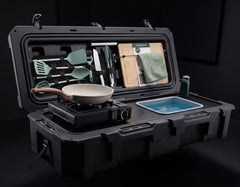
A hard-shell design helps here. The VOZ Camp Kitchen's weatherproof case means the vulnerable small parts — pump, faucet, utensils, seals on the inner compartments — spend most of their outdoor life inside a closed shell, so the sun only ever works on the exterior. Keeping the VOZ Camp Kitchen closed when you're not actively cooking is genuinely most of the battle.


UV protectant sprays: what works on which material
Protectant sprays are the second layer of defense, and they're material-specific — the bottle that revives your plastic case does nothing for a nylon carry bag.
- Plastic, rubber, and vinyl: UV protectants like 303 Aerospace Protectant were originally developed for aviation-industry rubber and plastics. They wipe on, dry to a matte finish, and add UV blockers that slow fading and cracking on case shells, gaskets, tubing, and trim. The manufacturer recommends applying out of direct sunlight, wiping the surface completely dry, and reapplying every 30 to 45 days of active use for full protection.
- Fabric and webbing: Fabric-specific guards (303 Fabric Guard is the common one) penetrate the weave instead of coating the surface, restoring water repellency and slowing UV fade on straps, totes, and canopy fabric. Give treated fabric 12 to 24 hours in a ventilated spot to cure before packing it away.
- What not to use: Skip oily or glossy household polishes on gaskets and seals. A dry-film silicone treatment keeps rubber supple; greasy dressings attract grit that abrades the seal every time you close the lid.
Be realistic about what sprays can do. They slow photo-oxidation; they don't reverse it. A gasket that's already cracked or a latch that's already brittle is a replacement job, not a restoration job — chemistry only runs one direction here.
Don't forget the water system
The water side of a camp kitchen has its own sun problems. If your tank or jug is translucent, sunlight passing through the walls does two things: it slowly yellows and embrittles the plastic, and it feeds algae in the water. Opaque containers block the light entirely, which is why every serious water-storage guide says the same thing — if light can get in, something green can grow.
Three habits cover it:
- Keep the tank in the case or in vehicle shade, not sitting full in open sun between meals.
- Empty the tank at the end of the trip. Sun plus standing water is the algae recipe; sun plus a dry tank is just slow plastic aging.
- Check tubing and the faucet's rubber fittings each season for stiffness — they're small, cheap parts, and catching them early beats a mid-trip drip.
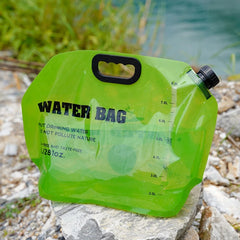
If your setup uses separate jugs or foldable water bags, a covered storage bag keeps them dark in the truck bed or on the campsite table.


Storage between trips: where most UV damage actually happens
Here's the part people miss: for a lot of campers, the worst sun exposure isn't at the campsite — it's the box living on an open truck bed, a sunny balcony, or by a garage window for the eleven months a year it isn't camping. A stored kitchen in direct sun ages faster than a used one in shade.
Store the kitchen indoors, out of direct light, and moderate in temperature — rubber parts keep best around 68 to 86°F with humidity under 65 percent, which conveniently describes most closets and finished garages. If your only option is outdoors or a windowed shed, an opaque cover or a spot with zero direct sun exposure is the minimum. Our full guide to storing a camp kitchen between trips covers the rest — moisture, pests, and packing order included.
FAQ
Is a faded case just cosmetic?
At the fading stage, mostly yes. But fading is the first step of the same process that ends in chalking and brittleness, so treat it as an early warning: that surface is absorbing a real UV dose. Add shade or a protectant before the chalky stage — once plastic goes brittle, no spray brings it back.
Does UV damage happen on cloudy days or in winter?
Yes, just slower. UV passes through cloud cover, and winter sun at elevation — especially reflected off snow — still delivers a meaningful dose. The bigger winter risk is storage: a box parked in a south-facing window collects sun all season. Cold itself is a separate problem, covered in our cold-weather care guide.
My case is black — do I still need to worry?
Less, but not zero. Carbon black pigment is a genuinely effective UV stabilizer, so black shells fade and chalk far more slowly than bright colors. The rubber seals, tubing, and any fabric parts on the unit don't get that benefit, though — they still want shade and an occasional protectant wipe-down.
Can I leave my camp kitchen set up outside all summer?
On a patio or long-term site, only under a roof or canopy. Months of continuous direct sun is the harshest duty cycle there is — far more total UV than years of weekend trips. If it must live outside, keep the lid closed, cover it, and put the water tank away empty.
How do I know when a gasket or seal is past saving?
Flex it. A healthy seal bends and springs back; a UV-aged one feels stiff, shows fine surface cracks, or sheds flakes. Cracked means replace — a compromised lid seal quietly gives up the weatherproofing the whole box depends on.
- Camp Kitchen Kit: Everything That's Included (and Why It Matters)
- How to Keep a Camp Kitchen From Rusting: Weatherproofing That Actually Works
- How to Store a Camp Kitchen Between Trips (So It's Ready Next Time)
- How Long Does a Camp Kitchen Last? Lifespan and What Wears Out First
- Cold-Weather Camp Kitchen Care: What Freezing Actually Breaks
Ready to upgrade your camp kitchen?
The VOZ Camp Kitchen includes everything you need in one weatherproof case. Sets up in 15 seconds.
Shop VOZ Camp Kitchen →