

Will Your Camp Stove Fit? Camp Kitchen Box Stove Dimensions and Compatibility

You found a camp kitchen box you like, and you already own a two-burner stove you like. The only question left is whether they'll live together. Here are real measurements — published stove dimensions, published box interiors, and the four things that actually block a fit.
There are two fit questions, not one
Almost every "will my stove fit" argument goes sideways because two different questions get mashed together:
- Does the stove fit inside the box for transport? This is a hard yes-or-no. The interior is a fixed rectangle and your stove is a fixed rectangle. One inch short is a no.
- Does the stove fit on top of the box while you cook? This is a soft question. Almost any two-burner sits on almost any lid; what matters is how much prep surface is left over once it's there.
Boxes built around a dedicated stove compartment — the classic chuck-box layout — answer question one and ignore question two. Boxes built around a full-length lid deck do the opposite. Know which problem you're actually solving before you start measuring, because the answer changes which box you should buy.
How to measure your stove in 90 seconds
Close the stove, latch it, and measure the box it would need — not the stove body. Three numbers:
- Length: latch edge to hinge edge, including any handle that sticks out past the shell.
- Width (depth): front face to back face at the widest point. On most propane two-burners the widest point is the control knobs, not the case. That's typically another 0.75 to 1.5 inches you will not find on the spec sheet.
- Height: feet to the top of the closed lid, including rubber feet and the regulator stub if it doesn't detach.
Then add one inch to length and width before you compare anything. A stove that matches the interior to the millimeter is a stove you will fight with in the dark, in the rain, with cold hands. An inch of slop is the difference between "fits" and "fits every time."

Published stove dimensions vs. real box interiors
These are manufacturer- and retailer-published packed dimensions for the two-burners people actually own. Remember that every one of them is the shell — add your own knob measurement on top.
| Stove | Packed size (L × W × H) | Weight |
|---|---|---|
| Coleman® Classic 2-Burner | 21 × 13.5 × 5.6 in (Coleman spec); retail listings give 21.9 × 13.7 × 4.1 in | 9.8–10.8 lb |
| Coleman Cascade 222 | 22 × 13.2 × 3.7 in closed | 13.05 lb |
| Camp Chef® Everest 2X | 23.5 × 13.5 × 4 in | 12 lb |
| Camp Chef Mountaineer 2X | 25.25 × 13.75 × 5.25 in closed | 16 lb |
| GSI Outdoors® Selkirk 540+ | 21.4 × 12.9 × 3.8 in folded | 10 lb |
| Eureka® Ignite | 18.5 × 12.8 × 4 in | 10 lb |
| Eureka Ignite Plus | 23 × 12.8 × 4 in | 11.96 lb |
| Partner Steel® 22" 2-Burner | 22 × 12 × 3.5 in | 17 lb |
| Iwatani® ZA-3HP (single butane) | 14 × 11 × 4.3 in | 5 lb |
| Gas One® GS-3400P (single, dual-fuel) | 13.5 × 11 × 4.45 in | 3.1 lb |
Read the length column top to bottom and the pattern jumps out: the mainstream two-burner class lives between 18.5 and 25.25 inches long and 12 to 14 inches deep. Height is the sleeper — 3.5 inches for a Partner Steel, 5.25 for a Mountaineer. That 1.75-inch spread is exactly the range that decides whether a stove clears a fixed shelf.
The single-burner butane cassette class is a different animal entirely: roughly 13.5 to 14 inches long, 11 inches deep, under 4.5 inches tall, and 3 to 5 pounds. Those numbers matter later.
Chuck-box-style camp kitchens publish an interior and a stove limit. Chuk Outdoors lists its kitchen box interior at 24.5 × 15 × 11 inches and says stoves under 24.5 inches wide and 15 inches deep fit, with adjustable shelves to handle stove height — though some of their own material cites a 22.5-inch maximum width, which is a good reminder to measure rather than trust a round number. Yoke Outdoors runs a standalone "Will My Stove Fit?" page listing owner-confirmed models: the Coleman Triton, Coleman 2-burner, Coleman 2-in-1 grill/stove, both Cook Partner single and double burners, and the GSI Selkirk 460 and 540.
Run those interiors against the table above and the math is blunt. A 24.5-inch-wide compartment swallows a Selkirk 540+, an Everest 2X, and an Ignite Plus with room to spare. It does not clear a Camp Chef Mountaineer 2X at 25.25 inches — that stove is longer than the hole, in any orientation. If the published limit is really 22.5 inches, the Everest 2X and Ignite Plus drop out too.
Where the VOZ Camp Kitchen fits in
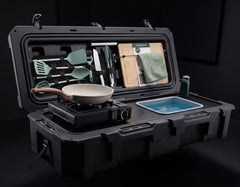
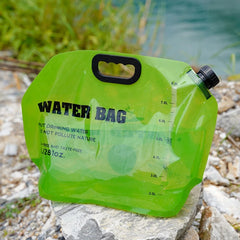
The VOZ Camp Kitchen answers the question differently: it ships with its own single-burner butane stove already sized to the case, so there is no compatibility gamble on the burner you cook with out of the box. The case closes at 47.6 × 19.3 × 11.4 inches, holds about 25 gallons of gear, weighs roughly 57 pounds loaded, and includes a removable countertop, a collapsible sink with a USB-rechargeable faucet, and a 2-gallon water bag.


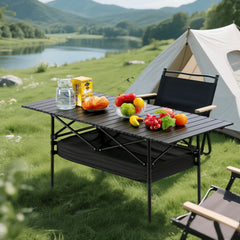
That 47.6-inch length is the interesting number for anyone who wants to run a two-burner anyway. It is roughly twice the length of the longest stove in the table. Set a 25.25-inch Mountaineer 2X or a 23.5-inch Everest 2X on the deck and you still have close to two feet of working surface beside it — enough for a cutting board and a staging plate without a second table. That is the fit question most people should actually be asking, and it's the one a stove-compartment box can't answer at all. If you're still deciding on capacity, our guide to what size camp kitchen box you need covers the volume side of the same decision.
The trade-off is honest: a 47.6-inch case needs 47.6 inches of flat space in your vehicle — fine in an SUV cargo area or a truck bed, poor in a compact trunk.
The four things that actually block a fit
When a stove doesn't go in, it's almost never the number on the spec sheet. It's one of these.
- Control knobs. The most common single point of failure. Knobs live on the long front face and add width that manufacturers don't publish. Some pull off; check yours before you give up on a box.
- The regulator and hose stub. A 1-lb-cylinder regulator often swings or unscrews. A permanently attached high-pressure hose for a 20-lb tank does not, and it can add three or four inches to the footprint. Coil the hose and measure the bundle, not the stove.
- Latches and lid lips. Weatherproof cases taper — the opening at the top is smaller than the floor, and the gasket lip eats another half inch on each side. Measure the opening, not the base.
- Heat. A stove that just finished dinner should not go into a sealed plastic case. Give it 15 to 20 minutes, and wipe the grease before it packs. The National Park Service's own camp-cooking guidance makes the related point in its cooking in camp guidance that you should test a new stove at home rather than discover a problem at the site — and packing dry-fitting your box at home is the same idea.
If nothing fits, size the stove to the box
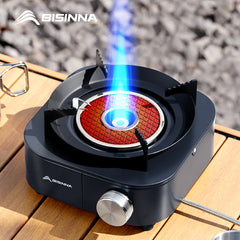
This is the option most people skip, and it's usually the right one. A single-burner butane cassette stove is 13.5 to 14 inches long and 11 inches deep — small enough that it fits essentially any camp kitchen interior with room left over for a pan. It runs on canisters sold at every grocery store, lights with a piezo igniter instead of a lighter, and weighs a third of what a steel two-burner does.

Two burners still win when you're feeding four or more people and want coffee and eggs going at once — we broke that decision down in our single-burner vs. two-burner comparison. For two people, or as a second burner alongside the one your box already came with, a cassette stove is the path of least resistance. Our camp stove collection covers both ends of that range, from single-burner cassette units to folding two-burners with windshields.


FAQ
Can I just leave the stove out of the box and pack it separately?
Yes, and plenty of people do. The cost is a second item to load and a stove that slides around your cargo area. If you go this route, pack the stove flat under the kitchen box, not on top — a 57-pound case landing on a stove lid over washboard road will bend the wind panels.
Does a bigger stove need a bigger box, or a longer lid?
A longer lid. Cooking surface, not interior volume, is what a big two-burner demands. A 25-inch stove on a 30-inch lid leaves you five inches of counter; the same stove on a 47-inch lid leaves you almost two feet. Interior volume matters for everything else you carry — see what a full camp kitchen kit includes for the list of what's competing for that space.
Do knobs really matter that much?
On a tight compartment, yes. Published widths are shell measurements. A stove listed at 13.5 inches deep can measure 14.5 or 15 across the knobs, which is exactly the difference between clearing a 15-inch interior and not. Measure across the knobs, every time.
How much BTU do I lose by going with a smaller stove?
Less than you'd guess for most cooking. A Gas One GS-3400P puts out 8,000 BTU from a single burner and an Iwatani ZA-3HP runs 12,000; a Coleman Classic delivers 20,000 total across two burners, roughly 10,000 each. Per burner, the compact stoves are competitive. Our guide to camp stove BTU walks through what those numbers mean for boil time and wind performance.
Will a stove fit on the lid while the box is open?
Depends on the design. Boxes whose lid becomes the counter, like the VOZ Camp Kitchen, are built for exactly that — the lid is the cooking deck. Boxes whose lid swings up as a wind wall or shelf usually are not. Check whether the lid is rated to hold weight before you put 16 pounds of steel and a full pot on it.
- Camp Kitchen Kit: Everything That's Included (and Why It Matters)
- Single-Burner vs. Two-Burner Stove: Which One Belongs in Your Camp Kitchen?
- Camp Kitchen Stove BTU: How Much Power Do You Actually Need?
- What Size Camp Kitchen Box Do You Actually Need?
- Butane vs. Propane for Your Camp Kitchen Stove: Which Fuel Wins?
- Nesting Cookware That Fits Inside a Camp Kitchen Box
Ready to upgrade your camp kitchen?
The VOZ Camp Kitchen includes everything you need in one weatherproof case. Sets up in 15 seconds.
Shop VOZ Camp Kitchen →

