Nesting Cookware That Fits Inside a Camp Kitchen Box: Building a Compact Pots-and-Pans Kit

A camp kitchen box already gives you a stove, a sink, and a place for everything, so the cookware question is not "what is the best camping cookware" but "what actually fits in the compartment next to the burner and still cooks a real dinner." Here is how to size a pot, pan, and kettle kit around the box you own, in what order to nest it, and what the included gear already covers.
Start With the Compartment, Not the Cookware
Every big cookware roundup ranks sets by weight and boil time. None of them tell you whether a set will let your lid close. Measure first. Record three numbers for the bay you plan to use: length, width, and the height from the compartment floor to the underside of the closed lid. Write them on a strip of tape inside the lid.
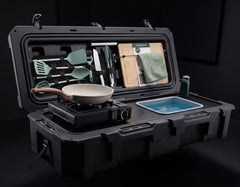
On the VOZ Camp Kitchen, the closed case measures 47.6 by 19.3 by 11.4 inches on the outside. Subtract the lid and floor thickness and you have roughly 10 inches of usable stack height, which is generous by chuck box standards but still less than a home stock pot with its lid on. In a long, low case like this one, height and the footprint of the biggest pot with its handle are the constraints, not width. If you are still deciding what kind of box to build around, the camp kitchen box guide covers the main layouts and what each one leaves room for.


Two rules follow. The nested stack, lid included, needs a half inch of clearance under the compartment height so nothing rubs on a washboard road. And the largest pot's diameter plus any fixed handle has to fit the compartment's shorter side: a 10-inch pot with a 5-inch riveted handle is a 15-inch object, and that is what kills most "compact" sets in a real box.
What's Included Already, and What You Are Actually Adding
Do not shop as if the box were empty. The VOZ ships with a butane stove and a frypan, a knife, spatula, and tongs, a cutting board, an LED light, a foldable sink with a USB-rechargeable faucet, and a 2-gallon water tank. That means the pan slot is already taken. What the box does not include is a lidded pot for pasta, soup, and rice, and a kettle for hot water. Those two pieces are the whole shopping list for most car campers.
Think of it as a permanent kit that lives in the box and never comes back into the house, which is the same logic behind what to keep permanently stocked in a camp kitchen box. Dedicated camp cookware takes the scorched bottoms and gravel scratches so your home pans do not.

The Three-Piece Rule: One Pot, One Pan, One Kettle
An Overland Bound forum member asked the question this article answers almost word for word: pots, a pan, and a kettle that nest, are compact, and are not crazy expensive, for one or two people on one- to three-day trips cooking soup, pasta, burgers, and pancakes out of a vehicle that is, in his words, "compact. VERY compact." The replies leaned toward simple stainless nesting sets, one member's 12-inch carbon steel wok with an 8-inch frypan and 6-inch pot nested inside, and a 10-piece stainless set an owner had used for 14 years.
For a box compartment, the answer is narrower than a full set. Three pieces cover a two- to four-person menu:
- A 2 to 3 quart lidded pot. Big enough for a pound of pasta or a family pot of chili, small enough to sit on a single cassette burner without overhanging the cartridge cover.
- An 8 to 10 inch frypan. The box already has one. If you replace it, keep the diameter the same so it still fits the pan slot and the burner.
- A 1 liter kettle. A 1.1 liter kettle holds 37 fluid ounces, which is two big mugs of coffee or the water for a box of instant oatmeal for three. It should ride inside the pot.
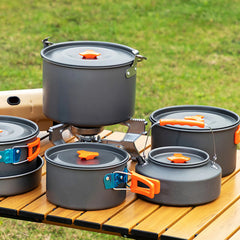
Our 3-piece camping cookware set is built on exactly that pattern: a non-stick aluminum pot, a frypan, and a 37 fluid ounce kettle that nest into one stack with folding handles and a mesh bag. Folding handles are the detail that matters most for a box, because a fixed handle adds inches to the footprint that a compartment wall does not forgive.


How Popular Nesting Sets Measure Up Against a Box Compartment
Here are the published nested dimensions and weights of the sets that show up most often in car camping reviews, from the makers' spec sheets and from OutdoorGearLab and CleverHiker's tests, checked against a roughly 10-inch stack height.
| Set | Nested size (in) | Weight | Cookware inside | Box fit |
|---|---|---|---|---|
| GSI Pinnacle Camper | 9.1 x 9.1 x 5.8 | about 4 lb | 3 L pot, 2 L pot, 9 in frypan, plus 4 mugs, bowls, plates | Fits easily; tableware duplicates what many boxes carry |
| GSI Bugaboo Ceramic Base Camper (large) | not published | 3 lb 11.9 oz | 5 L and 3 L pots, 9 in frypan, cutting board | Fits; 5 L pot is bigger than a single burner needs |
| Stanley Wildfare Core Full Serve | not published | 4 lb 11.2 oz | 3.7 qt pot, 7.25 in frypan, 4 bowls, cutting board | Fits; pan is on the small side for burgers |
| Stanley Even-Heat Camp Pro | 11.6 x 10.3 x 6.7 | 8.2 lb | 4.75 qt stock pot, 1.9 qt saucepan, 8.5 in frypan | Fits on height; the 11.6 in dimension with handles is the check |
| Magma 10-piece nesting (stainless) | 13 x 10.25 x 7.25 | 13 lb | 5 qt stock pot, 3, 2, and 1.5 qt saucepans, 10 in sauté pan | Fits, but it is a quarter of the box's loaded weight by itself |
Notice the pattern: nested height is almost never the problem. Every set with a published nested height stacks under 8 inches. What varies is weight and how much of the set one burner can use. The Magma set nests tightly because its trigger handles come off, but it puts 13 pounds into a box that already weighs about 57 pounds loaded. For a one-person carry, a three-piece kit is the smarter trade. If you want stainless durability without a 10-piece footprint, browse the camp cookware collection and check nested dimensions against the tape strip in your lid before you buy.


Nesting Order That Doesn't Scratch the Coating
A nesting set that rides loose in a compartment is a coating grinder; every mile of gravel road is thousands of small movements of metal on metal. Fire Maple's cookware care guide is blunt about it: put a cloth or paper divider between every stacked non-stick or hard-anodized piece, while plain stainless is low-risk to stack bare as long as it goes in dry. OutdoorGearLab credits the GSI Pinnacle Camper with "metal-on-metal contact virtually eliminated" through its nesting sequence alone, and that is the standard to copy.

The order that works in a box compartment:
- Largest pot on the bottom, handle folded. It becomes the container for everything else.
- Kettle or small pot inside it, with a microfiber towel wrapped around it. The towel is the divider and your dish towel at the same time.
- Cups, a spice kit, or the stove's lighter inside the kettle. Empty air inside a kettle is wasted compartment space.
- Frypan on top, cooking side up, with a paper towel or thin cloth on its surface. Never nest a pot inside a non-stick pan; the pot's bottom edge is what scores the coating.
- Lids flat on top, not wedged between pot walls. A lid jammed sideways is the piece that rattles, and rattling is scratching.
- Everything dry. A sealed box is dark and airtight, and a damp stack in it will smell by the second day of storage.
Point all folding handles the same direction so the stack lifts out as one unit. It should drop into its bay with no free play; if it slides, fill the gap with the dish towel. How the rest of the box is laid out around that stack is its own subject, covered in how to organize a camp kitchen box so you can find everything fast.
Match the Pan to the Built-In Burner, Not the Other Way Around
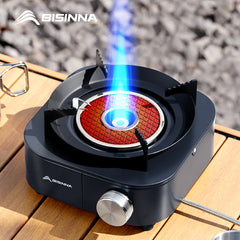
The last fit check is the stove. A single cassette burner has a cartridge sitting inches from the flame under a cover, and every cassette stove manual sets a maximum pan diameter so the pan cannot overhang that cover and cook the cartridge. Iwatani's spec for its Eco Premium model, for example, allows cooking utensils up to 11.5 inches in diameter without overhang, and cheaper stoves often allow less. The forum's 12-inch wok trick makes sense on a two-burner propane stove with a wide grate. On a cassette burner inside a box it is too wide, and a wok's bowl shape does not nest with flat-bottomed camp pots anyway.
Keep the largest cooking surface at or under 10 inches and you are inside the limit for nearly every cassette stove, including the one in the VOZ. That same ceiling is also what nests cleanly in the box, which is no coincidence: the burner, the compartment, and the cookware were all sized for one-pot-plus-pan cooking.
FAQ
Do I need a full cookware set if my camp kitchen box already has a frypan?
No. The frypan, utensils, and cutting board are already there. Add a 2 to 3 quart lidded pot and a kettle that nests inside it, and you have covered boiling, simmering, and hot water. A 10-piece set mostly duplicates gear you own and adds weight to a one-person carry.
Stainless or non-stick for a set that lives in a box?
Stainless stacks bare with little risk and shrugs off a scouring pad, which matters when the set never gets babied. Non-stick is easier to clean with limited water but needs a cloth divider between every piece and soft utensils only. If you pick non-stick, the divider habit is not optional inside a compartment that vibrates for hours.
How do I know a set will fit before I buy it?
Find the nested dimensions on the maker's spec sheet, add the length of any fixed handle to the widest measurement, and compare against the tape strip inside your lid. If a listing gives no nested dimension, assume the stack is about as tall as the largest pot plus one lid.
- What Is a Camp Kitchen Box? The Modern Chuck Box Explained
- What to Keep Permanently Stocked in Your Camp Kitchen Box (vs. Packing From Home)
- How to Organize a Camp Kitchen Box So You Can Find Everything Fast
- Camp Kitchen Kit: Everything That's Included (and Why It Matters)
- Single-Burner vs. Two-Burner Stove: Which One Belongs in Your Camp Kitchen?
Ready to upgrade your camp kitchen?
The VOZ Camp Kitchen includes everything you need in one weatherproof case. Sets up in 15 seconds.
Shop VOZ Camp Kitchen →