
Camp Kitchen for a Toyota 4Runner: Drawers, Liftgate, or Portable Box (Plus the 6th-Gen 2400W Outlet)

The Toyota 4Runner is one of the most popular overland rigs in the country, and every owner eventually faces the same kitchen question: build drawers into the cargo area, cook off the back of the truck, or keep everything in a portable box that lifts out when the trip is over. Here's how the numbers shake out for the 5th-gen and 6th-gen trucks, plus what the new 2400W outlet can and can't do for your cooking.
The 4Runner cargo numbers that decide your setup
Toyota's cubic-foot figures don't tell you whether a kitchen will fit. Owner tape measurements do. Here's what 4Runner owners have posted for the two current-era generations:
| Measurement | 5th gen (2010–2024) | 6th gen gas (2025+) | 6th gen hybrid (2025+) |
|---|---|---|---|
| Floor depth, rear seats up | about 34.5–36 in (seat upright) | about 42 in | about 42 in |
| Width between wheel wells | about 44.5 in | about 43 in | about 43 in |
| Floor to headliner | about 36.5 in (from the sliding deck) | about 31 in | about 29.5 in |
| Rear seat split | 40/60 | 60/40 | 60/40 |
Two things jump out. First, the 6th gen is noticeably shorter inside than the 5th gen, and the hybrid is shorter still, because its cargo floor sits a little higher over the hybrid hardware. Second, no version gives you 48 inches of flat floor in either direction with the rear seats up. Treat every figure as plus or minus an inch, and measure your own truck before you buy anything that has to fit to the inch.
Drawers: what they cost you in height (and dollars)
Drawer systems are the default 4Runner build, and for good reason: everything stays organized, locked, and out of sight. But the toyota-4runner.org forums have a long-running thread on rear drawers and kitchens, and the tradeoffs owners describe are consistent. One owner points out that a 4-inch-tall drawer may give you only about 2.5 inches of usable space inside. Others argue about keeping enough open floor for groceries and luggage when the truck is a daily driver. And almost everyone agrees you never have enough table space, no matter how elaborate the build.
The numbers from a roundup of popular 5th-gen drawer systems put the tradeoff in plain terms:
- Height: many of the full-width systems stand about 10 to 13.4 inches tall.
- Weight: roughly 78 to 150 pounds for most systems, with the heaviest options over 200 pounds.
- Price: from about $900 for the most affordable full-width option to $2,900 and up for premium systems, and more than $4,500 at the top end.
Do the math on a 5th gen. Put a 10-inch drawer on a floor with about 36.5 inches of headroom and you have roughly 26 inches left above it. In a 6th-gen hybrid with about 29.5 inches, the same drawer leaves you under 20. That's enough for a flat sleeping platform or a low cooler, but a tall cooler, a stacked tote, or a kitchen box on top gets tight fast. The drawer also stays in the truck on Monday morning, whether you're camping or not.
If you're still weighing a built-in slide against a box, we break down that choice in detail in camp kitchen vs. slide-out vehicle kitchen.

Cooking off the back: the 4Runner has a liftgate, not a tailgate
Pickup owners cook on a fold-down tailgate. 4Runner owners don't have one. Both generations use a top-hinged liftgate, which gives you something just as useful: a roof over the cook zone that keeps sun and drizzle off the stove and the cook. Both also keep the signature power roll-down rear window, so you can open the glass and reach in for a lighter or a spatula without raising the whole gate.
Many 5th-gen trucks also have Toyota's optional sliding rear cargo deck, which pulls out over the bumper and is rated to hold up to 440 pounds. That's a great way to slide a loaded kitchen box toward you so you don't have to crawl in after it. What it isn't is a cooking surface. Keep open flame out from under the liftgate and away from the cargo opening, and set the stove on its own stable base behind the truck.
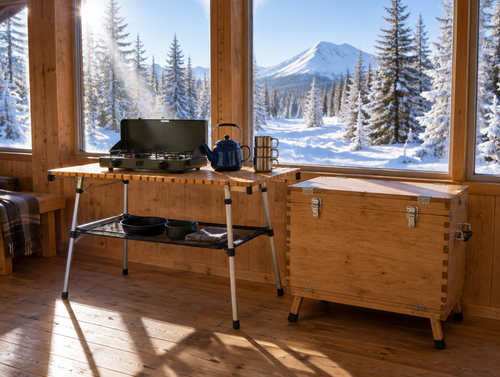
That base is where most 4Runner kitchens come together: the box on a folding table just behind the bumper, the raised liftgate overhead, and the cargo floor as your pantry. Our vehicle camp kitchen guide covers the same layout logic for trucks, vans, and trailers.


The portable box option: loading a 48-inch kitchen
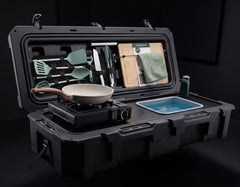
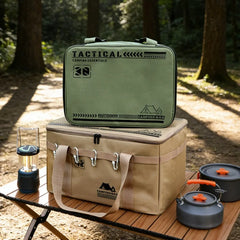
A portable box skips the install, the drill holes, and the daily-driver compromise. The VOZ Camp Kitchen measures 47.6 inches long, 19.3 inches wide, and 11.4 inches tall closed, and weighs about 57 pounds. Inside the weatherproof case you get a butane stove and frypan, a foldable sink with a USB-rechargeable faucet, a 2-gallon water tank, a cutting board, an LED light, and a utensil set. At 11.4 inches tall it takes up about the same headroom as a mid-height drawer, but it comes out of the truck when you get home.


Here's how it loads, using the owner measurements above:
- Seats up: at 47.6 inches, the box is longer than the floor is deep or wide in either generation, so it won't lie flat behind an upright rear seat.
- 5th gen: fold the 40 section of the 40/60 seat. Owners report about 66 inches of floor with the second row folded, so the box slides in lengthwise with room to spare, and you keep the larger side of the bench for passengers.
- 6th gen: the split flips to 60/40, but the 40 section still sits on the driver side. Fold it and run the box lengthwise; owners measure about 59 inches or more of floor with the seats down.
- Either truck: the 19.3-inch width leaves space beside the box for a cooler or duffel. Keep the box low, push it forward against the seatback, and strap it to the tie-down points so 57 pounds doesn't slide on washboard roads.
Our guide to a camp kitchen for an SUV behind the rear seats covers more loading patterns for midsize SUVs, including how to share the space with a fridge.

The 6th-gen 2400W outlet: can it run an induction burner?
This is the new part of the 4Runner kitchen conversation. On the 6th gen, Toyota makes a 2400W AC power supply standard on the i-FORCE MAX hybrid grades, with outlets in the cabin and in the cargo area. The hybrid is standard on the TRD Pro, Trailhunter, and Platinum, and available on the TRD Off-Road, TRD Off-Road Premium, and Limited. If you're shopping a gas i-FORCE truck, check the window sticker rather than assuming it has the same outlet.
On paper, 2400 watts is plenty. Portable plug-in induction burners top out around 1,800 watts on a standard 120V outlet, which leaves headroom for a 12V fridge that typically draws under 100 watts. Owners on the 4Runner6G forum report running induction cooktops, electric kettles, air fryers, and fridges from it. In practice, three things change the picture:
- The engine has to be running. Owners report the outlet only works with the vehicle on, and that the outlet setting doesn't stay on after you shut the truck off. As one owner put it, you end up cooking in the exhaust.
- Exhaust and an open liftgate don't mix. The CDC warns that if only the tailgate is open on an SUV, carbon monoxide from the exhaust will be pulled into the vehicle, and recommends opening vents or windows to keep air moving. Never sleep in or cook inside the cargo area with the engine running.
- It's loud. Owners describe the inverter's cooling fan kicking on once draw passes roughly 500 watts, and Toyota's manual notes the fan sound is normal. An 1,800-watt burner will keep it running.
The setup most 4Runner owners settle on is smarter: charge a portable power station from the 2400W outlet while you drive, then run the induction burner from the power station at camp with the engine off. One owner reports charging a power station at 1,700 watts from the outlet. That turns the truck into a rolling charger rather than an idling generator. We run the full numbers on battery size, cook time, and cost in propane vs. induction with a power station.
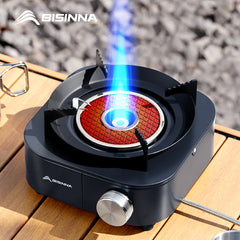
Even with induction in the mix, keep a flame stove in the box. Butane and propane work when the power station is empty, on the second cloudy day, and in any 4Runner, gas or hybrid.


FAQ
Should I get drawers or a portable camp kitchen box for my 4Runner?
If the 4Runner is a dedicated trail rig and you want everything locked in place, drawers make sense, but expect to give up 10 inches or more of height and spend roughly $900 to $2,900 or more. If it's also your daily driver, a portable box keeps the cargo area free between trips and moves with you to your next vehicle.
Will a full-size camp kitchen box fit in a 4Runner with the rear seats up?
Not flat. Owners measure about 34.5 to 36 inches of depth in a 5th gen and about 42 inches in a 6th gen, with 43 to 44.5 inches between the wheel wells. A box around 48 inches long needs one rear seat section folded.
Does every 6th-gen 4Runner have the 2400W outlet?
Toyota lists the 2400W AC power supply as standard on the i-FORCE MAX hybrid grades: standard on the TRD Pro, Trailhunter, and Platinum, and on the TRD Off-Road, TRD Off-Road Premium, and Limited when ordered with the hybrid. On a gas truck, check the window sticker.
Can I cook on an induction burner from the 4Runner outlet?
It has the wattage, but the engine must be running, which puts you next to the exhaust. Charging a power station while driving and cooking from that with the engine off is the safer and quieter approach.
Ready to upgrade your camp kitchen?
The VOZ Camp Kitchen includes everything you need in one weatherproof case. Sets up in 15 seconds.
Shop VOZ Camp Kitchen →