

Propane vs. Induction: Should Your Camp Kitchen Go Electric With a Power Station?

The fastest-growing piece of gear at car campgrounds isn't a stove — it's a battery. Now that power stations can push 1,800 watts, the pitch writes itself: ditch the gas canisters, plug in an induction cooktop, and cook with no flame at all. Before you rebuild your camp kitchen around a battery, it's worth running the actual numbers.
The Short Answer
Induction is legitimate camp-cooking technology now, not a gimmick. A portable induction burner boils water faster than most gas stoves, works in wind, makes zero carbon monoxide, and simmers with a precision no camp burner can match. But on the two measures that decide most camp kitchen choices — cooking energy per pound of gear and dollars per meal of hardware — gas still wins by a landslide. A 1-lb propane cylinder holds roughly three power-station charges' worth of delivered cooking heat, weighs about 2 pounds full, and costs a few dollars. The battery that replaces it weighs 27 pounds and costs several hundred. For most campers the smart setup isn't propane or induction — it's gas for heat, battery for everything else, and we'll show you where the crossover point sits.
What an Induction Burner Actually Draws
Portable induction cooktops built for US outlets top out at 1,800 watts — the ceiling of a standard 15-amp household circuit — and most real cooking happens between 1,000 and 1,800 watts. That number sounds small next to camp-stove ratings until you account for efficiency. According to the US Department of Energy, induction cooktops are up to three times more efficient than gas stoves and boil water 20–40% faster, because the coil heats the pan directly instead of warming the air around it. Roughly 85–90% of an induction burner's energy lands in the pan; an open gas flame outdoors delivers around 40% on a good day, and less in wind.
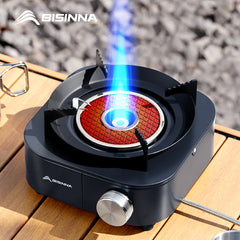
Translate that into camp-stove language: 1,800 watts is only about 6,100 BTU per hour of input, but at the pan it cooks like a 12,000–13,000 BTU gas burner. In tests, portable induction burners bring a liter of water to a boil in under three minutes. If BTU math is new to you, our guide to how much stove power a camp kitchen actually needs breaks down what those ratings mean at the picnic table.

The Runtime Math: What a Power Station Really Buys You
Power stations are rated in watt-hours, and an 1,800-watt appliance is the hungriest thing most people will ever plug into one. A 1,024Wh unit like the EcoFlow Delta 2 sustains a full-power induction burner for only about 30–34 minutes before it's flat. Here's the arithmetic across common sizes, assuming full 1,800W output and typical inverter losses:
| Station capacity | Full-power cook time | What that covers |
|---|---|---|
| ~500Wh (small, ~13 lb) | ~15 minutes | Coffee and eggs, once |
| 1,024Wh (EcoFlow Delta 2, 27 lb) | ~30 minutes | One serious dinner |
| 1,152Wh (Bluetti AC180, 37.4 lb) | ~35 minutes | Dinner plus a hot breakfast |
| ~2,000Wh (50+ lb) | ~60–65 minutes | A full day of cooking for two |
The saving grace: real camp cooking rarely runs the burner flat-out. Most meals need 10–30 minutes of burner time, much of it at half power, so a 1kWh station realistically covers one heavy cooking day. Then it needs a recharge — pennies' worth of electricity at a home outlet, but at a campsite that means most of a sunny day on a 200-watt solar panel, or a long drive with a car charger.
Energy per Pound: The Number Gas Campers Already Know
Here's the comparison the power-station marketing never shows. Propane holds about 21,600 BTU per pound — roughly 6.3 kWh of chemical energy in the fuel of a single green 1-lb cylinder. Even after an open burner wastes 60% of it, that cylinder still delivers about 2.5 kWh of heat into your pan, from a package that weighs 2 pounds full. A 1,024Wh power station, after inverter losses and induction's excellent efficiency, delivers roughly 0.8 kWh per charge — from 27 pounds of battery. Per pound of gear in your trunk, gas carries about 40 times more cooking energy. That's the same physics that makes the humble green cylinder such a workhorse, and it's why our 1-lb canister vs. 20-lb tank comparison matters more than any wattage spec: with gas, carrying a spare meal's worth of energy costs you 2 pounds, not 27.
Cold weather widens the gap. Propane keeps vaporizing down to −44°F, so a propane stove lights on the coldest morning you'll ever camp in. Butane — the fuel in cassette-stove canisters — starts losing pressure near freezing, and lithium batteries lose usable capacity in the cold too, so an induction setup gives up performance on both ends in winter. Every gas burner we sell runs on cylinders or cassettes you can buy at any big-box store on the way to the trailhead — no outlet required.


Where Induction Genuinely Wins
None of that math makes induction pointless. It wins clearly in a handful of situations:
- No combustion, no carbon monoxide. Induction makes heat with a magnetic field, not a flame, so it's the one cooktop safe to run under an RV awning or in spaces where a gas burner never belongs.
- No open flame. During wildfire season, a flameless burner sidesteps the campfire anxiety entirely — though always check your specific land agency's current fire restrictions, which can also limit stove use.
- Wind immunity. Wind can steal a huge share of an open flame's heat before it reaches the pot. Induction's heat is generated inside the pan itself.
- Real simmer control. Precise low-power settings hold a sauce or oatmeal at a whisper — something budget gas burners struggle with.
- Free refills if you already carry solar. For RVers and boondockers with panels on the roof, sunshine becomes cooking fuel.
Who fits that profile? RV and van travelers with big house batteries already installed, tailgaters parked next to an outlet or a generator, and basecampers running serious solar. If that's you, an induction plate is a genuinely good second burner. If you're loading a trunk for a weekend, it's an expensive way to carry less cooking time.
What This Means for a Camp Kitchen Box
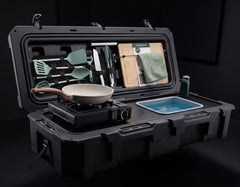
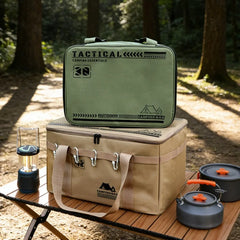
A camp kitchen box settles this debate the practical way: use each energy source for what it does best. The VOZ Camp Kitchen runs its drop-in cassette burner on gas because heat is where gas embarrasses batteries — and it already uses battery power where electricity genuinely wins, in the USB-rechargeable faucet pump that moves water with a few watts instead of 1,800. Everything else you need to cook the meal — cookware, prep surface, sink, and 30-plus pieces of kit — packs into the same case; see exactly what's included in the box. If you already own a power station for your fridge and lights, an induction plate can ride along as a flameless second burner on the box's lid. But as the backbone of the kitchen, the gas burner earns its spot every trip: it weighs nothing, costs almost nothing to feed, and never needs a sunny afternoon to recover.


FAQ
Can a power station really run an induction cooktop?
Yes, if its continuous AC output is at least 1,800 watts — check the continuous rating, not the surge number. Output determines whether the burner runs at all; capacity in watt-hours determines for how long. Budget roughly 1,000Wh per heavy cooking day.
Is induction cheaper than gas for camp cooking?
Per meal, both are cheap: recharging a 1kWh station at home costs well under a dollar, and a 1-lb propane cylinder costs a few dollars and covers several meals. The real cost gap is hardware — a burner-capable power station runs several hundred dollars, while a gas burner setup costs a fraction of that.
What cookware works on induction?
Any flat-bottomed pot or pan a magnet sticks to, per the Department of Energy's guidance. Cast iron and most stainless steel work; bare aluminum and titanium camp cookware won't heat at all, so check your mess kit with a fridge magnet before you commit.
Does induction work in cold weather?
The cooktop does, but its power source suffers: lithium batteries deliver less usable capacity in the cold. Propane, by contrast, keeps flowing down to −44°F. For winter and shoulder-season trips, gas is the dependable choice.
How big a power station do I need for camp cooking?
As a floor: 1,800W continuous output and 1,000Wh of capacity, which buys roughly half an hour of full-power cooking or one substantial dinner. Anything smaller is a phone-and-lights battery, not a kitchen.
Ready to upgrade your camp kitchen?
The VOZ Camp Kitchen includes everything you need in one weatherproof case. Sets up in 15 seconds.
Shop VOZ Camp Kitchen →

