Camp Kitchen With a Truck Camper Shell or Topper: Tailgate vs. Side Setup (and Cooking in Bad Weather)

A camper shell turns a pickup bed into a bedroom and a garage at the same time, and that is exactly why the old "just cook off the tailgate" advice stops working. Here is how to choose between a tailgate kitchen and a side kitchen under a shell, topper, or tonneau, and how to keep cooking when the weather turns.
Why a shell changes the tailgate-vs-side question
On an open bed, the tailgate is the obvious counter. Add a cap and three things change. The rear door has to stay open while you cook, so every trip for a spatula means reaching past a lit burner into the bed. If you sleep back there, the platform and bedding sit right behind the stove, catching grease spatter and steam. And a cab-high shell has no headroom to spare, so anything stacked above the tailgate line comes out before the gate becomes a work surface.
Truck campers on the Expedition Portal forum have argued this out. The tailgate camp likes the fast setup. The side camp points out that cooking beside the truck keeps the rear door closed in bad weather, keeps the sleeping platform dry, and lets you move the kitchen to whichever side is out of the wind. Both are right. The answer depends on whether you sleep in the bed, what weather you camp in, and what kind of cover you run.
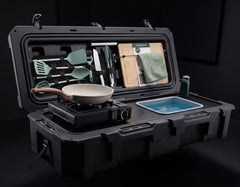
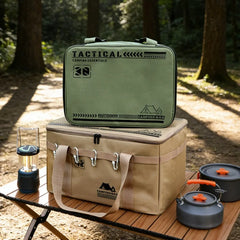
What makes either layout painless is a kitchen you can carry as one unit. A VOZ Camp Kitchen closes into a single 47.6 by 19.3 by 11.4 inch case at about 57 pounds loaded, with the butane stove, collapsible sink, USB-rechargeable faucet, 2-gallon tank, and 30-plus cooking items inside. It rides flat in the bed, then goes wherever the weather says the kitchen should be that night. Our vehicle camp kitchen guide covers how that plays out across trucks, vans, and trailers.


Option 1: The tailgate kitchen under a shell
This is the default for a reason. A full-size tailgate sits close to home-counter height. Dealer spec sheets for the 2025 F-150 list the open tailgate at 37.4 inches from the ground, and Ford's body builder guide for the current Ranger puts its open tailgate at 36.1 inches. A standard home kitchen counter is 36 inches. You get a stable, level, waist-high surface with no legs to fuss with.
| Surface | Height from ground |
|---|---|
| Home kitchen counter | 36 in |
| 2025 Ford F-150 tailgate, open | 37.4 in |
| Current Ford Ranger tailgate, open | 36.1 in |
A kitchen box sitting on that gate raises the burner and cutting board a bit higher still. Shorter cooks often prefer moving the box onto a table beside the truck, which is the first hint that the side setup is not only for bad weather.
Where the tailgate kitchen falls apart under a shell:
- The rear door is your only access. With the box on the gate, the fridge, water jug, and dry bin behind it are blocked until you move the kitchen.
- The sleeping platform is in the splash zone. Frying bacon eighteen inches from your pillow is how a sleeping bag ends up smelling like a diner for the rest of the trip.
- Wind funnels in. A raised rear door and open gate make a scoop. Wind that hits the back of the truck goes straight across the burner and into the bed.
- Rain protection is partial. A lifted cap door covers the gate in a straight-down rain and not at all in a sideways one.
Tonneau covers are a special case. A hard folding or roll-up cover sits at bed-rail height, so the bed becomes a low, sealed drawer and the tailgate is the only counter you have. Ford's body builder guide lists the current Ranger box at 20.6 inches deep, and Toyota's product information sheet lists the 2024 Tacoma bed at 21.2 inches. A kitchen box that closes to 11.4 inches tall rides under either cover with room for a folded table on top. In wet climates, a freestanding canopy over the tailgate does what a cap door would.

Option 2: The side kitchen beside the truck
A side kitchen means the box comes out of the bed and sets up on a table or the ground along the driver or passenger side, usually under an awning. It costs one carry and a table. In return it solves every item on the tailgate list at once.
- The rear door stays closed. Bedding stays dry and clean, and you can still grab gear through the door without stepping around a stove.
- You can pick the lee side. Wind shifts, you carry the box to the other side. The truck body is the windbreak.
- Side windows become a pass-through. Caps with opening side windows, sold as "windoors" by Leer and A.R.E., let you reach a fridge or dry-goods bin from outside without opening the back at all.
- Awnings cover the side better than the rear. A standard side awning like the ARB 2500 shades about 8 feet 2 inches along the truck and 8 feet 2 inches out. Wraparound 270-degree awnings run from about 70 square feet up to roughly 130 square feet depending on the model, and reach around the rear corner so the tailgate gets some cover too.
The trade-off is real. You need a table or a flat spot, and you cook at whatever height that table gives you. An all-in-one box is easier to live with here than loose bins, because it is one carry and one set of latches rather than a stove, sink, and jug shuttled around the truck separately.


| Your situation | Better spot | Why |
|---|---|---|
| Bed is cargo, you sleep in a tent or roof tent | Tailgate | No bedding to protect, fastest setup |
| You sleep on a platform in the bed | Side | Keeps grease, steam, and rain off the bedding |
| Rain or snow in the forecast | Side under an awning | Rear door stays shut, better coverage |
| Steady wind | Side, lee of the truck | Truck body blocks it, and you can switch sides |
| Quick roadside lunch | Tailgate | Not worth carrying the box out |
| Tonneau cover, no shell | Tailgate | Cover folds forward, gate is the only counter |
Cooking in bad weather under a shell
Start with the rule that matters most. The U.S. Consumer Product Safety Commission is blunt about it: fuel-burning stoves, heaters, and lanterns should never be used inside a tent, camper, vehicle, or other enclosed shelter, because people die every year from carbon monoxide poisoning in exactly those spaces. A camper shell is a small vehicle. Even with the door open, the burner belongs on the tailgate or outside the shell, never on the platform inside it. The CPSC page on camping equipment and carbon monoxide is a short read.
With that settled, the weather playbook for a shell truck is short:
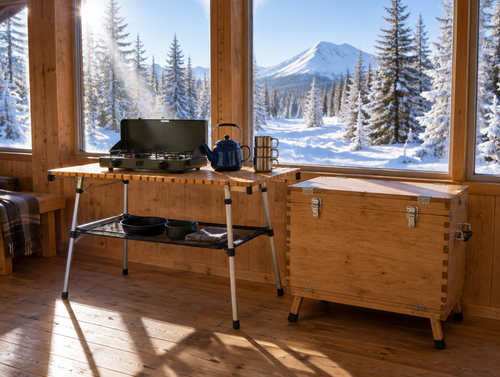
- Rain, little wind. Tailgate is fine. The raised cap door is your roof. Pull the box to the front edge of the gate so drips off the door land behind the stove, not in the pan.
- Rain with wind. Go to the side, under an awning, with the truck between you and the weather. Shut the rear door so the bedding stays dry.
- Wind, no rain. Lee side of the truck, box turned so the open lid faces the wind and works as a shield. The National Weather Service's Beaufort scale is your field gauge: leaves and small twigs in constant motion means roughly 8 to 12 mph, small branches moving means 13 to 18 mph. MSR's guidance says a 5 mph breeze can make an open-burner canister stove use as much as three times the fuel for the same cooking job, so even a light wind is worth blocking.
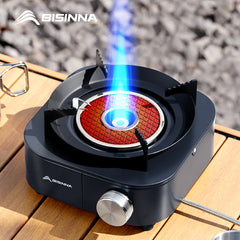
- Cold. Plain butane stops vaporizing at about 31 degrees Fahrenheit, so a butane cassette stove gets sluggish near freezing. Keep the canister in the cab until you cook, or bring a propane stove for shoulder-season trips. It sets up beside the box the same way, so nothing else in the layout changes.


Don't block the sleep platform
If you sleep in the bed, the platform sets the rules for where the kitchen rides. Under a cab-high cap the platform usually sits at or just below the bed rails, leaving a full drawer of storage underneath. Truck campers on Expedition Portal put 24 inches of clearance above the mattress as a bare minimum for resting on an elbow and around 30 inches to sit up, which is why taller caps exist: Leer's FAQ notes its 180 model adds about 4 inches over cab height, and Leer dealers list the 122 high-rise at about 11 inches over the cab.
Three placement rules keep the kitchen and the bed from fighting:
- Kitchen rides under the platform, not on it. An 11.4-inch closed case slides under a platform built at bed-rail height on any current mid-size or full-size bed. If you build the platform lower to gain headroom, measure the gap first.
- Kitchen goes nearest the tailgate. It is the one thing you pull out every night, so it is the last thing loaded and the first thing out. Water jug and fridge go against the cab or behind a side windoor.
For bed lengths and how a box rides in a short bed, see our guides to camp kitchen setups for a truck bed and fitting a camp kitchen in a mid-size truck bed.
FAQ
Can I cook inside the camper shell with the rear door open?
No. The CPSC says fuel-burning stoves should never be used inside a tent, camper, vehicle, or other enclosed shelter, and an open rear door does not make a shell an open space. Keep the burner on the tailgate, outside the cap's roofline, or beside the truck.
Does the tailgate hold the weight of a full kitchen box?
A loaded all-in-one box weighs about 57 pounds, less than one adult sitting on the gate. Set it flat across the tailgate rather than on one edge.
Do I need an awning for a side kitchen?
Not in dry weather. The truck body is the windbreak and the open lid of the box shields the burner. An awning earns its keep once you camp in rain, because it lets you keep the rear door shut while you cook.
Will a kitchen box fit under my sleeping platform?
If the platform sits at bed-rail height, yes on any current mid-size or full-size truck, since those beds run about 20 to 21 inches deep and the box closes to 11.4 inches. Lower platforms need a tape measure before you commit.
- Vehicle Camp Kitchen: Best Options for Trucks, Vans, Trailers & RVs
- Best Camp Kitchen Setups for a Truck Bed: Short Bed to Full-Size
- Will a Camp Kitchen Fit a Mid-Size Truck Bed? (Tacoma, Ranger, Maverick)
- Cooking With a Camp Kitchen in Rain and Wind: How to Weatherproof Your Setup
- Roof Top Tent Camp Kitchen: Cooking Setups That Work When You Sleep on the Roof
Ready to upgrade your camp kitchen?
The VOZ Camp Kitchen includes everything you need in one weatherproof case. Sets up in 15 seconds.
Shop VOZ Camp Kitchen →