Camp Kitchen vs. RV Outdoor Kitchen: Do You Still Need a Portable Box?

If your travel trailer already came with a slide-out outdoor kitchen, it is fair to ask whether a portable camp kitchen box is redundant. Spend a season reading RV forums, though, and the same verdict shows up again and again: the built-in is great for grabbing a cold drink, but a lot of owners barely cook on it. Here is an honest look at how an RV's outdoor kitchen actually compares to a portable box — and when you still want to keep one in the rig.
Two very different ideas of an "outdoor kitchen"
A built-in RV outdoor kitchen is a compartment molded into the side of a travel trailer or fifth wheel. Pop the hatch and you typically get a small two-burner cooktop or a flip-up griddle, a compact sink, a mini fridge, and a strip of counter — all plumbed and wired into the trailer. It is permanently attached, so it is always there and never needs packing.
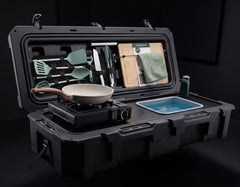
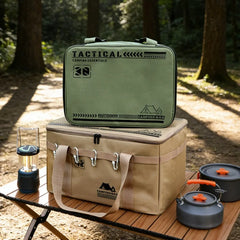
A portable camp kitchen box is the opposite: a self-contained case you carry. The VOZ Camp Kitchen, for example, opens into a butane stove, a collapsible sink fed by a USB-rechargeable faucet, a 2-gallon water tank, a cutting board, a rechargeable LED light, and a full 30-plus-piece cookware and utensil set — then closes back into a weatherproof case that rides in any vehicle. It is not tied to one trailer, which is the entire point.


So the comparison is not really "which is better." It is "what does each one actually let you do?" For the broader portable-versus-built-in argument, our camp kitchen vs. chuck box guide walks through the same trade-off from the chuck-box side.
Side-by-side: RV outdoor kitchen vs. portable box
| Factor | Built-in RV outdoor kitchen | Portable camp kitchen box |
|---|---|---|
| Location | Fixed to one trailer | Rides in any vehicle |
| Setup | Open the hatch | Lift it out, open the lid |
| Cooktop | Usually 2 small burners (often ~5,200–7,200 BTU) or a griddle | Self-contained burner with an included pan |
| Prep space | Narrow built-in counter | Lid/cutting board plus any table you set it on |
| Sink | Small basin; some units lack a real drain | Collapsible sink, USB faucet, 2-gal tank |
| Fridge | Often a small mini fridge | None — pair with a cooler |
| Cookware / utensils | None — bring your own | 30+ pieces included |
| Works away from the rig | No | Yes — patio, picnic table, day-use area |
| Weather placement | Locked to the trailer wall | Move it into shade or out of the wind |
| Cost | Bundled into the RV price | Standalone purchase |
Two rows in that table do most of the work in this debate: "works away from the rig" and "weather placement." Those are exactly where a built-in cannot follow you.
Where the built-in RV outdoor kitchen wins
Give the RV outdoor kitchen its due, because it has a real job. Its best trick is that there is no setup at all — you lift a hatch and the burner, sink, and fridge are right there at counter height. The mini fridge is the genuine standout: cold drinks and snacks live outside, so you stop opening the main door and letting the cooled air and the bugs trade places. On a hot afternoon, cooking outside also keeps heat and food smell out of the living space, which is the comfort argument RVers bring up most.
For light duty — reheating, boiling water, frying a few eggs, washing a couple of dishes without trekking inside — the built-in is genuinely convenient. The catch is that "light duty" is about where its usefulness stops.

Where a portable box still wins
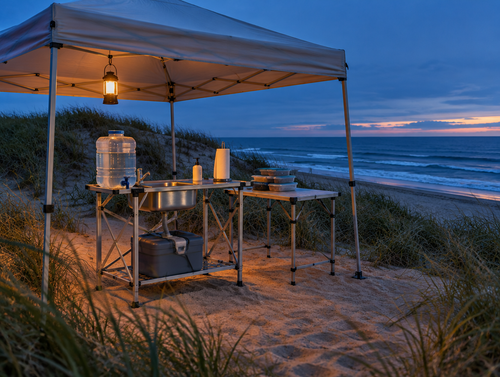
The first gap is cook area and power. A built-in cooktop is usually two modest burners crammed into a narrow recess, and owners regularly complain they heat food more slowly than the indoor range and leave almost no room to work beside the pan. A portable box puts the burner out on an open surface with the lid and cutting board as prep space, and you can park it next to a full-size camp table for a real cooking station. That is why so many RVers end up bolting a 17-inch Blackstone griddle onto the outdoor rail and running it off the trailer's propane quick-connect — they are quietly admitting the factory burner was not enough.
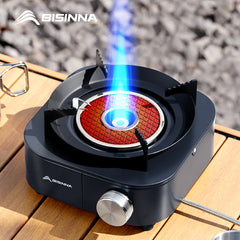
If your built-in burner has been a letdown, a standalone camp stove is the easiest fix, and there are a lot of good ones at different output levels.


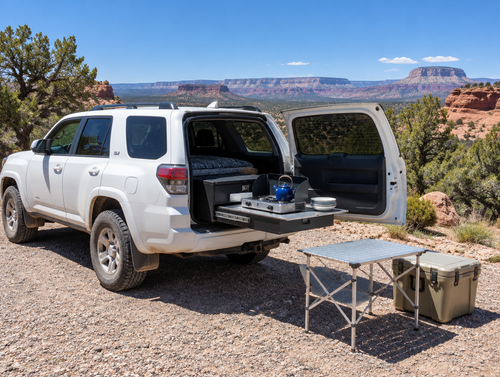
The second gap is placement. A built-in is welded to the side of the trailer, so wherever you park is where you cook — in the sun, in the wind, in the dust kicked up by the road. A portable box goes wherever the conditions are best: under a shade tree, behind a windbreak, on a covered patio, or at a day-use picnic area miles from camp. That mobility is also why the box doubles as a kitchen for the truck, van, or SUV you tow with — our guide to a vehicle camp kitchen for trucks, vans, trailers and RVs covers how it travels between rigs.
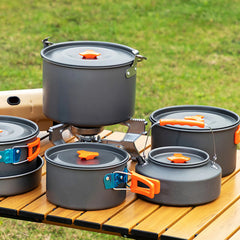
The third gap is completeness. An RV outdoor kitchen gives you the fixtures; it does not give you a single pot, pan, knife, or spatula. A loaded box ships with the cookware and utensils already inside, so there is nothing to forget on the counter at home. And it keeps cooking even when the trailer is in the driveway and you are car-camping for the weekend.
The "marketing over function" complaint
Search any RV forum for outdoor-kitchen threads and a pattern emerges. Plenty of owners love theirs, but a vocal group calls the feature more marketing than function, and their gripes are specific and worth knowing before you rely on one:
- Weak burners. The two small burners do not heat as fast as the indoor stovetop, and there is little prep room beside them.
- No real drain. Some units have a sink that does not drain properly, so you fill and dump the basin by hand after every use.
- Grease and smoke. Cooking tight against the trailer wall can leave a thin grease film that attracts dirt, and vents can let smoke and odor creep back inside.
- Awkward height on uneven ground. If the site is not level, the fixed counter can be a stretch — especially for shorter cooks.
- Bug management. Fridge vents in the compartment need added screens, or you invite insects in every time you open it.
The consistent forum advice is that an outdoor kitchen is worth it if you have kids or spend most of your time outside, and probably not worth leaning on if you spend most of your time inside the RV. Either way, none of those complaints describe a portable box — a self-contained kitchen sets up away from the wall, carries its own drainable sink and water, and moves to wherever the cooking is actually pleasant.

So do you still need a portable box?
For most RVers, yes — not to replace the built-in, but to cover what it cannot. Keep the outdoor fridge and quick sink for grabbing drinks and rinsing hands. Reach for the portable box when you are actually cooking dinner for the group, when you want to set up away from the trailer, when the weather pushes you under cover, or when you take the tow vehicle out for a day trip and leave the trailer at camp. If you tend to compare full setups by brand, our VOZ vs. Yoke Outdoors comparison shows what a complete portable kitchen includes against another premium box.
If you do not own an RV with a built-in at all, the math is even simpler: a portable camp kitchen gives you the same cook-outside, sink-and-fridge-nearby experience without buying a whole trailer to get it.
FAQ
Does an RV outdoor kitchen replace a camp stove?
Only for light cooking. The built-in burners are usually small — commonly in the 5,200 to 7,200 BTU range — and slower than your indoor range. For boiling water or frying eggs they are fine; for cooking a real meal for several people, most owners add a separate stove or griddle anyway.
Why do so many RV owners say they do not use the outdoor kitchen?
The most common reasons are weak burners, cramped prep space, sinks that do not drain on their own, and grease or smoke near the trailer wall. Owners who cook mostly inside, or who are usually solo, tend to find it goes unused.
Can I use a portable camp kitchen if I do not have an RV outdoor kitchen?
Absolutely — that is the most common use. A self-contained box gives you a stove, a sink with running water, prep space, and a full cookware set in any vehicle, no built-in required.
Is the small RV outdoor kitchen sink worth it?
For rinsing hands and a couple of dishes, it is handy. The limitation is drainage: some units make you dump the basin by hand. A portable sink with its own tank and faucet handles real dishwashing more cleanly and can sit wherever you want it.
Ready to upgrade your camp kitchen?
The VOZ Camp Kitchen includes everything you need in one weatherproof case. Sets up in 15 seconds.
Shop VOZ Camp Kitchen →