Renting vs. Buying a Camp Kitchen: When Rental Gear Makes Sense (and When It Doesn't)

In 2026 you can rent almost everything for a camping trip — the tent, the sleeping bags, even the stove — and have it shipped to your door. Whether you should is a math problem, and for the cooking side of camp the answer flips faster than most people expect.
What Renting Camp Cooking Gear Actually Costs
Rental pricing for kitchen gear looks cheap per item until you add up a real trip. Here are current published rates from national and regional outfitters that ship or rent locally in the US:
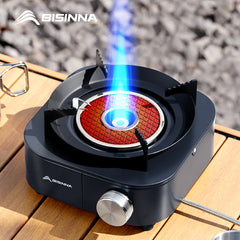
- Two-burner propane stove: one Arizona-based national shipper (Lower Gear Outdoors) lists $12 for a 3-day rental and $18 for a week. A Brooklyn outfitter (Gear To Go Outfitters) charges $25 for the 3-day minimum and $33 for a week, adding $2 per day after day three. Denver's Outdoors Geek lists a two-burner propane stove at $21 per week.
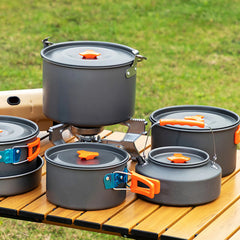
- Car-camping cookware set for four (5L and 3L pots, 9-inch frypan, cutting board, utensils): Teton Backcountry Rentals charges $10 per day for the first two days, then $8 per day — $28 for a typical 3-day weekend.
- Full camping kits: REI's basic two-person car camping kit starts at $114 for members and $171 for non-members for the first night, with discounted additional nights — but the rental program now operates in only about a dozen stores.
Two costs never show up on the rate card. First, fuel is never included — rental companies can't ship propane or butane, so you're buying canisters at your destination either way (a standard 16.4-ounce propane cylinder runs roughly an hour on high). Second, if you're not near a rental shop, shipping both directions gets added at checkout, and on a $25 stove rental the round-trip freight can rival the rental fee itself.

Add it up honestly: a weekend's worth of rented cooking gear — stove plus a four-person cook set — lands around $55–65 per trip before fuel and shipping. That number is the whole rent-vs-buy debate in miniature, because a comparable owned two-burner stove costs about what three or four of those rentals do. If you'd rather own that piece outright, this is exactly the category where a mid-priced two-burner stove pays for itself fastest.


The Catch: You Can't Really Rent a Full Camp Kitchen
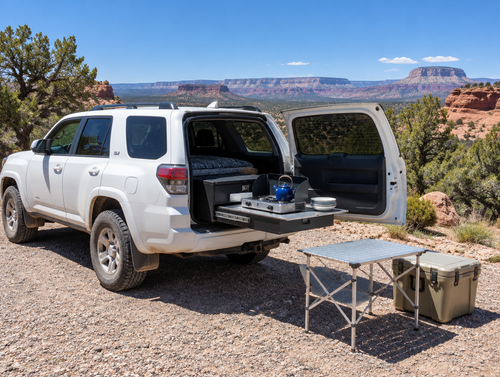
Here's what the rental guides gloss over: rental fleets are built around the sleeping side of camping. Tents, bags, pads, backpacks — that's the inventory. On the cooking side, most fleets stop at a stove and a nesting cook set. Searching the major national outfitters turns up exactly one full chuck-box-style camp kitchen for rent (a wooden Outdoorsman box in Outdoors Geek's Denver fleet), and effectively nothing with a working sink, faucet, or water system.
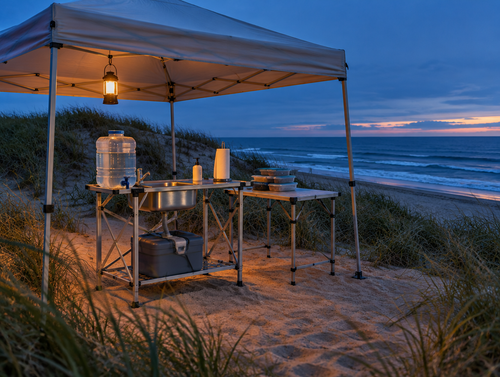
That matters because a camp kitchen box isn't just a stove in a crate — it's the stove, prep surface, washing station, and organized storage for every utensil, all in one carry. The parts of camp cooking that rentals can't cover (running water for washing hands and dishes, a dedicated prep surface, a permanent home for 30-odd small items) are precisely the parts that make cooking outside feel civilized instead of chaotic.
So the real-world rental decision isn't "rent a camp kitchen or buy one." It's "piece together a partial kitchen from a rental fleet, or own a complete one."
The Break-Even Math
Run the numbers against what you'd actually buy, and the crossover points are earlier than most renters assume:
| Your camping pattern | Rental cost (kitchen gear only) | When buying wins |
|---|---|---|
| One trip a year | ~$55–65/trip + fuel + shipping | It mostly doesn't — keep renting |
| 3–5 trips a year | ~$165–325/year | A budget-to-mid-tier setup pays for itself in the first season or two |
| Monthly trips, April–October | ~$385–455/year | Even a premium all-in-one box breaks even in about 2–3 seasons |
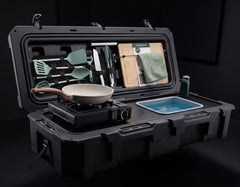
Take the premium case, since it's the hardest test. The VOZ Camp Kitchen — a complete box with a butane stove, collapsible sink, USB-rechargeable faucet, 2-gallon water tank, and 30+ pieces of cookware and utensils — currently sells for $1,169. At $55–65 per trip in piecemeal kitchen rentals, that's a break-even of roughly 18–21 trips. A weekend-a-month camper gets there in under three seasons; a frequent family gets there in about a year and a half — and the rental comparison isn't even equivalent, because none of those rented setups includes running water. Cheaper owned setups cross over far sooner, which is the full cost-benefit case we ran in Are Camp Kitchen Boxes Worth It?


When Renting Genuinely Makes Sense
Renting isn't a trap — it's the right call in specific situations, and it's worth being honest about them:
- Your first camping trip ever. If you don't yet know whether your family will camp twice a year or twice a decade, $60 of rented cooking gear is cheap insurance against a garage full of regret.
- You're flying to the trip. Checked-bag fees and fuel restrictions make shipping-based rental services (Arrive Outdoors, for example, delivers to your home, hotel, or a FedEx location) genuinely practical for destination trips.
- You camp once a year or less. Below roughly two trips a year, per-use rental cost stays under ownership cost for a long time, and the rental company handles cleaning and storage.
- You're auditioning a category. Renting a two-burner stove for one trip is a low-cost way to learn what you actually want before spending real money — the same try-before-you-buy logic applies to testing whether an organized kitchen setup matters to you.
- You have zero storage. A studio apartment with no garage changes the math; gear you can't store degrades and gets replaced anyway.
When Buying Wins

Ownership wins on more than cost once you camp regularly, and some of the advantages don't show up in a spreadsheet:
- Frequency: at three or more trips a year, per-use cost drops below rental rates within a season or two, and everything after that is nearly free cooking.
- Consistency: your knife is where you left it, your stove lights the way it always does, and setup becomes muscle memory. Rented gear resets that learning curve every trip.
- Hygiene: cooking gear is the most personal category of camp equipment. A rented sleeping pad is one thing; a rented frypan and cutting board that hundreds of strangers have cooked on is another.
- No reservation roulette: your kitchen never books out on Memorial Day weekend.
- Completeness: you can own the parts no fleet rents — the sink, the faucet, the water tank, the organized storage.
There's also a sensible middle path: rent the bedroom, buy the kitchen. Tents and sleeping bags are the most expensive items to buy well and the easiest to rent — while cooking gear is the cheapest category to own relative to how much you use it, and the one you most want to be yours. Plenty of families rent a big cabin tent for years while owning their cook setup from trip one. If you go that route, start with our breakdown of budget, mid-range, and premium camp kitchen tiers so you buy at the level that matches your actual trip count.
FAQ
Can you rent a complete camp kitchen box?
Almost never. Rental fleets carry stoves and cook sets, but full chuck-box-style kitchens are vanishingly rare — we found a single wooden chuck box in one national fleet, and no rentals at all with an integrated sink, faucet, or water tank.
Is renting cheaper for a single trip?
Yes, almost always. One weekend's kitchen rental runs $55–65 plus fuel, far less than buying everything. The math only flips with repetition — starting around three to five trips, ownership pulls ahead for good.
Do gear rentals include stove fuel?
No. Rental companies can't ship propane or butane canisters, so fuel is always your separate purchase at the destination. Budget for it either way — a 16.4-ounce propane cylinder lasts about an hour of cooking on high.
What about buying used instead of renting?
Used is often the best of both worlds: ownership economics at a rental-adjacent price. Camp kitchen gear holds up well if it was stored dry, but inspect before you pay — our guide to buying a used camp kitchen covers exactly what to check.
- What Is a Camp Kitchen Box? The Modern Chuck Box Explained
- Are Camp Kitchen Boxes Worth It? An Honest Cost-Benefit Look
- Camp Kitchen Price Tiers Explained: Budget vs. Mid-Range vs. Premium
- The Best Time to Buy a Camp Kitchen: Sales Calendar and When Prices Actually Drop
- Buying a Used Camp Kitchen or Chuck Box: What to Check Before You Pay
Ready to upgrade your camp kitchen?
The VOZ Camp Kitchen includes everything you need in one weatherproof case. Sets up in 15 seconds.
Shop VOZ Camp Kitchen →