The Best Camp Kitchen Add-Ons and Upgrades: Legs, Side Tables, Lighting, and More

A camp kitchen box gets you from tailgate to first meal fast — but talk to anyone who has run one for a few seasons and you'll hear the same thing: the setup they love is the setup they tuned. A leg kit here, a clamp-on side table there, a light that actually points at the cutting board. This guide covers the add-ons and upgrades that genuinely improve a camp kitchen, roughly in order of how much difference they make.
Why Add-Ons Exist (and Why They're Worth Your Attention)
If you're new to the category, start with our guide to what a camp kitchen box is and how the modern chuck box evolved. The short version: a chuck box packs your whole outdoor kitchen into one carryable case. The base box solves organization. Add-ons solve everything the box can't know about in advance — your height, your campsite terrain, how late you cook, and how many people crowd your prep table.
The market backs this up. Trail Kitchens, one of the premium chuck-box makers, sells an optional leg system and a clamp-on "Add-A-Table" as paid accessories, and long-running mod threads on overlanding forums are full of owners bolting lights, rails, and hooks onto their boxes. People don't just buy camp kitchens — they upgrade them. Here's what's actually worth the money.
Leg Systems: Get Your Countertop to the Right Height
Height is the upgrade most people don't know they need until they feel it. Home kitchen counters are built to a 36-inch standard for a reason — kitchen designers put the ideal work surface about 2 to 4 inches below your elbow, which is where chopping and stirring stop straining your lower back. Now compare that to cooking on a picnic-table bench seat, a tailgate, or the ground: you spend the whole meal hunched.

That's why leg kits are the flagship add-on in this category. Trail Kitchens' optional leg system uses adjustable aluminum legs to raise its chuck boxes to a 32-inch working height, and adjustability is the feature to insist on — campsites are rarely level, and legs that adjust independently let you shim the kitchen flat on sloped or rocky ground.
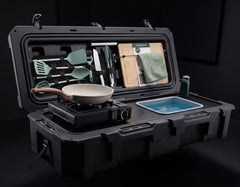
If you're still choosing a box, you can skip the aftermarket step entirely. The VOZ Camp Kitchen unfolds on its own integrated stand, with the stove, sink, USB-rechargeable faucet, and water tank already built into the case — the "leg kit" is part of the design rather than a separate purchase.


Side Tables: The Cheapest Way to Double Your Workspace
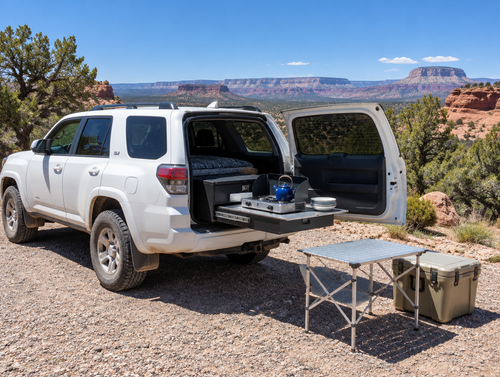
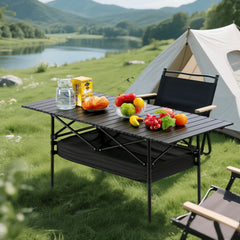
Counter space disappears fast once a stove and a cutting board are down. Clamp-on side tables solve this without adding another piece of furniture to pack: Trail Kitchens' Add-A-Table, for example, mounts to the side or rear of the box with tension knobs, rides on two telescoping legs, and adds more than 40 inches of table surface.
If your box doesn't have mounting points, a freestanding folding table pulled up alongside does the same job — and doubles as a serving station at dinner. An adjustable-height side table is the most versatile pick because you can match it to your main work surface, and a roll-up camp table gives you a full second station for group trips. Either way, the goal is the same: one surface for raw prep, one for the stove, and a landing zone for finished food. Three zones, no juggling.


Lighting: Cook After Sunset Without a Headlamp in Your Eyes
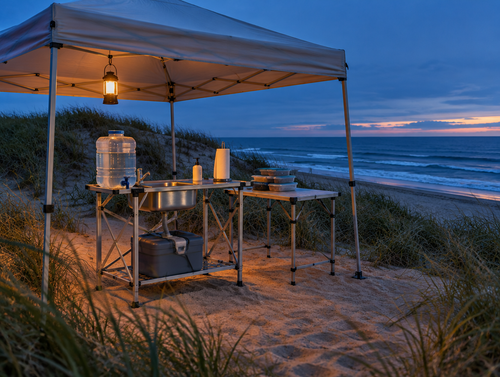
Most camp dinners finish in the dark, and a headlamp is the worst tool for the job — it blinds everyone who looks at you and throws your own shadow onto the cutting board. A dedicated kitchen light is a cheap upgrade that changes evening cooking completely.

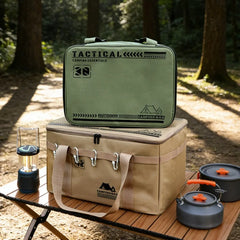
The numbers are lower than you'd guess. Lighting guides from lantern makers put cooking and gathering areas at roughly 200 to 500 lumens — a well-diffused 300-lumen lantern often feels brighter at the prep surface than a harsh 600-lumen spotlight. Placement matters more than raw output: mount the light above and slightly behind or beside your work area so it casts light down onto the food without shadows. Look for three features on any camp kitchen light: a hook or magnetic mount so it hangs from a canopy pole or lid, USB recharging so it tops up from the same power bank as your faucet pump, and a warm-white setting that doesn't make dinner look gray.
Small Add-Ons That Punch Above Their Weight
None of these costs much, and each one removes a specific campsite annoyance:
- Stove windscreen. Wind steals heat from open burners and stretches boil times. A folding windscreen around the stove keeps the flame where it belongs — and packs completely flat.
- A dedicated spice kit. Raiding the pantry every trip is how you end up seasoning chili with nothing but salt. A compact spice bottle set lives in the box permanently.
- A rechargeable faucet pump. If your setup doesn't have running water yet, a USB-C water dispenser pump turns any jug into a hands-free tap for rinsing and dishes.
- A cutting board cut to fit. Size it to a shelf or drawer in your box so it stores flat and doubles as a serving tray.
- S-hooks and carabiners. Clip utensils, a towel, and a trash bag to the box or table edge — the fastest way to keep the work surface clear.


Two rules keep this from becoming clutter. First, every add-on needs a permanent home inside the box — our guide to organizing a camp kitchen box shows how to give every item an assigned spot. Second, gear that lives in the box stays in the box; our breakdown of what to stock permanently versus borrow from home explains why duplicates beat borrowing every time.
Upgrades to Skip
A few popular add-ons rarely earn their weight. Full cast-iron cookware sets are wonderful at a drive-up site and dead weight everywhere else — one skillet is plenty. Oversized canopy systems that are a chore to rig get skipped after the second trip; a simple tarp over the kitchen handles most weather. And single-task gadgets — quesadilla presses, egg holders for a dozen eggs when you camp as a couple — are the first things you'll cull. The test for any upgrade is simple: if it doesn't fit inside the closed box or set up in under a minute, it will eventually stay home.
FAQ
What's the first add-on I should buy?
Whichever pain point hit you last trip. If your back ached, fix your working height with legs or a taller table. If you ran out of room, add a side table. If you cooked by headlamp, buy a hangable light. For most people, extra surface area delivers the biggest day-one difference.
Can I add legs to any chuck box?
No — bolt-on leg kits need factory mounting points, and drilling a box that wasn't engineered for point loads is a good way to crack a panel. If your box has no leg option, set it on an adjustable-height folding table instead; you get the same standing-height result without modifying anything.
How bright should a camp kitchen light be?
Around 200 to 500 lumens covers a cooking area. Diffused light beats a bright spotlight, and hanging the lamp above and slightly behind your prep space keeps shadows off the cutting board.
Where do add-ons go when the kitchen is packed?
Inside the box, or they don't come. Flat items — windscreen, cutting board, roll-up table — slide alongside shelves, and small kits get an assigned bin. If an accessory has no packed home, it becomes loose cargo you'll forget on the garage floor.
Ready to upgrade your camp kitchen?
The VOZ Camp Kitchen includes everything you need in one weatherproof case. Sets up in 15 seconds.
Shop VOZ Camp Kitchen →