Where Does the Cooler Go? Pairing a Cooler With Your Camp Kitchen Setup

You planned the stove, the prep surface, and the sink — and the cooler ended up wherever there was room, usually in full sun with someone digging through it every ten minutes. Cold storage deserves a spot in your camp kitchen layout, not an afterthought. Here's exactly where the cooler goes and how to pair it with your setup.
The Short Answer: Shade, Arm's Reach, Off the Hot Ground
Three rules cover most campsites:
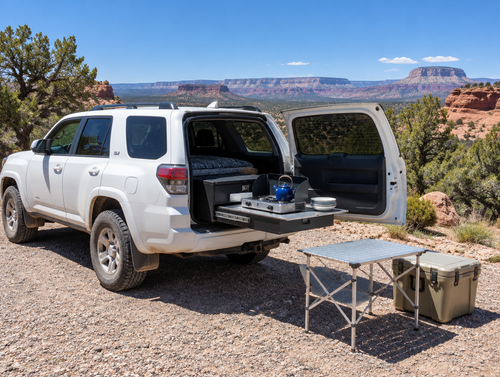
- Shade first. Direct sun is the fastest way to burn through ice. Park the cooler on the shady side of your kitchen — under a tree, a canopy, or the shadow of your vehicle — and move it as the sun tracks through the afternoon.
- Within a step or two of your prep area. If the cooler sits across the campsite, every burger patty and stick of butter turns into a round trip. Close to prep, but out of the cook's walking line to the stove.
- Off hot ground. Sun-baked dirt and asphalt radiate heat into the cooler's base. A picnic table bench, a folding stand, or even a slab of firewood under each corner slows the melt.
One more constraint: a cooler is food storage, so overnight it follows the same wildlife rules as the rest of your kitchen — locked in the vehicle or a bear box where required, never in the tent.
Make It a Fourth Zone: Cook, Prep, Wash — and Cold
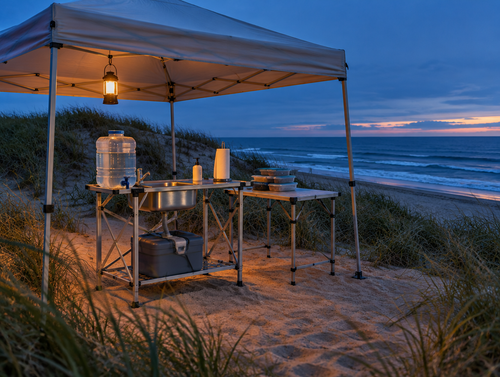
A camp kitchen works best when each job has a station. If you already run the classic fast camp kitchen setup, you have a cook zone at the stove, a prep surface, and a wash station at the sink. The cooler is the fourth zone: cold storage. Place it on the prep side of the box, opposite the stove, so raw ingredients flow cooler → cutting board → burner in one direction and nobody reaches over a lit flame to grab the milk.

Keep the cooler out of the “triangle” between stove, prep, and sink rather than inside it. The lid needs room to swing open fully, and the person on drink duty shouldn't cross paths with the person carrying a hot pan. A spot at the end of the prep table — lid hinge facing the kitchen — lets you open it one-handed and see the contents without moving anything.
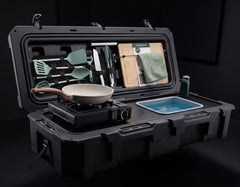
An all-in-one box makes this easy to plan. The VOZ Camp Kitchen packs the stove, sink, water tank, USB-rechargeable faucet, and 30+ cooking items into one weatherproof case, so the only large piece of gear left to position is the cooler itself: set the box on its stand, drop the cooler beside the prep wing, and the whole kitchen is two steps wide.


One Cooler or Two? The Drinks-and-Food Split
The biggest ice-killer isn't the weather — it's the lid. Every time someone opens the cooler for a soda, warm air pours in and cold air spills out. That's why the FDA recommends packing beverages in one cooler and perishable food in a second one, so constant drink runs never expose the meat, dairy, and eggs to warm air.
The split works like this:
- Drinks cooler: lives in the social area near the chairs, gets opened constantly, and it doesn't matter. Cheap ice, topped off as needed.
- Food cooler: lives in the shade at your camp kitchen's cold zone, opens only at mealtimes, and holds its temperature for days.
For short trips and day cookouts, a soft-sided option can stand in for the second box. A large insulated cooler bag handles the drinks-and-snacks role at a fraction of the weight, then folds flat in the camp kitchen case on the drive home.


Cooler vs. 12V Fridge With a Camp Kitchen
Overlanders and van campers increasingly pair their camp kitchen with a 12V compressor fridge instead of an ice chest. Both pair fine with a portable kitchen box — the trade-offs are power and placement.
| Ice cooler | 12V compressor fridge | |
|---|---|---|
| Power needed | None | Compact units average roughly 1–3 amps while the compressor runs; larger 60–80L fridges draw more |
| Cold duration | Days, then you need ice | Indefinite while powered |
| Where it lives | In the shade next to the prep zone | Usually stays in the vehicle or trailer, wired to a battery |
| Best for | Weekend trips, big groups, drinks | Multi-week travel, boondocking with solar or a power station |
Note the placement difference: a fridge typically stays in the cargo area, which pulls your cold zone back to the vehicle. If you cook at a table 20 feet from the tailgate, you've rebuilt the shuttling problem a cooler solves by sitting next to the prep surface. Many overlanders run both — fridge in the truck for the week's perishables, small cooler at the kitchen as the day's working stock.
Ice Management for Multi-Day Trips
Where the cooler sits determines how fast the ice dies; how you pack it determines everything else. The habits that matter most:
- Pre-chill the cooler overnight with sacrificial ice or ice packs before you load it, so the insulation isn't fighting a warm box from hour one.
- Use block ice for the base, cubes for the gaps. USDA food-safety guidance notes a block of ice keeps food colder longer than cubes — freeze water in clean milk cartons at home for free blocks.
- Pack it full. A full cooler holds its temperature longer than a partly filled one; top off dead space with frozen water bottles that become drinking water as they thaw.
- Load raw meat low. If everything shares one cooler, keep raw meat and poultry sealed below the ready-to-eat food so drips can't reach it.
- Plan around 40 °F. Perishables need to stay at 40 °F or below. Between 40 °F and 140 °F — what the USDA calls the danger zone — bacteria can double in as little as 20 minutes, and food left out longer than 2 hours (1 hour above 90 °F) should be tossed.

A common manufacturer rule of thumb is a 2:1 ice-to-contents ratio — about a third of the cooler is food and drink, the rest ice. It sounds like a lot until day three, when your cold zone is still actually cold.
FAQ
How far from the tent should the cooler be?
Treat it like the rest of your kitchen: keep food storage well away from where you sleep so food smells don't lead wildlife to your tent, and follow posted storage rules where you camp. In developed campgrounds that usually means the cooler rides out the night in your locked vehicle or the site's bear box.
Should the cooler go on the picnic table?
The bench or a stand is better than the tabletop. On the table it eats your best prep surface and sits in the sun; on the ground it picks up heat from the dirt. Bench height also saves your back at mealtimes.
Should I drain the meltwater?
Keep it if the remaining ice is holding and everything inside is in sealed containers — cold water insulates better than the air that would replace it. Drain it when packaging is getting soaked or the water has warmed enough that ice is disappearing quickly, then top off with fresh ice.
Can the cooler just stay in the car?
Overnight, yes — that's often required in bear country. During the day, a closed vehicle in the sun turns into an oven, so bring the cooler out to the shady side of your camp kitchen while you're in camp.
Ready to upgrade your camp kitchen?
The VOZ Camp Kitchen includes everything you need in one weatherproof case. Sets up in 15 seconds.
Shop VOZ Camp Kitchen →