Camp Kitchen Food Safety: Keeping Raw Meat Cold and Stopping Cross-Contamination at Camp

Food poisoning ends more camping trips than rain, bugs, and forgotten tent poles combined — and almost all of it traces back to two mistakes: letting raw meat warm up, and letting raw-meat juices touch food that's ready to eat. The fix isn't more gear. It's running your camp kitchen the way a line cook runs a station: cold things stay cold, raw and ready-to-eat never share a surface, and hands and boards get washed between the two.
The Two Numbers That Run Camp Food Safety: 40°F and 140°F
The USDA calls the range between 40°F and 140°F the "Danger Zone" — the temperatures where bacteria multiply fastest, doubling in number in as little as 20 minutes. Everything else in this article is just those two numbers applied to a campsite:
- Cold food stays at or below 40°F. That's the job of your cooler, your ice, and your packing order.
- Hot food stays at or above 140°F — or gets eaten while it's still hot off the stove.
- The 2-hour rule: perishable food left in the Danger Zone for more than 2 hours should be thrown out. On a hot day above 90°F — which describes most summer afternoons at a car-camping site — that window shrinks to 1 hour.
Notice what's not on the list: smell, color, or "it looks fine." The bacteria that cause foodborne illness don't announce themselves. Time and temperature are the only signals you get, so the whole game is controlling both.
Build a Cold Chain That Survives the Drive
Your raw meat's safety is decided mostly at home, before the truck leaves the driveway. A few habits stack the odds heavily in your favor:
- Freeze the meat before you pack it. Frozen meat and frozen marinade act as extra ice, keep themselves out of the Danger Zone longer, and thaw slowly in the cooler. Plan raw-meat meals for the first day or two; frozen-solid packs can anchor day-two dinners.
- Use block ice as the base, cubes to fill gaps. A block of ice lasts longer than an equal weight of cubes because it has less surface area. Frozen water bottles and gel packs work too — and the bottles become drinking water as they melt.
- Pack the cooler full. A full cooler holds its cold temperature longer than a partially filled one. Top off dead space with extra frozen bottles.
- Raw meat goes on the bottom, sealed twice. Zip-top bag, then a second bag or a small leak-proof bin, sitting below everything else so juices physically cannot drip onto produce, cheese, or anything eaten raw.
- Drinks get their own cooler. Every lid-opening dumps cold air. A separate drinks cooler means the food cooler opens a handful of times a day instead of forty.
- Park the cooler in shade and keep it closed. At camp, that means under the table, on the shaded side of the vehicle, or under the same canopy as your kitchen — never in a hot trunk or in direct sun.

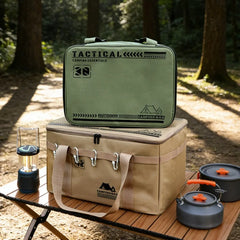
For short trips and tailgates where a hard cooler is overkill, an insulated cooler bag handles the cold side of the kitchen — same rules apply: pre-chill everything, pack it full, keep raw meat bagged at the bottom.


Zone the Kitchen: Raw on One Side, Ready-to-Eat on the Other
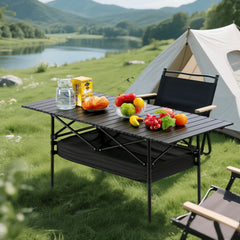
Cross-contamination almost never happens inside the cooler — it happens on the prep surface, when the cutting board that held chicken thighs meets the tomatoes. At home, counter space makes separation easy. At camp you have to build it deliberately, and this is where an all-in-one kitchen box earns its keep: it gives you fixed, repeatable stations instead of a chaotic picnic-table sprawl.
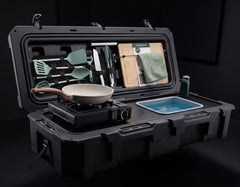
A VOZ Camp Kitchen deploys with a stove bay, a sink, and a lid that doubles as a prep counter — it sets up in seconds, which matters here because a kitchen that assembles itself the same way every time lets you assign zones once and reuse them every trip:
- Raw zone: one end of the lid counter, closest to the stove. Raw meat comes out of the cooler, gets seasoned on its own cutting board, and travels the shortest possible path to the burner.
- Ready-to-eat zone: the opposite end of the counter (or a side table) for salads, buns, fruit, and serving plates. Raw meat and its packaging never cross the centerline.
- Two cutting boards, two colors. One board lives in the raw zone, one in the ready-to-eat zone. Color-coding removes the "wait, which board was the chicken on?" conversation entirely.


Two more rules borrowed straight from USDA grilling guidance: never put cooked meat back on the plate or board that held it raw, and don't rinse raw chicken in the sink — washing raw poultry splashes bacteria onto surrounding surfaces instead of removing it. The heat of the stove kills what washing can't.
The Sink Is Your Cross-Contamination Firewall
Handwashing is the least glamorous and most effective food-safety tool at camp. The FDA's standard is soap and water for at least 20 seconds — after handling raw meat, after the bathroom, before eating. At a typical campsite that standard quietly dies, because the water jug is buried in the truck and wet wipes feel like enough. They aren't; wipes smear, running water rinses.
This is the practical argument for a camp kitchen with a built-in sink and faucet: when soap, running water, and a basin are standing three feet from the stove, the 20-second wash actually happens — between touching raw burger patties and slicing buns, and again before anyone eats. The same station handles the raw-zone cutting board and knife with hot, soapy water before they touch anything else.

After dinner, the same sink runs the full cleanup — our three-bin dishwashing method walks through wash, rinse, and sanitize order so the boards and tongs that touched raw meat come out genuinely clean, not just grease-free.
Cook to Temperature, Not to Color
A browned outside says nothing about a safe inside — especially over a camp stove's uneven flame or a wind-buffeted grill. A pocket food thermometer weighs about as much as a spork and removes all guesswork. The USDA's safe minimum internal temperatures:
| Food | Safe internal temperature |
|---|---|
| Beef, pork, lamb, veal — steaks, chops, roasts | 145°F, then rest 3 minutes |
| Ground meats (burgers, sausage) | 160°F |
| All poultry, whole or ground | 165°F |
Probe the thickest part, away from bone and fat. Two marinade rules ride along with this: marinate in the cooler, never out on the table, and never reuse a marinade that touched raw meat unless you boil it first — the cleaner move is setting aside a reserved portion for basting before the raw meat ever goes in.
FAQ
How long does raw meat stay safe in a cooler?
As long as the cooler actually holds it at or below 40°F — that's the number that matters, not a fixed day count. Packed frozen against block ice in a full, shaded cooler, meat routinely stays safe into day two or three; a cheap cooler opened constantly in the sun may lose the battle in an afternoon. A refrigerator thermometer tossed inside tells you the truth. Once perishables have sat above 40°F for over 2 hours (1 hour above 90°F), throw them out.
Do I really need a second cooler just for drinks?
It's the single cheapest upgrade to your cold chain. Drinks are what people dig for all day; separating them means your meat cooler stays closed and cold from breakfast to dinner.
Can I use the camp kitchen sink to rinse raw chicken?
No — the USDA advises against washing raw poultry anywhere, home or camp, because splashing spreads bacteria to nearby surfaces. Take chicken from its bag straight to the raw-zone board, then to the stove. Use the sink for what it's actually for: washing hands, boards, and knives after raw meat is handled.
Where does food safety meet bear safety?
Same discipline, second audience. Leftovers should be cooled and back in the cooler within the 2-hour window — and that cooler, along with every scented item, then needs to be stored where wildlife can't get it. Our bear-safe camp kitchen layout guide covers the storage half of that equation.
- How to Set Up a Camp Kitchen in Under 15 Seconds (Step-by-Step)
- How to Wash Dishes With a Camp Kitchen Sink: The 3-Bin Method Made Easy
- Bear-Safe Camp Kitchen Layout: Where to Put Your Cook Station, Food, and Tent
- Where Does the Cooler Go? Pairing a Cooler With Your Camp Kitchen Setup
- 12V Fridge vs. Cooler for Your Camp Kitchen Setup: Which One Earns Its Spot?
Ready to upgrade your camp kitchen?
The VOZ Camp Kitchen includes everything you need in one weatherproof case. Sets up in 15 seconds.
Shop VOZ Camp Kitchen →