Bear-Safe Camp Kitchen Layout: Where to Put Your Cook Station, Food, and Tent

A bear almost never comes into a campsite for the tent — it comes for the kitchen. Where you place your cook station relative to where you sleep and where you store food is the single most important layout decision you make in bear country, and it costs nothing but a few minutes of planning.
The bear-safe triangle: tent, cook station, food storage
The classic bear-country layout is a triangle with three separate points: your tent at one corner, your cook station at the second, and your food storage at the third. Leave No Trace educators call it the "Bearmuda Triangle," and the logic is simple: bears investigate smells, and almost every smell in camp is generated at the kitchen or stored with the food. If those two points sit away from your tent, a curious bear has no reason to end up next to your sleeping bag.
The distances depend on where you camp:
- Backcountry: The National Park Service tells backcountry campers to prepare food 100 yards away from the tent and 100 yards away from any water source. Yellowstone's backcountry regulations use the same number — sleep 100 yards (91 m) from your cooking and food storage areas.
- Frontcountry Leave No Trace guidance: roughly 200 feet — about 70 adult paces — between sleeping, cooking, and food storage points where the site allows it.
- Developed campgrounds: you obviously can't put 100 yards between your tent pad and the picnic table. There, the triangle collapses into a different rule set: cook at the designated pad, and move every attractant into the bear locker or a hard-sided vehicle at night. More on that below.
One more detail that most articles skip: wind. Set your tent upwind of the cook station and food storage when the site allows it, so overnight breezes carry cooking odors away from where you sleep, not across it. Bears work scent the way we work eyesight — the National Park Service notes a bear can smell food from over a mile away. You will not out-hide a bear's nose; the goal is to make sure the nose leads it somewhere that isn't your tent.

Where the cook station goes
Pick the kitchen spot first, before the tent goes up. You're looking for four things:
- Downwind and downhill of the tent site. Cold night air flows downhill; a kitchen below your tent keeps settling odors moving away from you.
- 100 yards from water in the backcountry — the same National Park Service rule that protects your tent also keeps food smells and dishwater away from streams and lakeshores.
- Open sightlines. Cook where you can see approaches for 50+ yards. Avoid setting up against thick brush, on game trails, or next to berry patches — you want to see a bear long before it's at the stove, and it should never have to surprise you (or you it) at close range.
- A surface you can strike quickly. In bear country the kitchen isn't a permanent installation — it gets consolidated every night.
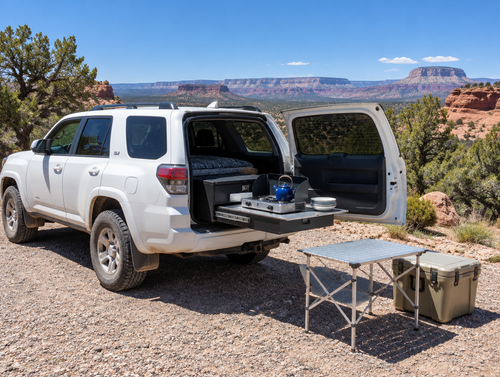
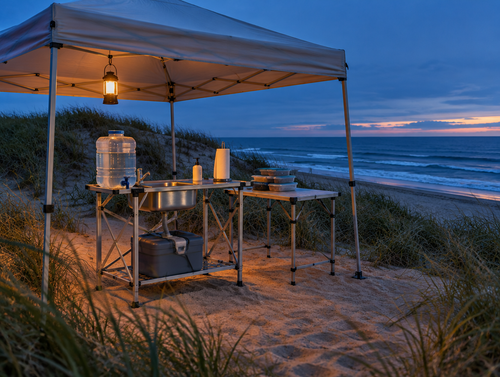
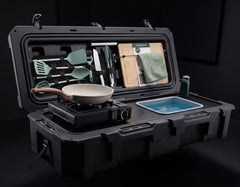
That last point is where an all-in-one kitchen earns its keep. When your stove, sink, prep surface, and utensils live in one case — like the VOZ Camp Kitchen — the entire cook station is a single carry. It deploys in about 30 seconds (here's the full 30-second setup walkthrough), and it closes just as fast, which means the nightly "strip the kitchen" routine is one latch-and-lift instead of a 20-minute scavenger hunt for loose spatulas, sponges, and spice bottles scattered across a picnic table. Loose gear is exactly what gets forgotten out overnight, and forgotten gear is what draws bears.


We covered a full bear-country base camp build — wall tents, meat care, the works — in our hunting camp setup guide. This article stays on the layout itself, because the triangle applies to every trip, not just hunting season.
What goes in the sealed box at night — and where the box goes
Let's be direct about something: a camp kitchen box is weatherproof, not bear-resistant. A latched case keeps out rain, dust, and mice — it will not stop a determined black bear, and it doesn't satisfy food storage regulations on its own. The box's bear-country job is consolidation: everything smellable ends up in one container that you can move to approved storage in a single trip.
Here's the split that works:
| Goes into the locker or vehicle at night | Can stay out overnight |
|---|---|
| All food and drinks (sealed or not), coolers, trash bags, dish sponge and soap, spice kit, cooking oil, used paper towels, toothpaste and toiletries, scented wipes, stove with grease residue | Water tank filled with plain water, folding table, chairs, firewood, washed and dried cookware (in unregulated areas — in national parks, stow it anyway) |
If that "into the vehicle" list looks aggressive, it mirrors how the strictest parks define food. Yosemite's campground regulations, for example, count drinks, trash, toiletries, and any scented item as "food," require it all to be in a food locker around the clock in campgrounds, and back the rule with fines of up to $5,000. Vehicle storage there is allowed only during daylight, out of sight, with windows fully closed. Other parks are looser — many allow overnight storage in a locked, hard-sided vehicle — but if you pack to the Yosemite standard, you're legal almost everywhere.
The food storage point: locker, vehicle, hang, or canister
The third corner of the triangle depends on what's available, in this order of preference:
- Bear locker. If the campground provides one, use it — that's the point of it, and in many parks it's mandatory. Latch it every time you walk away.
- Hard-sided vehicle. Where regulations allow, a trunk or a closed cab with everything out of sight works for car campers. The U.S. Forest Service specifically recommends the trunk when you're camped near your vehicle. A truck bed, a soft-top, or a tent does not count.
- Bear hang. No locker, no vehicle nearby? Forest Service and Yellowstone guidance agree on the geometry: food, garbage, and every scented item go at least 10 feet off the ground and 4 feet out from the trunk or pole.
- Bear-resistant container. In many backcountry zones an approved canister is required and a hang isn't legal — check the local order before you go.
Note what's not on that list: your cooler. Standard coolers and insulated bags are scent amplifiers, not bear protection — they ride inside the locker or the vehicle at night, never on the picnic table.

The evening shutdown routine
The layout only works if the kitchen actually gets stripped every night. A repeatable order helps — this one takes about ten minutes:
- 1. Wash and dry cookware right after dinner, not "later." Later is dark, cold, and skippable.
- 2. Strain and disperse dishwater away from camp and water sources — the full method is in our graywater disposal guide. Strained food bits go in the trash bag, and the trash bag goes to storage with the food.
- 3. Wipe every surface — the prep lid, the table, the stove top. Grease splatter is an attractant even when the food is locked away.
- 4. Sweep the ground for crumbs, wrappers, and the pasta that escaped the strainer.
- 5. Load the box. Food, spices, oil, sponge, soap, trash — everything smellable goes in.
- 6. One carry to storage. Box and cooler go to the locker or vehicle. Latch, close, windows up.
- 7. Final headlamp sweep of the site, and check your pockets and tent for snacks and toothpaste before you zip in.
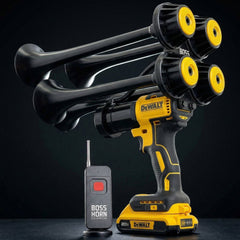
Some campers in grizzly country add a noise deterrent to the nightstand — state wildlife agencies such as Colorado Parks and Wildlife list an air horn as an approved way to haze a bear that's already investigating a campsite (bear spray remains the tool of record for close encounters, especially with grizzlies). If cordless-tool batteries already ride in your rig, a wildlife deterrent horn that runs on a DeWalt® 20V, Milwaukee® 18V, or Ryobi® 18V pack is one less device to keep charged.


FAQ
Is a camp kitchen box bear-proof?
No. It's weatherproof and rodent-resistant, and it makes the nightly consolidation fast — but it is not a certified bear-resistant container. At night the whole box goes into a bear locker or a hard-sided vehicle, exactly like a cooler would.
Can I leave my camp kitchen set up overnight in bear country?
The structure, yes — a clean, empty stand or table can stay out. The contents, no. Anything with a scent (food, oil, soap, sponge, trash) must go to approved storage. If your kitchen packs into one case, "stripping" it takes about a minute.
Do I really need the triangle at a drive-in campground?
You can't get 100 yards of separation on a standard site, and you don't need to — the campground version is: cook at the pad, never in or beside the tent, and move all attractants to the locker or vehicle every night and every time you leave the site. Parks like Yosemite require exactly this, around the clock.
What if there are no bears where I camp?
Run the routine anyway. The same layout defeats raccoons, mice, and skunks — campsite raiders you'll meet in every state — and it keeps your kitchen packed, clean, and ready to roll out in the morning.
- How to Set Up a Camp Kitchen in 30 Seconds
- Camp Kitchen for a Hunting Camp: A Bear-Country Setup That Cooks Anywhere
- Where to Dump Camp Kitchen Sink Graywater (Leave No Trace, Done Right)
- Where to Set Up Your Camp Kitchen: Placement and Safety Rules That Actually Matter
- The Camp Kitchen Pack-Up Routine: Break Camp in 20 Minutes
Ready to upgrade your camp kitchen?
The VOZ Camp Kitchen includes everything you need in one weatherproof case. Sets up in 15 seconds.
Shop VOZ Camp Kitchen →