Camp Kitchen for a Honda Element: Tailgate, Slide-Out, and Box Setups That Work

The Honda Element is a shoebox on wheels with a hose-it-out floor, and that's exactly why car campers still hunt down 2003 to 2011 models. Cooking out of one is a different job from cooking out of a regular SUV, though. The clamshell tailgate, the low floor, and the seats that flip up or come out entirely all change where your kitchen should live.
What Makes the Element Different From Other SUVs
Most crossovers have one liftgate and a carpeted load floor. Honda built the Element around a few utility features that matter a lot once you start cooking out of it:
- A clamshell tailgate. Honda's launch materials describe a split rear gate: the bottom half drops down to make a seat for two, and the top half swings up into a canopy for shade and weather cover. You get a bench and a roof over your kitchen without buying either.
- A urethane-coated utility floor. Honda calls it hard, flat, and water- and scratch-resistant, and says it wipes clean with a damp cloth. A splash from the sink or a dropped pan of grease isn't a disaster.
- Rear seats that flip or leave. The 50/50 rear seats fold up and latch to the sides, or come out completely. That decides whether your kitchen goes behind a seat, next to one, or takes over the whole back.
- Six cargo hooks built into the cargo area for strapping down bulky gear, which is what you need to keep a heavy kitchen box from sliding.
- Center-opening side doors with no B-pillar. With both side doors open, you can reach the cargo area from the side as well as the back.
The numbers that matter for a rigid box: spec listings put the cargo floor at about 66.7 inches long from the tailgate to the front seats, about 38.7 inches wide at the beltline, and 46 inches tall inside. Cargo volume runs about 25.1 cubic feet behind the rear seats and 74.6 cubic feet with them out of the way. Model year and trim shift these by a little, so measure your own before you build or buy anything.
The Low-Tailgate Problem (and Why Counter Height Matters)
The Element's lower gate makes a great seat and a bad counter. It folds down level with the cargo floor, and that floor sits low. Spec sheets put the Element at roughly 70 inches tall overall with a 46-inch-tall cargo box, so the load floor, and the dropped gate with it, sits somewhere around the low 20s in inches. A standard home kitchen counter is 36 inches.
That gap is more than a foot. Chopping onions or washing dishes on a surface that low means hinging forward at the hips the whole time, and camp cooking stacks prep, cooking, and cleanup into one long session. We covered the ergonomics in detail in our camp kitchen counter height guide. The short version: light standing work like food prep should sit a few inches below your elbow, which for most adults lands in the mid-30s to around 40 inches.
So the best Element setups use the tailgate for what it does well, like sitting, staging gear, and holding the cooler lid open, and put the actual cooking surface at standing height under the upper gate's canopy.

Setup 1: Tailgate Plus a Standing-Height Table
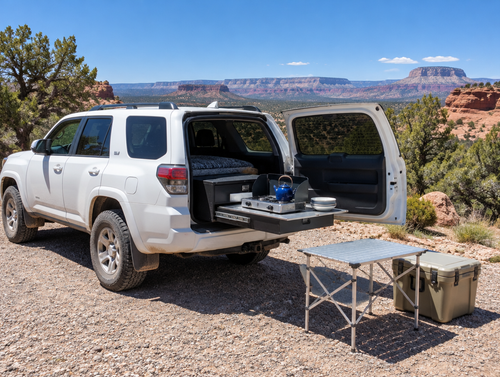
This is the no-build option, and plenty of Element campers never go further. One couple featured in a Gnomad Home roundup of Element conversions runs their camp stove on a folding table and uses the lowered tailgate when they need extra workspace.
How to make it work:
- Pop the upper gate for shade or rain cover, and drop the lower gate as a staging shelf for the cooler, the cutting board, and plates.
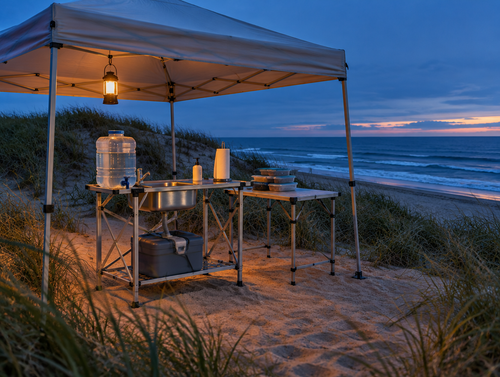
- Set a height-adjustable table just behind or beside the tailgate, still under the edge of the canopy. Put the stove on the table, not on the floor or the gate.
- Keep the burner fully outside the vehicle. The upper gate is a canopy, not a kitchen ceiling.
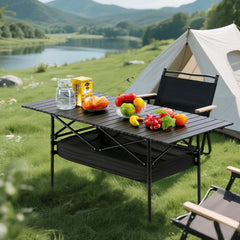
An adjustable-height folding side table is the simplest fix for the height gap, because you can raise it to your elbows instead of accepting whatever height a table came with. It folds flat enough to slide in beside a flipped-up rear seat.


Best for: people who still need the rear seat for passengers on some trips, and anyone who wants to try Element camping before cutting plywood.
Setup 2: The Slide-Out Drawer Build
The classic Element conversion is a sleeping platform with a kitchen drawer under the back end. A full-time Element camper profiled by Gnomad Home keeps her kitchen in the rear, with a camp stove on a heavy-duty slide-out drawer, a cooler, and a 20-liter water tank. Storage under the bed holds bowls, utensils, and the rest of the kitchen. Used Element micro-campers for sale often have the same layout: a rear box that pulls out to reveal the kitchen.
The appeal is real. Open the clamshell, pull the drawer, and you're cooking. The tradeoffs are just as real:
- It's permanent-ish. A platform and drawer take over the space where the rear seats go. One commercial bed-and-cabinet setup for the Element, installed in place of both rear seats, leaves only the two front seats until you pull the cabinet out.
- It inherits the low floor. A drawer slides out at platform height. That's often better than the bare floor, but it's rarely 36 inches, so many builders still crouch to cook.
- Water is a separate system. You still need a tank, a way to pump it, and somewhere to catch the gray water.
- The build is the project. Drawer slides rated for the load, plywood, and fasteners into the floor add up in time and money before you've cooked a meal.
Best for: people who dedicate the Element to camping and sleep in it most weekends.
Setup 3: An All-in-One Camp Kitchen Box
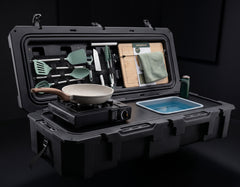
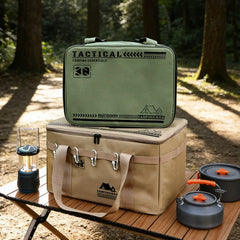
The third route skips the carpentry. Everything lives in one sealed case that rides in the back and comes out at camp. The VOZ Camp Kitchen is the example we know best: a weatherproof case measuring 47.6 x 19.3 x 11.4 inches closed, about 57 lbs, with a butane stove and frypan, a collapsible sink with a USB-rechargeable electric faucet, a removable 2-gallon water tank, a cutting board, an LED light, and utensils inside. Setup takes under 30 seconds.


Here's how that box fits an Element:
- Lengthwise, not crosswise. At 47.6 inches, the case is longer than the roughly 38.7-inch cargo width, so it runs front to back. With the rear seats flipped up or removed, the 66.7-inch floor swallows it with room to spare.
- Next to a flipped-up seat half. Because the rear seats split 50/50, you can flip one half up against the wall and run the box along that side. That leaves the other seat for a passenger, or for the cooler and bags.
- Strapped to the cargo hooks. Run two straps over the lid to the built-in hooks so 57 lbs can't slide forward under hard braking.
- Fill the water at camp. Water weighs about 8.34 lbs per gallon according to the USGS, so a full 2-gallon tank adds nearly 17 lbs to the lift out of the cargo bay.
At camp, slide the box to the tailgate edge, lift it onto a sturdy table or a level surface at a comfortable height, and open it. The box itself becomes the kitchen: stove, sink, and running water in one spot, with the clamshell canopy overhead and the lowered gate as your bench. When you leave, everything goes back in the case and the Element is a regular car again, no platform to unbolt.
Best for: Element owners who switch between daily-driver duty and weekend camping, or anyone who wants a sink and running water without plumbing a build.

Quick Comparison
| Tailgate + table | Slide-out drawer | Camp kitchen box | |
|---|---|---|---|
| Build required | None | Platform, slides, fasteners | None |
| Rear seat use | Keep both | Usually gives up both | Keep one or both |
| Cooking height | Adjustable via table | Fixed at platform height | Set by what you put it on |
| Running water | Bring a jug | Separate tank to plumb | Built-in tank and faucet |
| Back to daily driver | Instant | Remove the build | Lift out one case |
For how the Element compares with trucks, vans, trailers, and other platforms, our vehicle camp kitchen guide covers the full range.
FAQ
Can I cook inside my Honda Element when it rains?
No. The CDC says camp stoves and other fuel-burning devices should never be used inside a camper, and a CDC report on camping deaths found that opening doors or flaps doesn't stop carbon monoxide from building up. Cook outside under the raised upper tailgate, with the burner outside the cargo area.
Can the lowered tailgate hold a loaded camp kitchen box?
Honda advertises the lower gate as seating for two, but we couldn't find a published load rating, so check your owner's manual. A table at standing height is better for cooking either way.
Will a camp kitchen box fit with the rear seats in place?
A 47.6-inch case needs the floor length you get by flipping up at least one rear seat half. With one half up, it runs lengthwise along that side and the other seat stays usable.
Is the urethane floor safe for spills from a camp sink?
Honda describes the floor as water-resistant and easy to wipe clean. Still, do your dishwashing outside and catch the gray water in a container instead of letting it run onto the floor.
Ready to upgrade your camp kitchen?
The VOZ Camp Kitchen includes everything you need in one weatherproof case. Sets up in 15 seconds.
Shop VOZ Camp Kitchen →